You are being downvoted for a seemingly flippant remark, but someone should really check whether senior execs conveniently are already well positioned to move there.
They are being downvoted because people who live in Austin think it's laughable that execs are moving to Austin because it's some cushy vacation spot. Execs are moving to Austin from CA for the exact same reason a huge chunk of the rest of the techies are moving to Austin:
1. No state income tax.
2. Comparatively cheaper home prices, though with news link this perhaps not for long, centrally located Austin single family homes are incredibly expensive now.
3. Vibrant tech and VC community - not at the same level as SV but a not-too-distant second-or-third.
I would be very interested to see data and analysis about migration within the US by income deciles. I suspect outside of the tier 1 cities, the biggest migrations for higher income populations are to WA/NV/FL/TX/TN due to no income tax.
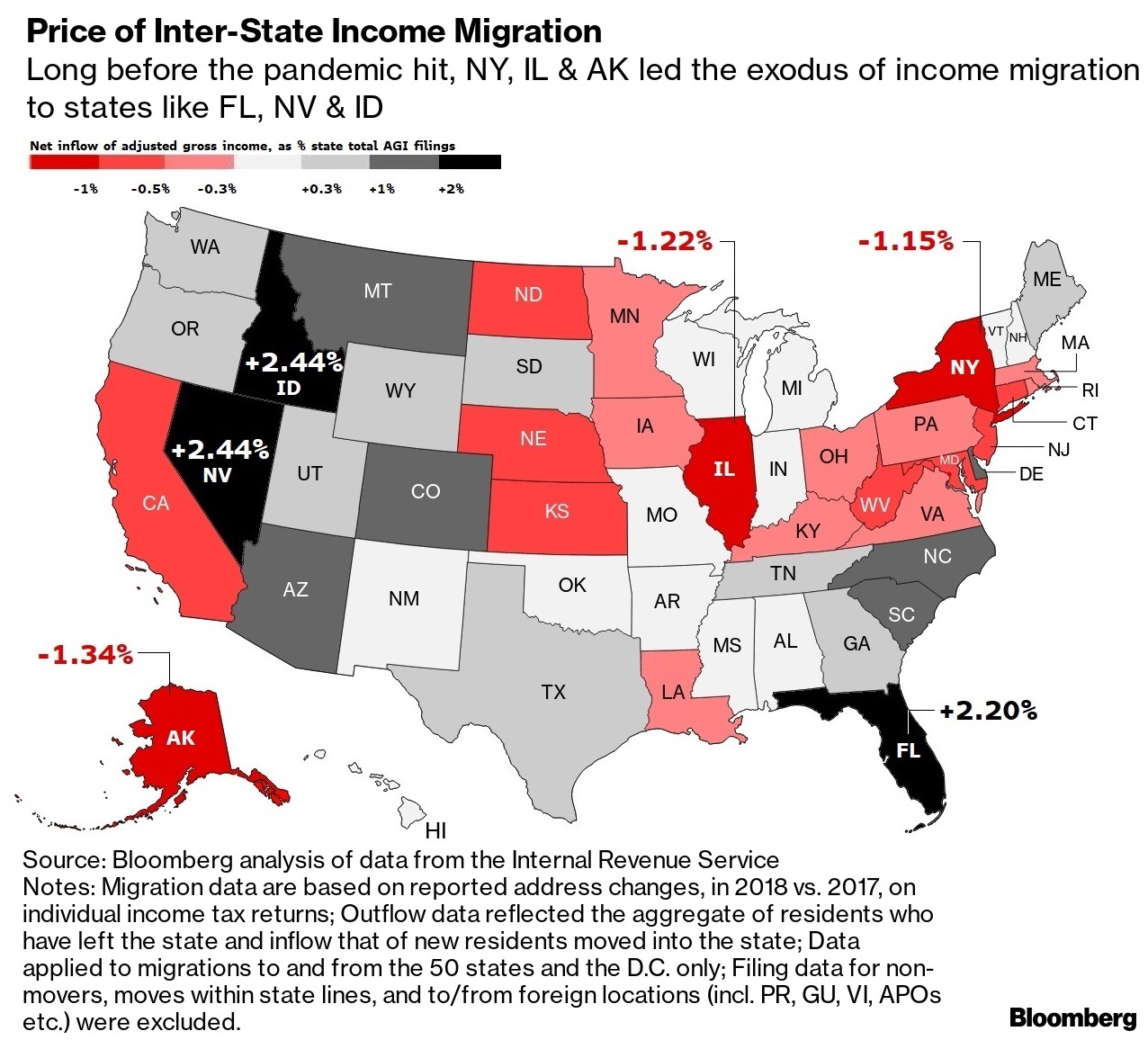
This Bloomberg article had a chart showing change in adjusted gross income from 2017 to 2018, but I'd be interested in something going back a few decades.
> 3. Vibrant tech and VC community - not at the same level as SV but a not-too-distant second-or-third.
Uh, no.
Austin has a lousy VC community. There are countless articles about it.
And, as for tech, for software it's mainly only Tivoli alums--and a lot of the best ones decamped for greener (read: better salary not in Austin) pastures. IBM as a technical presence has been gone forever (the Advanced Workstation Division was quite amazing and IBM Somerset was one of the PowerPC development arenas). Apple just came in so hasn't spun anybody out yet.
Totally disagree. In software you have vibrant alumni communities from Trilogy, Indeed, HomeAway/VRBO, etc., not to mention tech giants that have large engineering outposts in Austin, e.g. Google, PayPal.
I can think of two in my extended network just off the top of my head. One is a run-of-the-mill general practitioner and the other is a brilliant entrepreneur. And these are people I live near in out here in East BFE.
The house we bought was a vacation home for a little old couple from Omaha. A remote place on a hill overlooking Lake Travis, 30 minutes from downtown. Amazing sunsets, the weather is in the 60s and 70s in January, the springtime wildflowers are unreal, there's great food, good live music, lots of charming little hill country towns just a short trip away.
Uh, yeah they do. Just because the climate isn't as nice as the Bay Area doesn't mean people don't have homes there. For one, the culture/night life is incredible there.
Piazza (forums) and office hours (bluejeans--think youtube livestreams but on a proprietary platform.
For me, this semester, I finished a group project where we coordinated over slack/google hangouts. After that project, I didn't have anything left to finish the semester. I felt like I was done because the reinforcement loops I get from work (virtual back-clapping) were done and I had a hard time separating that from the "here's the next task. Also no one is talking to you about what needs to be done."
I'm another dropout (loved some of the courses, especially the OS ones, have close-to-zero interest in machine learning, though, and that's maybe half of the class offerings), but to answer your question, all the courses I was in had a "participation" component to the grade where you were expected to ask/answer questions on the online forum thing for your class. There were also optional office hours, as I recall.
It was certainly nothing like just hanging out with colleagues in the cafe between classes, but for those (like me) who just can't go to a school like GT in-person, I'm glad the opportunity is available even though I'd say it's probably the hard-mode version of the program given the limited course catalog (not all courses are integrated into the program yet) and lack of in-person interaction.
Interesting. I would imagine that doesn't make you feel like your classmates are your peers, and it would be hard to make friends with them. Friendship or at least friendliness goes a long way towards motivating people to learn stuff. Moreover, networking is an important reason for going to grad school, but it seems like the school is not encouraging this.
I would personally prefer a direct answer. Then your post could be informative and discussed. Perhaps you could add nuance to the discourse. I think that by joking around that you’d be banned for doing so prevents that discussion from happening
Will not happen. The U.S. military industrial complex views these sorts of algorithms as a vital technology in fighting future wars, and also fears that it's at a disadvantage to China because 4x population means a strategic advantage purely from the size of data sets Chinese ML researchers have access to.
>the fundamental skills that you need are mathematics and software engineering
So much this. If I have to interview another junior-level DS who has a MNIST project in their github and still somehow can't manage fizzbuzz or a fibonacci function I'm probably going to take up religious asceticism.
EDIT: I said junior, but I meant Senior. We're talking people with PhD's who claim to have done extensive software engineering in previous roles.
Try filtering them on their specific ability to visualize things. My neighbor was 80+ year old math guy who could see graphs of equations in his head.
My hypothesis is that good stats people probably don't visualize (Aphant) or visualize very specific types of data in a unique way. Without visualization, people tend to fall back to logical thinking - or emotional thinking, depending.
For example, I have a friend who can look at 2D seismic data and see what the underground formation looks like in his mind, in 3D.
The person you are replying to seemed to be complaining about their lack of programming ability, not statistical ability, so how would this help in their situation?
Yup, I think I and that child are talking past each other. :-(
It's good though because they raise some really valid points about the importance of intuition. I joke with my colleagues that all we're doing is encoding data as a hilbert space and slapping an algorithm on it, but that elides the fact that intuition like the child is talking about is important for knowing how to build that hilbert space.
I think there is an issue with focus of the role. If job is more focused on programming then the candidate must be at least proficient in coding. Otherwise if you need a mathematical modelling person then you need to look into relevant training background (undergrad degree etc). A lot of my colleagues in my research institute are from a physics background. Because molecular biology require a lot of statistics. They are ok coders but what they really contribute is the modelling part.
If I have to interview another whose only ML tools are GLMs, random forests and boosted trees (only ever with one hot encoding, of course) I’m going to do the same.
What all of these pearl-clutching arguments amount to is former gatekeepers kvetching about there no longer being a gate for them to keep.
The information dissemination landscape is evolving, and we are only being held back by those too cowardly to let go of their control and let us grow and ascend.


Wouldn't those be exactly the people you need in order to stop these scams?