For e.g. there's a trend where painters post a painting of them while standing next to it. I do not subscribe to any subreddits but as some of these become popular, they pop into my homepage. 9 out of 10 of these are painted by a pretty woman.
Wait until you learn that some people abuse this to funnel potential subscribers to their OF. And I don't mean the kind that's about the artwork they show off (which would usually be on Patreon these days, I guess?).
Most woman don't run an OF of course. And wether they do or don't, anyone should be free to socialize over their hobbies on the internet, and/or present their art work for other to appreciate (and get validation with hundreds or thousands of up votes). But those on the intersection that choose to run thinly disguised ads ruin it for me :(
Any chance that this reflected to our company account instead of AI Studio?
We want to switch to Gemini from Claude (for agentic coding, chat UI, and any other employee-triggered scenarios) but the pricing model is a complete barrier: How do we pay for a monthly subscription with a capped price?
You launched Antigravity, which looks like an amazing product that could replace Claude Code, but do I know I will be able to pay for it in the same way I pay Claude, which is a simple pay per month subscription?
I disagree. I think, as software developers, we also mostly speak to other software developers, and we like to share around AI fail stories, so we are biased to think that AI works for swe better than other areas...
However, while I like using AI for software development, as also a middle-manager, it increased my output A TON because AI works better for virtually anything that's not software development.
Examples: Update Jira issues in bulk, write difficult responses and incident reports, understand a tool or system I'm not familiar with, analyse 30 projects to understand which of them have this particular problem, review tickets in bulk to see if they have anything missing that was mentioned in the solution design, and so on ... All sorts tasks that used to take hours, now take minutes.
This is in line with what I'm hearing from other people: My CFO is complaining daily about running out of tokens. My technical sales relative says it is now taking him minutes to create tech specs from requirements of his customers, while it used to take hours.
While devs are rightfully "meh" because they truly need to review every single line generated by AI and type-writing the code is not their bottleneck anyway. It is harder to realise the gains for them.
> I would love to examine Stockfish play that seemed extremely counterintuitive but which ended up winning.
If you want to see this against someone like Magnus, it is rare as super GMs do not spend a lot of time playing engines publicly.
But if you want to see them against a normal chess master somewhere between master and international master, it is every where. For e.g. this guy analyses his every match afterwards and you frequently here "oh I would never see that line":
I'm sorry but there are already tons of similarly "imported" comments here that disparage AI and AI artists that similarly add no value to the discussion.
My intention was solely to support the parent in the face of prevalent general critique of what he dabbles in.
Have these males exercised for about 2-3 hours per week? If no, and you do not have this consistency too, that's one thing that's relatively simple to add to your life, which will also increase your overall happiness. That alone probably adds another 5 years and pushes your healthy lifespan forward too.
Machine reliability does the same thing the same way every time. If there's an error on some input, it will always make that error on that input, and somebody can investigate it and fix it, and then it will never make that error again.
Human reliability does the job even when there are weird variances or things nobody bothered to check for. If the printer runs out of paper, the human goes to the supply cabinet and gets out paper and if there is no paper the human decides whether to run out right now and buy more paper or postpone the print job until tomorrow; possibly they decide that the printing doesn't need to be done at all, or they go downstairs and use a different printer... Humans make errors but they fix them.
LLMs are not machine reliable and not human reliable.
> . If the printer runs out of paper, the human goes to the supply cabinet and gets out paper and if there is no paper the human decides
Sure, these humans exists, but the others, that I happen to encounter every day unfortunately, are the ones that go into broken mode immediately when something is unexpected. Today I ordered something they ran out of and the girl behind the counter just stared in The Deep not having a clue what to do now. Do or say. Or yesterday at dinner, the PoS (on batteries) ran out of power when I tried to pay for dinner. The guy just walked off and went outside for a smoke. I stood there with waiting to pay. The owner apologized and fixed it after a while but I am saying, the employee who runs out of paper and then finds and puts more paper in is not very ... common... In the real world.
I was brought up on the refrain of "aren't computers silly, they do exactly what you tell them to do to the letter, even if it's not what you meant". That had its roots in computers mostly being programmable BASIC machines.
Then came the apps and notifications, and we had to caveat "... when you're writing programs". Which is a diminishing part of the computer experience.
And now we have to append "... unless you're using AI tools".
The distinction is clear to technical people. But it seems like an increasingly niche and alien thing from the broader societal perspective.
I think we need a new refrain, because with the AI stuff it increasingly seems "computers do what they want, don't even get it right, but pretend that they did."
We have absolutely descended, and rapidly, into “computers do whatever the fuck they want and there’s nothing you can do about it” in the past 5 years, and gen AI is only half of the problem.
The other half comes from how incredibly opinionated and controlling the tech giants have become. Microsoft doesn’t even ALLOW consent on windows (yes or maybe later), Google is doing all it can to turn the entire internet into a chrome-only experience, and Apple has to be fought for an entire decade to allow users to place app icons wherever they want on their Home Screen.
There is no question that the overly explicit quirky paradigm of the past was better for almost everyone. It allowed for user control and user expression, but apparently those concepts are bad for the wallet of big tech so they have to go. Generative AI is just the latest biggest nail in the coffin.
We have come a LONG way from the "Where do you want to go today?" of the 90s. Now, it's "You're going where we tell you that you can go, whether you like it or not!"
Nit: no ML is deterministic in any way. Anything that is Generative AI is ML. This fact is literally built into the algorithms at the mathematical level.
First, they all add a source of randomness, and second deterministic according to the users model. A pseudo-random number generator is also deterministic in the technical sense, but for the user it isn't.
When the user can't reason about it, it isn't deterministic to them.
If you think programs are predictable, I have a bridge to sell you.
The only relevant metric here is how often each thing makes mistakes. Programs are the most reliable, though far from 100%, humans are much less than that, and LLMs are around the level of humans, depending on the humans and the LLM.
Programs can be very close to 100% reliable when made well.
In my life, I've never seen `sort` produce output that wasn't properly sorted. I've never seen a calculator come up with the wrong answer when adding two numbers. I have seen filesystems fail to produce the exact same data that was previously written, but this is something that happens once in a blue moon, and the process is done probably millions of times a day on my computers.
There are bugs, but bugs can be reduced to a very low level with time, effort, and motivation. And technically, most bugs are predictable in theory, they just aren't known ahead of time. There are hardware issues, but those are usually extremely rare.
Nothing is 100% predictable, but software can get to a point that's almost indistinguishable.
> And technically, most bugs are predictable in theory, they just aren't known ahead of time.
When we're talking about reliability, it doesn't matter whether a thing can be reliable in theory, it matters whether it's reliable in practice. Software is unreliable, humans are unreliable, LLMs are unreliable. To claim otherwise is just wishful thinking.
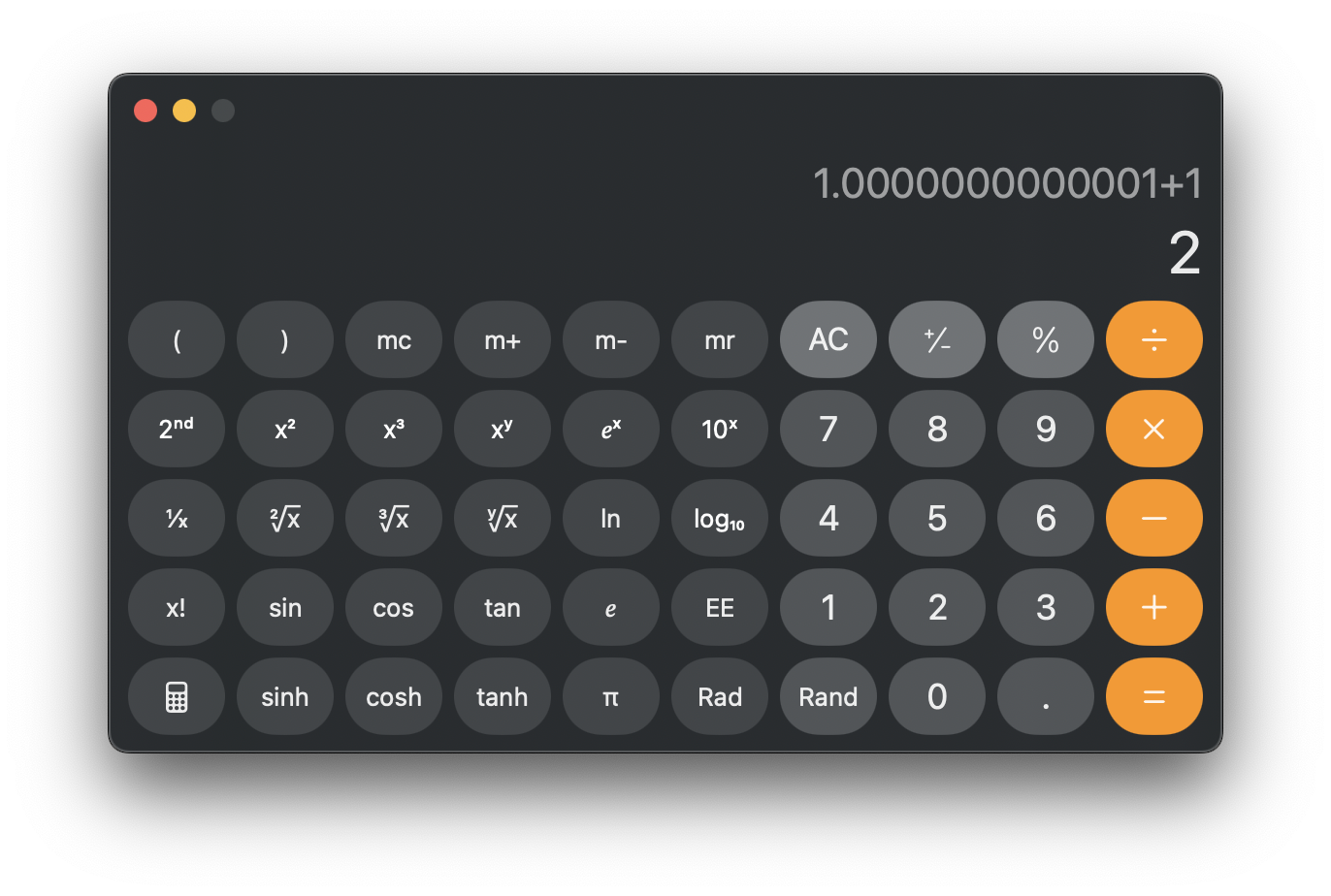
In fact in this case, it's not the known limitation of floating point numbers to blame: this Calculator application gives you the ability (submenu under View > Decimal Places) to choose a precision between 0 to 15 decimal places, and it will do rounding beyond that point. I think the default is 8.
The original screenshot shows a number with 13 decimal places, and if you set it at or above 13, then the calculation will come out correct.
The application doesn't really go out of its way to communicate this to the user. For the most part maybe it doesn't matter, but "user entering more decimal places than they'll get back" might be one thing an application might usefully highlight.
Sorry, but this annoys me. The claim might be false if I had made it after seeing your screenshot. But you don't know what I've seen in my life up to that point. The claim that all calculators are infallible would be false, but that's not the claim I made.
When a personal experience is cited, a valid counterargument would be "your experience is not representative," not "you are incorrect about your own experience."
Well if you haven't seen enough calculators to see one that can't add, a very common issue with floating point arithmetic on computers, you shouldn't offer your experience as an argument for anything other than that you haven't seen enough calculators.
Well, to make the claim you actually made, which is that you haven't seen a single calculator that was wrong, anywhere from zero to all of them. It's just that the "zero" end of that spectrum doesn't really tell us anything about calculators.
That's not a tautology. You said "programs are the most reliable, though far from 100%"; they're just telling you that your upper bound for well-made programs is too low.
RE: the calculator screenshot - it's still reliable because the same answer will be produced for the same inputs every time. And the behavior, though possibly confusing to the end user at times, is based on choices made in the design of the system (floating point vs integer representations, rounding/truncating behavior, etc). It's reliable deterministic logic all the way down.
> > Programs can be very close to 100% reliable when made well.
> This is a tautology.
No it's not. There are plenty of things that can't be 100% reliable no matter how well they're made. A perfect bridge is still going to break down and eventually fall apart. The best possible motion-activated light is going to have false positives and false negatives because the real world is messy. Light bulbs will burn out no matter how much care and effort goes into them.
In any case, unless you assert that programs are never made well, then your own statement disproves your previous statement that the reliability of programs is "far from 100%."
Plenty of software is extremely reliable in practice. It's just easy to forget about it because good, reliable software tends to be invisible.
> No it's not. There are plenty of things that can't be 100% reliable no matter how well they're made. A perfect bridge is still going to break down and eventually fall apart. The best possible motion-activated light is going to have false positives and false negatives because the real world is messy. Light bulbs will burn out no matter how much care and effort goes into them.
All these failure modes are known and predicable, at least statistically
>I've never seen a calculator come up with the wrong answer when adding two numbers.
Intel once made a CPU that barely got some math wrong that probably would not affect the vast majority of users. The backlash from the industry was so strong that intel spent half a billion (1994) dollars replacing all of them.
Our entire industry avoids floating point numbers for some types of calculations because, even though they are mostly deterministic with minimal constraints, that mental model is so hard to manage that you are better off avoiding it entirely and removing an entire class of errors from your work
But now we are just supposed to do everything with a slot machine that WILL randomly just do the wrong thing some unknowable percentage of the time, and that wrong thing has no logic?
No, fuck that. I don't even call myself an engineer and such frivolity is still beyond the pale. I didn't take 4 years of college and ten years of hard earned experience to build systems that will randomly fuck over people with no explanation or rhyme or reason.
I DO use systems that are probabilistic in nature, but we use rather simple versions of those because when I tell management "We can't explain why the model got that output", they rightly refuse to accept that answer. Some percentage of orders getting mispredicted is fine. Orders getting mispredicted that cannot be explained entirely from their data is NOT. When a customer calls us, we cannot tell them "Oh, that's just how Neural networks are, you were unlucky".
Notably, those in the industry that HAVE jumped on the neural net/"AI" bandwagon for this exact problem domain have not demonstrated anything close to seriously better results. In fact, one of our most DRAMATICALLY effective signals is a third party service that has been around for decades, and we were using a legacy integration that hadn't been updated in a decade. Meanwhile, Google's equivalent product/service couldn't even match the results of internally developed random forest models from data science teams that were.... not good. It didn't even match the service Microsoft has recently killed, which was similarly bragadocious about "AI" and similarly trash.
All that panopticon's worth of data, all that computing power, all that supposed talent, all that lack of privacy and tracking, and it was almost as bad as a coin flip.


reply