netcup is fine unless you have to deal with their support, which is nonexistent. Never had any uptime issues in the two years I've been using them, but friends had issues. Somewhat hit or miss I suppose.
Used to use Hexchat and swapped to halloy more than a year ago and couldn't be happier. The development is coming along nicely and a lot of modern features got added since I've been using it. It's a joy to use in conjunction with soju and my irc experience hasn't been this smooth in a long time.
Yea, I read an article on here a few years ago (which I can't seem to find anymore), that a lot more cars in the US crash into buildings compared to the EU and the main takeaway point was that it is probably because of the long and straight roads in the US, since you go faster and aren't as focused.
I think about half of the Japanese albums I tag have a mistake of some sort on Discogs, such as wrong okurigana or kanji usage. I've corrected some of them myself, but it happens so often that I've mostly given up. In the end it's faster to transcribe from the back cover.
> For example, the Act permits law enforcement to use certain systems that collect biometrics in public places if those systems help perform a “targeted search” for, say, an abduction victim, or to help prevent a “specific, substantial, and imminent” threat to life. This exemption requires authorization from the appropriate governing body, and the Act stresses that law enforcement can’t make a decision that “produces an adverse legal effect” on a person solely based on these systems’ outputs.
WV L1 Keys/ PR SL 3000 keys require breaking into the TEE to steal those decryption keys.
Ever wondered why netflix 4k web-dls take a while for less popular shows?
Netfliy monitors these more tightly apparently and blacklist keys that are used to download. Then the group needs to buy some new device, the old one is burned.
I think there's some kind of watermarking going on, so once a rip is released to the public they can trace it back to which device keys were used to decrypt it.
Watermarking would require a separate version of each encoded file for each target device, which is not amenable to efficient CDN-ing.
It's quite easy to grab the encrypted media files, as they go over the wire - do this from two devices and compare what you get. (you don't need to strip the DRM to see if the two files are identical)
They wouldn't necessarily need to serve different data to each client when they control the whole playback stack, they could get clever by including duplicate frame data with subtle differences and making each device key only able to decrypt one of the variants. Repeat that throughout a show to add additional bits to the signature until it's uniquely identifiable.
But they don't control the playback stack, once the attacker has the keys. The attacker brings their own stack, decrypting the data with their own software.
Watermarking was a problem when Widevine L1 was first introduced. Pirates seem to have found a way to scrub the watermark from their releases. Either that or someone is burning a _lot_ of cash on playback hardware judging from the rate of 4K WEB-DL releases.
It doesn't need to be a lot - just replaced in the same cadence as the latency from initial broadcast to key revocation. Even if it's all in-house in Netflix and the watermark sufficient to identify the specific device key not all releases are made instantly after being made available on the platform, it still has to be downloaded, verified, watermark extracted before the key can be revoked.
If that's just a total of a single day, 365 cheap netflix devices per year certainly isn't out of the question, especially with the number of people involved in the many ripping groups.
Depending on the bit size of a watermark, device-based watermarking should be easy to defeat using a quorum of devices to agree on bit values. It should only take around log2(n) attackers to remove an n-bit watermark.
I have a similar experience as a german on the internet.
Aliexpress (straight up wrong translations), Discord (anglicism, adjective ordering and weird sentence/tone structures) and plenty of others I don't remember, the list is pretty long. Size doesn't really seem play an effect aswell.
Another big issue are potential bugs you encounter. If you just get a translated error message without any error number or something similar it's a very frustrating experience to troubleshoot it. I've spend quite some time retranslating error messages to solve issues.
Add to it that often knowledge bases are outdated in the translated languages.
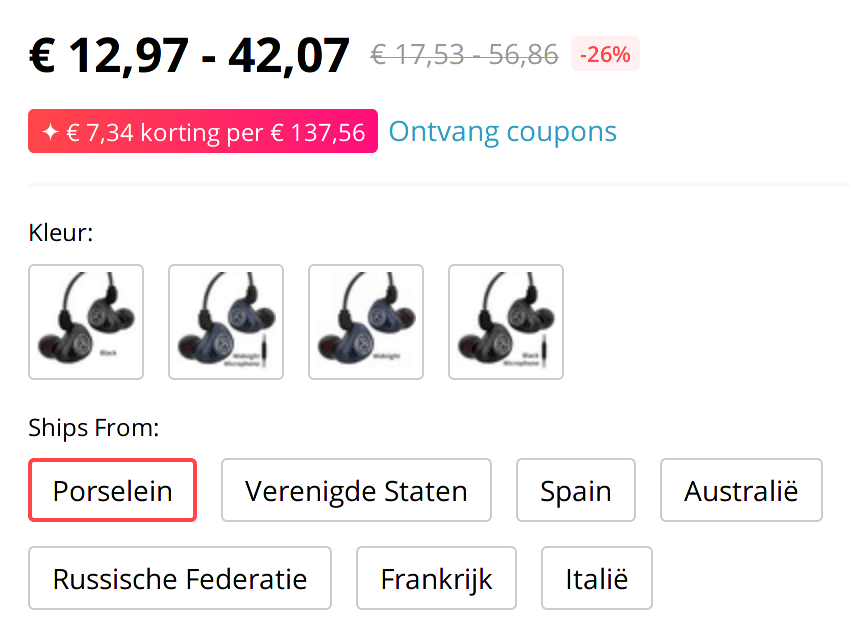
Plenty of items on Aliexpress can be shipped from multiple locations. "China" is almost always one of the options. Well, in Dutch they've translated that to "Porselein". That is a valid translation, if you are talking about plates and dishes made from porcelain)
I wonder how actively harmful this bad translation is to their business.
Weird, I sometimes get the French translation of AliExpress (when my cookie expires I suppose) and I haven't noticed "China" being translated as Porcelaine in French. I wonder why it's different. Also now I wonder why I get the French version, since I live in Flanders (although I'm a French speaker).
AliExpress translations are totally incomprehensible though anyway. I really don't think they should show the translated versions by default.
(By the way, your second link doesn't respond for me)
This holds true in all areas of software development—nay, in business in general. To the point where I’m not really sure why people do expect large players to do a good job, because they just about never do.
Large organisations are very close to incapable of producing good results—their software will be clunky and slow, their translations present but bad, their customer support painful. Small organisations are more likely to be able to produce good results. Notwithstanding this, small enterprises are often unable to match large for certain resource availability (including time!), which acts as a balancing factor so that small is not often uniformly superior to large, though it’s much more likely to be superior in a certain subset of fields; and this is the case with i18n/l10n.
I think this actually stands to very simple reason when examined numerically: have enough mass and you’ll produce average results (regression to the mean); be small and you’re more likely to deviate from the mean, whether for good or for bad, and if for bad you’re more likely to fail, so you’ll tend to end up with more above-average small players.