Y Combinator loves to bash Israel (and Jews!) for some reason. I agree with your assessment. There's plenty of Israel critical material on Facebook. Only a very few items--items that would be not legal under US law, have been cited as examples. There's no secret kabal conspiracy here.
>"Y Combinator loves to bash Israel (and Jews!) for some reason."
As a Jew, active on HN for years, I have not seen this to be the case at all.
I have seen sporatic posts that appeared biased or racist on both sides of the aisle...definitely not more or less than exists in the real world... and certainly not enough to generalize about YC at all.
I don't see y combinator's specific involvement at all. It's certainly likely some HN community members aren't huge fans of Israel, since that country acts like an asshole all the time. I don't see much in the way of anti-Jewish sentiment, however, and being critical of Israel is hardly the same thing outside of emotional rhetoric.
My observation is that it's not HN/YC per se who do the bashing, rather it's a subset of readers who seem to hold anti-Israel biases, thus the "Israel is automatically wrong" type of comments that frequently appear in discussions.
That doesn't necessarily equate to antisemitism but doesn't exclude it either. Anti-Israel sentiment is often associated with strains of "social liberalism"[0] and related political positions, leading to anti-Israel comments being made in the context of policy discussion.
OTOH HN readers have shown keen interest in Israeli technological developments. At times praise for their successes has been evident, so obviously not all comments about Israel are negative. I've had the idea there are distinct subsets of HN users with different attitudes. Depending on the subject matter, one or another group is more inspired to add comments.
Being critical of Israel's government and its policies is not the same as being anti-Semitic. That's a popular rhetorical trick to deflect all criticism, and it's not valid.
Presumably the fact that they take down repositories that disagree with their politics (or the politics of other governments). They also don't appear to put up any fight against DMCA's, and they mandate that all users must run proprietary JavaScript. LibreJS makes the site mostly work though, so it's not that bad. The biggest problem is their policies, which are not pro-free-software (no matter what they might say).
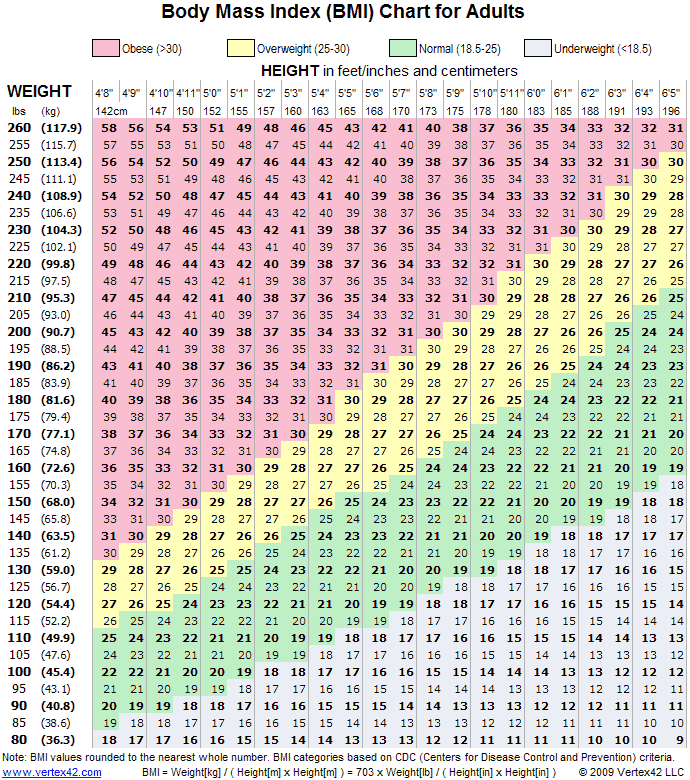
For an average height, the span between the lowest non-over-or-underweight weight and the highest is a lot more than 20 pounds, and being a bit into the overweight range doesn't automatically make you unhealthy either.
That's not quite correct. The CDC recommends a body fat percentage between 18% to 25%, and it's generally acknowledged that athletes can drop down to around 5%-6% without adverse effects. So, given those numbers, most healthy adults are carrying at least 20 pounds that they could safely lose.
CDC recommends BMI of 18 to 25. Completely different from body fat percentage. 25% body fat is pretty fat. It's a noticeably protruding belly, drooping love handles, and sometimes breast tissue that could be classified as an A-cup. BMI is a pretty poor standard anyway, since it would classify anyone who does body building even recreationally as obese.
So my original numbers were actually correct, but instead of the CDC it's the American Council on Exercise, whatever that is. The page before has the CDC recommendations on BMI. I was surprised too that 25% is considered acceptable. I am aware of the difference between BMI and body fat percentage, and that the former is an inaccurate gauge of fitness.
Considering the American Council on Exercise pushes the "Health at Every Size(C)" bullshit I'd never take them seriously. I can't be bothered to go find real studies on the issue but I would have to guess they'd tell you there's an increased risk of health issues at 25% body fat.
Ah ok, I suppose I expected WebMD to rely on better sources of information. I stay around 7-10% body fat and feel good in that range -- the few times I've gone below that I felt lethargic and performed poorly in sports.
I suspect you're not actually at 7-10% body fat, that is ridiculously low. Like just skin and muscle, nothing else. It is physically impossible for most people to go below 7% without some serious drug abuse or eating disorder. Google image search "7% body fat" and see for yourself.
Your numbers are good for males. Often women have issues if they drop to the 5-6% range... missed periods, decreased fertility, hormonal changes, and other such things. Weirdly, some of the same issues people have with anorexia, only to a healthier extreme. I'm pretty sure they recommend women to have at least 9-11% body fat if they are muscular.
The biggest problem with our health, however, is still Obesity. Just as the fat were mislead by being made to believe that "low fat == healthy" these people will be similarly think "low carb == healthy" and proceed to get obese on low-carb foods.
Face it, if you're a healthy weight, by body-fat percentage, you don't have to worry about fructose vs glucose or fat vs carbs.
Americans need to put their forks down. We need to start holding the overweight and the fat accountable for their expensive lifestyle choices.
> We need to start holding the overweight and the fat accountable for their expensive lifestyle choices.
Ha, that's a good one. The answer you'll get is that nobody is responsible for their expensive lifestyle choices, and everyone is a victim of the system. People are fat? Not their fault; they live in food and exercise deserts and/or are trapped in the poverty cycle where they can only afford garbage calories. What, they are middle class? Genetic, then. Their parents are fat and it takes an overwhelming amount of effort to break the cycle.
The only solution is to change the system, not people. Which, unfortunately, can have adverse effects on healthy weighted people that like the current system.