Maybe I’m not smart enough to grasp all these flowery words, but is this suggesting if I spend a few years writing some code, you should get to copy it for your own interests and without compensating me as long as your sales and marketing is better than mine?
I don’t think Rockchip learned from the ffmoeg code. They simply copied it outright without attribution.
I think both of you are right. But OP may think of the larger picture. A bit like 'move fast and break things', that sort of things where you blur the lines when it's valuable enough. Not that I agree with this ethical stance, but surely there's some sclerotic aspect of being too stiff on rules. It's a weird balance.
> if I spend a few years writing some code, you should get to copy it for your own interests
If you publish the code, there's an argument to be made that yes, others should freely use it: if you could (or did) monetize the code yourself you wouldn't publish it. If you didn't, or failed trying to monetize it, maybe it's better for society if everyone else also gets to try?
Right, but what incentives are we really pushing here?
If the only way to make any amount of money or, at least, not be stolen from, is to keep everything internal and be protectionist, then where is the progress?
So much of the modern world is built on open source. Do we really want every company and their mom recreating the world from scratch just so they don't get fucked over? Would things like the iPhone even exist in such a world?
I feel terrible for the author, having to work in this kind of structure. Someone should tell mytaxi that even Spotify never got “tribes and squads” to work, it sounds like for the same reasons/problems mytaxi ran into.
Edit: accidentally hit update instead of scrolling…
One thing missing from the article that I don’t think has been mentioned is confidence and setting expectations. I’ve found if I expect certain results and convey confidence, people are more likely to follow your lead, or at least listen to you. Don’t act like a know it all, and be sure to encourage and question others so the environment is collaborative (solve problems as a group; don’t be a hero). But set expectations.
Also, I don’t think you mean “intimacy.” Do you mean “empathy?”
> Also, I don’t think you mean “intimacy.” Do you mean “empathy?”
The words that follow support it being "intimacy". That is what intimacy is — being close enough to someone that you can be open without a feeling of being left exposed. How would empathy fit?
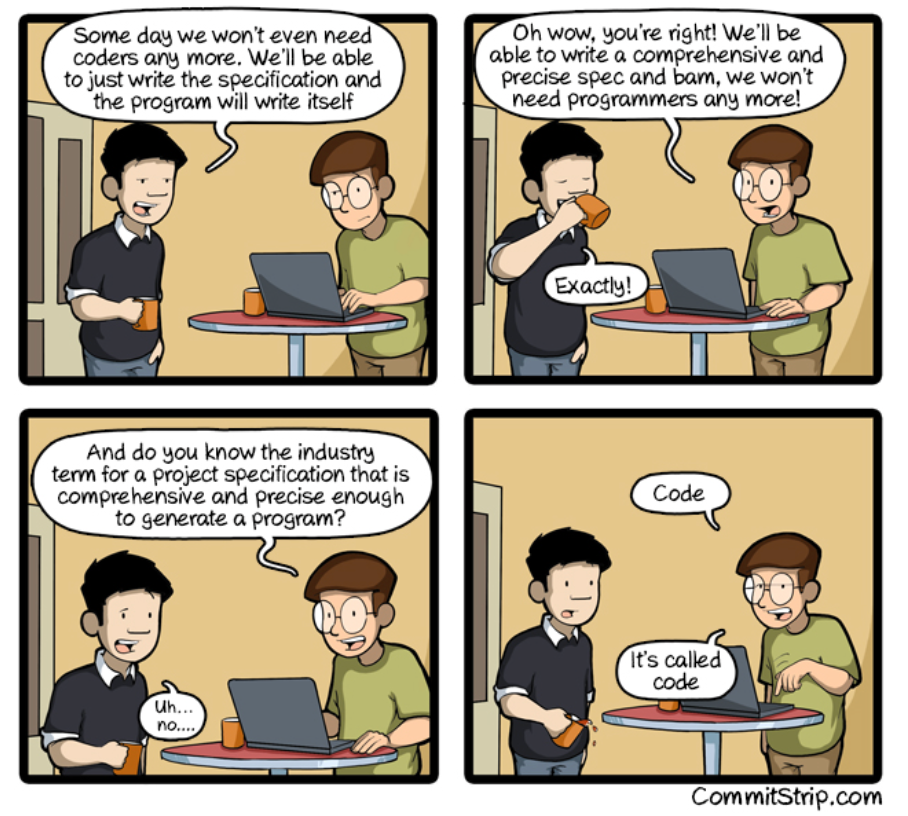
One of my coworkers (not a developer, but familiar enough with technology) asked about a new “low code” app and wondered if our engineering team used that. My response, I think, provides something of an answer to this paradox: it’s not writing the code that’s time consuming; it’s the requirements gathering. It’s not enough to generate code or even have the LLM build or deploy the software. It’s all the knowledge and experience around crafting an app that’s likely preventing the shovelware. Turns out code is only a part of our job.
Also, why is this the “Gorman” Paradox? He literally links to the article that I remember as first proposing this paradox (though I don’t think the original author called it a paradox). This author just summarizes that article. It should be the Judge Paradox, after the original author.
The example in the article of letting Claude deploy the app worries me. It has me thinking of that line, “AI is really good until you know what you’re talking about.” If the author was clueless of how to deploy the app, how do they know the app was deployed safely or securely?
Just this past week I asked Claude for some help with C++ and a library I was somewhat unfamiliar with. What it produced looked great—-if you didn’t know C++ very well. It turned out Claude knew even less about this library than I did, generating tons of code that was completely incorrect. I eventually solve my problem through research and trial and error, and it was nothing like what Claude recommended. It certainly didn’t leave me feeling confident enough to let the LLM have the level of control over my computer or project that the author is allowing it in the article.
I’m not looking forward to a future spending all my time cleaning up the messes LLM’s create.
>"AI is really good until you know what you’re talking about."
Maybe this is a case well represented by the bell curve meme? "AI is great; can do everything" (but you've no domain knowledge so cannot guide it and everything means autonomous creation, so when eventually reaches a roadblock will have no idea what to do), "AI is really good until you know what you’re talking about" (then seemingly doesn't work and is even counterproductive), "AI is great; can do everything" (you've domain knowledge and can guide it and everything means application and assistance).
Essentially rather hope for the LLM to create all by itself as seems to be the current case for many, you should be able utilize your knowledge and have it assist you to both generate an initial code and converge it to where you want.
I agree you need to know what you’re doing. But Claude Code is definitely better than I am at some things- probably the most important of which is starting some mundane task that I would otherwise procrastinate indefinitely.
It’s very good at Typescript, search, and research, but still does stupid stuff and requires review and steering.
I don’t get into the same flow while using it, either, but I think that might be a matter of time. I find it allows me to spend more of my time thinking at a higher level. I could see myself learning to really enjoy that. Code review is exhausting, though, and has always been my least favorite aspect of the job. It seems my future is going to be code-review-heavy, and that is probably the biggest drawback.
I know approximately nothing about approximately everything. Claude seems pretty good at those things. But in every case I’ve used Claude Code for something I do know about it’s been unsatisfactory as a solo operator. It’s not useless, but it is basically useless for anything serious unless you’re very actively guiding it.
I think it has a lot of potential value and will become more useful over time, but it’ll be most useful when we can confidently understand the limitations.
I know a lot about Typescript and its ecosystem. I’ve taught it to students, and worked on it at companies whose names you’d recognize. Claude Code is better than I am at some things that I know deeply, in some cases. It does stupid things on occasion (like use global mutable state), but it is still more useful than not. So, I guess it depends on how you define “better”, but I’ve learned things I didn’t know, and it allows me to do projects and experiments that I’d otherwise be too lazy to do.
yeah- this is a fair concern and I should have been clearer. I wouldnt do this on anything with real data or production traffic. that hetzner instance was a side project with nothing sensitive on it. the point was more about claudes ability to reason through infrastructure problems not that everyone should hand over ssh keys. you're right to be cautious
> But then I mentioned I had credits on Fly.io, was eligible for Vercel's free tier, had a Cloudflare account, and a Neon database.
I miss the days where deploying an app was just uploading some files. Maybe we need AI to understand this artificial complexity we introduced ourselves?
Right there with you. I’m working on fixing an app deployment this weekend myself and dreading picking my way through GitHub actions, ansible scripts, container configs, and deployment APIs to figure how why the thing stopped deploying. Thank goodness it’s just deploying to VMs and not Kube, or I’d probably lose a week.
This somewhat reflects my sentiment to this article. It felt very condescending. This "self-limiting beliefs" and the implication that Seattle engineers are less than San Francisco engineers because they haven't bought into AI...well, neither have all the SF engineers.
One interesting take away from the article and the discussion is that there seem to be two kinds of engineers: those that buy into the hype and call it "AI," and those that see it for the fancy search engine it is and call it an "LLM." I'm pretty sure these days when someone mentions "AI" to me I roll my eyes. But if they say, "LLM," ok, let's have a discussion.
I agree. This "cooldown" approach seems antithetical to some basic tenants of security in the open source world, namely that more eyeballs makes for better code. If we all stop looking at or using the thing, are these security professionals really going to find the supply-chain problems for us in the thing, for free?
Instead of a period where you don't use the new version, shouldn't we instead be promoting a best practice of not just blindly using a package or library in production? This "cooldown" should be a period of use in dev or QA environments while we take the time to investigate the libraries we use and their dependencies. I know this can be difficult in many languages and package managers, given the plethora of libraries and dependencies (I'm looking at you in particular JavaScript). But "it's hard" shouldn't really be a good excuse for our best efforts to maintain secure and stable applications.
On the Steam Deck you boot into desktop mode and it’s a standard Linux. Install what you want. I have Heroic Launcher on mine, running games from GOG and Epic alongside Steam games.
I slapped a nice sticker of a boat anchor on my work laptop. Seemed fitting. Slow (thanks to 4 separate malware/virus scanners), weighs a ton, lasts for an hour on battery.
Same boat, and 100% agree. I couldn’t find a single example of Windows or Windows software where I think the experience is in any way better. Windows only saving grace, as a developer, is WSL.
For a simple example, no app remembers the last directory you were working in. The keys each app uses are completely inconsistent from app to app. And it was only in Windows 11 that Windows started remembering my window configuration when I plugged and unplugged a monitor. Then there’s the Windows 95-style dialog boxes mixed in with the Windows 11-style dialog boxes; what a UI mess. I spoke with one vendor the other day who was actually proud they’d adopted a ribbon interface in their UI “just like Office” and I verbally laughed.
From a hardware perspective, I still don’t understand why Windows and laptop manufacturers can’t get sleep working right. My Intel MacBook Pro with an old battery still sleeps and wakes and lasts for several hours, while my new Windows laptop lasts about an hour and won’t wake from hibernate half the time without a hard reboot.
I think Windows is the “good enough” for most people.
> I don't think the automation options in MacOS are better than AutoHotKey (even Linux doesn't have something as good).
Did you try Keyboard Maestro https://www.keyboardmaestro.com/main/ (I've never used AutoHotKey and I'd be super curious if there are deficiencies in KM relative to it, but Keyboard Maestro is, from my perspective, a masterpiece, it's hard to imagine it being any better.)
Also I think this statement needs a stronger defense given macOS includes Shortcuts, Automator, and AppleScript, I don't know much about Windows automation but I've never heard of them having something like AppleScript (that can say, migrate data between applications without using GUI scripting [e.g., iterate through open browser tabs and create todos from each of them operating directly on the application data rather than scripting the UI]).
Yeah, the things that AppleScript can do is so crazy.
I've fully automated keeping 1 tab in Chrome logged into a website that insists on logging me out every hour or something. (not banking or anything)
Mac also can't get sleep right. Have you tried to make a macbook consistently be 'awake' when the lid is closed?
You can't, really. Almost everyone resorts to buying an HDMI dongle to fake a display. Apple solved the problem at such a low level, the flexibility to run something in clamshell mode is broken, even when using caffeine/amphetamine/etc etc etc.
So, tradeoffs. They made their laptops go to sleep very well, but broke functionality in the process. You can argue it's a good tradeoff, just acknowledge that there WAS a tradeoff made.
I did for years too, but newer MacBooks no longer allow running with lid-closed unless connected to a monitor, I was disappointed to recently learn this.
If I’m wrong, someone tell me how to do it! On an M4 MacBook Air running latest OSX release.
I don’t mean this to sound like I’m being a jerk, but why would I want my MacBook to be awake with the lid closed? If I want it to be awake doing something, I leave the lid open and let the screen sleep. Maybe I’ve been using a Mac too long, but lid closed means sleep to me. I’ll even do that when I have it plugged into a monitor: close the lid to make it sleep.
> And it was only in Windows 11 that Windows started remembering my window configuration when I plugged and unplugged a monitor.
Oh god, I'm going to have to bite the bullet and switch to 11, huh?
The one thing that has been saving me from throwing my PC out the window in rage has been the monitor I have that supports a "keep alive" mode where switching inputs is transparent to the computers connected to it. So when switching inputs between my PC and laptop neither one thinks the monitor is being disconnected/reconnected. If it wasn't for that, I'd be screaming "WHY ARE YOU MOVING ALL MY WINDOWS?" on a regular basis. (Seriously, why are you moving all my windows? Sure, if they're on the display that was just disconnected, I get you. But when I connect a new display, Windows 10 seems to throw a dart at the display space for every window and shuffle them to new locations. Windows that live in a specific place on a specific display 100% of the time just fly around for no reason. Please god just stop.)


I don’t think Rockchip learned from the ffmoeg code. They simply copied it outright without attribution.
reply