Okay.. I'm a Model S owner and I love Tesla and I chuckled at the whole Insane mode and gave a bit of an amused snort at Ludicrous mode.
This, however, really makes me wonder WTH is going on there:
HEPA Air Filters
"There are three modes: circulate with outside air, re-circulate inside air and a bioweapon defense mode that creates positive pressure inside the cabin to protect occupants."
EDIT: Very fair points about driving by skunks or nasty smells. The naming is what gets me though. If it was called Noxious Smell Defense Mode or something, that would make perfect sense. Looking at Wikipedia, a "medical grade HEPA filter" can filter out 99.97% of particles at least 0.3 micrometers in diameter. Dunno if the Tesla filters are also using UV irradiation, and I also couldn't find any documentation of the particulate size of skunk odor, so it will be interesting to see documentation on what exactly it can filter out.
EDIT2: Watched a bit of the intro event video. Looks like it has a specific set of activated charcoal filters for sulfur type particulates, so certainly seems like it could be a skunk odor killer. :)
Yah I found that a bit paranoid. Probably what happened though is that the system is controlled by a microcontroller and it took 3 minutes for some programmer to add that feature for fun, and then some marketer thought they would throw it in and make it real.
Modern cars have a cabin air outlet. It's usually hidden in the trunk or the back of the cab (on trucks), and vents somewhere like behind the plastic bumper. There are rubber flaps on them to ensure one-way air travel and keep water out. Perhaps Tesla's has a motor on theirs to keep it closed against the increased cabin pressure.
Just by pumping air inside through filters a positive internal pressure is automatically created. How much pressure will be created is proportional to the pump's flow rate and inversely proportional to the car leakage constant ( I think it's something like leakage ~ k * P.I.P., which would make P.I.P. ~ pump flow/k ), but some positive internal pressure is a given even with those outlets.
Probably depends on the bioweapon. For instance, I'd expect it to be effective against anthrax spores, which was the most recent bioweapons scare we had.
You're still using outside air, but by maintaining positive pressure you ensure that it's only coming in through the filter, rather than a mix of air intake and leaky joints.
Not sure about particular type of filter, but CBRN countermeasures found on tanks, APCs and such are also basically air filtration with positive internal pressure.
It absolutely is, but that doesn't mean it wouldn't work in principle.
A HEPA filter is used in a lot of labs where biological substances are handled, even potentially hazardous ones. It should filter many types of biological agent out of the incoming air, and the positive pressure will keep such things entering other ways.
I think the reason they put it in is so people would talk about it and, look, we are. It is a marketing gimmick that likely doesn't require any additional hardware in the car (the air pump and HEPA filter are already in it, this just turns the pump up and adds a new dash button).
I'll give Tesla the nod for one thing: They sure know how to market. Between the wing doors, the bio-protection mode (which will be on the nightly news), and insane mode they're very savvy.
They are probably storing compressed air in the cabin. You start the bioweapon-defense-mode, the fan raises the pressure in the cabin ( that uses outside air) and then shuts off. (Or they store a little bit of air somewhere, perhaps for the breaks, and use that.)
Sounds silly to most, but there are situations where you don't want unfiltered outside air leaking in. If "seriously filtered cabin air supply" is relatively easy to add, there's no downside to adding it. Here around Atlanta, the pollen count can exceed 5000 for weeks (and 500 is considered "extremely high"); a good filter would be dearly appreciated by many. For an interesting comparison re: "bioweapon", consider the armored luxury car market with product features such as http://www.caratsecurity.com/Products/sedans-and-SUVs.php
It's not silly at all. I wish I had this everyday that I'm sitting in traffic. My car has multiple climate control modes that default with the vent open. Some heater modes override the vent button and force me to use outside air. I actually know what the outside humidity is and the amount of car exhaust I want to suffer. But apparently that doesn't matter to Mazda.
The point is there's a difference between ambient outside air leaking into the car like a sieve, vs completely sealed with air supplied via biohazard rated filtration. Also, you'd be surprised how long you can function fine in a sealed box the size of a car cab.
If you haven't seen waves of pollen wafting thru the air for miles, like we regularly see near Atlanta, you may not grasp the interest.
I would buy this car for this feature alone. Allergies are the bane of my existence. I would love to have a car that is an allergy free zone. Sometimes, I drive through big farm areas... and I want to die.
" To qualify as HEPA by US government standards, an air filter must remove (from the air that passes through) 99.97% of particles that have a size of 0.3 µm."
That means bacteria (1-10 µm) and spores (~1 µm) but not virusses (~ 100 nm +/- a lot) and certainly not molecules emitted by a skunk corpse.
Its activated charcoal filter has the primary layer, a secondary layer that filters sulfur gases, and a tertiary layer that filters alkaline gases.
Skunk spray is made primarily of thiols and their acetate derivatives. Thiols (the main ugly smelling ones are both thiols) are organosulfur compounds, and would be filtered by the secondary chemical filter.
The gases that make the decaying corpse smell are acidic (AFAIK), so would be filtered by the tertiary layer.
Recirculating cabin air is plenty for skunk. Even economy American cars -- that no-one would confuse with exceptional engineering -- do just fine keeping the stink out.
My old GMC Jimmy had no recirculate setting. Incredible. We live off gravel roads. When following another car, I had to just stop and wait a minute for the air to clear, else I'd be choked by lime dust in seconds.
Full disclaimer, I work for a somewhat prestigious air filtration company.
I agree the wording is a little bit on the strange side. However, if they are saying that it's a "bioweapon defense mode" they should probably be saying that they can catch 0.03 microns as opposed to 0.3 microns. That is virus level small. There should also be several filters in there, a large particulate filter for the big stuff, an activated carbon filter for the odors, and an ultra fine particulate filter for the 0.03 kinds of small stuff.
UV ends up not being worth it because you'd have to replace the bulb almost on a monthly basis. Ionizers just make your particulates sticky, so they'd go right through the filter and stick to your clothes/seats/walls.
In the Launch Event video, Elon goes into more detail around the 10 minute mark.
The filtering is effective down to 0.01 microns. During testing, they were not able to detect any measurable level of spores, bacteria, or viruses in the air passing through the system.
Two separate filters, and the main filter has three levels of activated carbon.
First: Universal (hydrocarbons)
Second: Acidic gases (sulfur)
Third: Alkaline gases (ammonia)
> UV ends up not being worth it because you'd have to replace the bulb almost on a monthly basis.
I have a UV system on my home A/C, and the bulb usually burns out once every two years (and it's always on). I'd imagine this would be greatly extended if in place in a car when it's not always on. Am I missing something?
The effectiveness of a UV lamp decreases with age, so they can stop being effective long before they actually burn out. There should be a manufacturer rating on the lamp, which will depend on its composition and other things.
As an example the lamps I use have a rating of ~8000hrs, about a year, but to the outside observer they'll still look functional until they blow after 2-3 years.
I don't think the goal is to provide a bio-weapon defense system (I think it's more for bad smog), but this truthfully is how you would defend against a bio-weapon in a vehicle; use the only safe air source (the HEPA filter) to pump air in at a rate that maintains positive pressure in the cabin, preventing air from leaking into the vehicle from unsafe sources (e.g., a small crack in a seal somewhere).
During the release event last night, Elon called it a "bioweapon defense mode" as a joke and everyone laughed. I don't think they seriously mean it, but it can still be useful for people with allergies.
   - Just Read the Instructions
   - Of Course I Still Love You
...and other silly, whimsically chosen names in the tradition of Culture spaceships (from the series by Iain Banks). Perhaps they're naming their special modes in a slightly similar vein?
Tesla's silly naming is a little more insidious than that. They started out naming their cars S E and X, only changing E to 3 to get around a Ford trademark.
HEPA is not just to avoid smells or pollen. It's the only filter that can remove PM2.5 (particulate matter < 2.5 microns in size). WHO terms them as group 1 carcinogens and in most cities including NY, Houston etc, PM2.5 levels are far beyond safety limits. It's a shame that other auto manufacturers don't include a HEPA as their cabin filter. That might be because of gasoline engine limitations.
The name is obviously tongue in cheek much like Ludicrous Mode. I think it's hilarious and I hope when the Model 3 comes out I am able to get a Bioweapon Defense Mode button on mine.
People who shall remain nameless have been installing custom paintball gun-like devices on the undercarriages of cars with hoppers filled with pepper spray balls. Normally aimed to the rear of the car, they can be used to stop dangerous tailgaters or the like.
I'm sure there are other things in the works, so this isn't really that far fetched.
The car must be reasonably air-tight by itself to make this work, and I imagine there should be a warning signal/siren to driver if someone tries to open a window when this mode is enabled.
> HEPA Air Filters "There are three modes: circulate with outside air, re-circulate inside air and a bioweapon defense mode that creates positive pressure inside the cabin to protect occupants."
This is immensely useful in Chinese cities!
Well, given how common forest fires are, I think it can be useful. In the last two years, I've been through three forest-fire caused 'air quality warnings' which caused genuine discomfort in Arizona, Minnesota, and Oregon.
That is pretty amazing pricing. Most premium families would be looking to the Land Rover Evoque ($41K), BMW X5 ($54K) etc But Tesla is pricing it not to compete with the baseline Porsche Cayenne ($58K) but around the Cayenne Turbo S level ($157K). I guess they aren't planning on building a lot of them.
I spend a lot of time in a little ski town near me (Park City) that is absolutely covered in Porsche Cayenne Turbos. It's the perfect SUV for your family + ski gear + showing off just a little bit that you're really wealthy.
I have zero doubt the parking lots next to the ski slopes will be covered in Model X's in a couple of years.
Wonder how rear-mounting compares to top-mounting for overall drag. Anyway, for most users, I imagine you're not driving around with ski gear on your car 99% of the time, so it's a reasonable design decision.
Rear mounting is not going to work very well for people who don't like road grime getting all over their gear. I'd much rather have a roof box. The model X is really appealing to me other than that detail.
Unless you live in Germany you're not really ever going to hit that top speed. You will however have ample chance to take advantage of the acceleration.
Raced a Porsche Cayenne Turbo on the 101N in Palo Alto, kept up till around 140mph, at which point my transmission ran out of gearing and he kept going. I was impressed.
Do you accelerate at 100% each time though? I dont think I ever floor my car "off the line", I think I only use maximum power to go from 60-80 on the motorway.
Not all the time but sometimes for fun. I would do it a lot more in an electric because the "gas" is "free" (assuming it is charged with solar). At least it is something I can legally do, as opposed to going 155mph.
Oddly enough accelerating like that isn't always "legal". Where I'm from it could be classed as dangerous driving, and I believe in the USA it could fall under "Exhibition of Speed".
By and large it is more efficient to accelerate at full power, assuming your goal is to reach a certain top speed regardless, so if you were _really_ concerned about conserving petrol then you should be going full blast off the line. That said I expect the fuel usage such a situation to be negligible anyway, especially to someone who can afford/justify a car that does it in 4 seconds.
My car isn't that fast, or particularly economical, but I know I've never thought "I'd love to accelerate at full power here to show how fast my car is, but I just can't justify the pennies it will cost me"! Outside of hyper-milers I wonder how many people do actually think about it.
Huh, I just looked up my state's statute on this and it contained verbiage like "Includes, but not limited to". How the heck can they get away with defining a law so vaguely? I guess I wrongly assumed that a law had to actually define what it was making illegal.
The above poster is drawing a distinction between faster (top speed) and quicker (acceleration). Auto-journalism usually uses this language. In everyday speech, "faster" is ambiguous.
You floor the car each time you get on the highway? Also if we are talking about rolling start Tesla's advantage over the Turbo S would practically melt away.
Since Teslas don't make a super-annoying noise when floored, yes, it does appear that Tesla owners frequently floor it, from stoplights, stop signs, and on highway ramps.
Yes, a rolling start is a big help on highway ramps. Doesn't help much at stop signs and lights.
Additionally, the Model X appears to be significantly faster than the similarly-priced Cayenne Turbo S.
Cayenne Turbo S (the fastest Cayenne model) does 0-60 in 3.8 seconds. [1] The Model X P90D also does it in 3.8 seconds, or 3.2 with the speed upgrade, which costs $10k on other Tesla models, [2] bringing the total Model X price to $152k to the Porsche's $157k.
How long can an electric car like a Tesla maintain heavy acceleration? I doubt it could complete a lap around a track. Meanwhile a Porsche Cayenne will have no problem with that.
According to the link it can do a quarter mile in 10.9 secs, so I suppose it depends on what size/type of track you're talking about. Though obviously it wouldn't be able to sustain this for an incredibly long time, I imagine your distance per charge drops significantly at full acceleration.
That's one way to look at it. Another way is that they've been serving the upper-class automobile market for decades and have been recently introducing cheaper models.
A C-class with options will run you $50k now, and $65k on an E which has long been their bread and butter car.
I'm less familiar w/ the BMW family but I'm sure it's similar.
So I think Tesla is absolutely competing with Mercedes and BMW, though certainly their most high-end models are competing with world class cars of any nameplate.
I think the point was affordability. There aren't a lot of people who will spend 150K+ on a car, where merely owning home(with no mortgage) is a luxury these days.
Which is a little bit misleading, as the Model S starts at $70,000, but the cheapest Model S that's "equivalent" to a Model X (third-row seats, 90kWh battery, etc.) is over $90,000. So that phrasing might lead one to think that the Model X starts at $75,000, while it's probably $95,000 or more depending on just which features they consider to be equivalent.
It's not fair to compare the Model X to a Sedan. Do you have numbers for other SUVs? Remember the idea here is that it's assumed you'll be buying a car already.
Also, even if the total lifetime carbon was equal, it's still better to buy a vehicle that produces all that carbon in localized places where it could possibly be captured instead of all over crowded urban areas.
Not only that, but the fuel source of an ICE must produce carbon output. However, there are many fuel sources for EVs that are carbon neutral (solar, wind, hydro, nuke).
Where I live, my power comes from mostly nuclear sources, so the production of my car has been the only major carbon impact that it's had.
As you can see by the numbers the manufacturing takes a big part of the whole carbon production of EV.
Nuclear power is a very bad power source.
There is no final depot for nuclear waste on earth. We have to get rid of nuclear power. Hundreds of generations past us will have to deal with this shit of our generation.
I think what jedberg meant was that if you are producing the electricity at a centralized place (like even a coal-fired power plant) you could theoretically capture carbon using massive scrubbers on the exhaust towers. Developing similar technology and installing it in all of the individual gas-burning cars would be near impossible.
My 2c: The real "secret plan" here is that converting us to electric vehicles paves the way to develop (and creates structural demand for) 0-emission ways to recharge them, like:
- resurgence of large nuclear plants
- self-contained micro-nuclear reactors that you could bury in your yard
- solar on your garage (paired with a Tesla Powerwall to recharge your car at night)
These 'scrubbers' and nuclear plants are already in my calculations of battery manufacturing C02 production. Base of the CO2 production calculation is the energy mix of germany. In the US it would be even higher(?).
Source is an independent german energy research institute btw.
EVs are the holy grail, at least for the next century. Thinking EVs are the holy grail, is incredibly smart.
You link them up to nuclear, wind, or solar and drastically reduce the total pollution output across the life of the vehicle, versus a gasoline or diesel vehicle.
EVs are as clean as their energy source. Gas and diesel cars are the exact opposite: extremely polluting no matter what you do to them. EVs win period. There's no scenario in which they don't, especially over the next few decades as they leap far ahead of traditional vehicles in every regard. At worst they're less polluting than gasoline vehicles over time, at best they're far less polluting.
In the long term electric vehicles are obviously the greener solution. We can't be carbon neutral if we need to burn carbon to propel our vehicles.
Fossil fuels need to be extracted, transported, refined, transported, stored at gas stations, and then transported with the vehicle before it's used. That's a lot of mass and energy before it even makes the car go forward.
Some other non-obvious benefits: electric cars last longer and require less maintenance, they're quieter, they don't put harmful chemicals in the air to breathe, and they reduce total milage by not requiring trips to a gas station.
And? If you drive a car for 100,000 miles and it gets 30mpg the whole time, that produces about 65 tons of CO2.
If the EV car gets its power somewhere clean, that ends up being about 13 tons total. For now we get some mix of dirty and clean energy, but that mix can at least be improved. Burning the gallon of gas will always produce 20 pounds of CO2[1].
building heavy cars is the only solution when battery tech doesn't allow for light weight batteries. We are at what, four to five pounds of battery for each mile driven? That isn't exactly a great number.
I look at all the little motors in those doors, and other robotic gadgets, and just see reliability issues. Their 8-year warranty on the drivetrain is great, but you are still stuck if the rest of the car doesn't work. I guess it's a fact of life now that cars, especially high-end cars, are not really built for more than two lease-lengths now. So how much embodied energy does that represent? Has anyone seen a full-lifecycle analysis of Tesla cars? Probably no worse than other luxury cars, but still.
Safest and fastest seem possible, but I'm rather doubting its off road capabilities. Unless of course being capable of driving off road isn't something we expect from an SUV these days.
You can tell from the photos you won't be taking this off road.
It's more akin to a people mover with the 7 seat option and the ground clearance being limited. If you look at the most popular SUVs i.e. BMW X3/5, Mercedes M, Land Rover they have a lineage in proper 4WDs.
But let's be honest almost nobody who drives an SUV actually takes it off road.
The irony is that a van will often handle better than a SUV with a car based platform and a lower center of gravity.
My wife has a BMW X5 and it drives like a piece of industrial farm equipment. We also own a Honda Odyssey which IMO handles significantly better - it's basically an Accord with a taller roof.
Do people actually go off road with SUVs? You just need to stand near any speed bump, pot hole filled road or construction zone for five minutes to realise that the cars that slow down the most are usually SUVs.
People with SUVs want a smooth and "safe" ride, not to throw themselves down a mountain and conquer nature like in TV ads.
Cool thing is, they could actually claim "safe" in a bigger sense of the word that most companies do not. Zero emissions is safer for everyone over the long term.
I'd want to see a cradle-to-grave carbon footprint analysis first, though.
Personally, I'm much more impressed by the crash safety than stuff like emissions.
It's hard to get people to care about emissions. But almost everyone has been in a car crash at some point. Most people know someone who has been killed or severely injured in one.
What makes Tesla remarkable is that their EVs aren't just good EVs, they're good cars. Previous EVs were basically sold as, "Well, this is kind of a crap car, but it doesn't burn gasoline!" And then people wondered why there were few buyers. Being extremely safe is a big part of that whole "good cars" thing.
Spoken like a person who didn't live through the 70s. The roads were a blue haze, with choking smog over most cities. Think Beijing today.
Once emissions were controlled to a comfortable level, then further improvements became marginally less important. That's natural and probably correct. I imagine Federal regulations are too stringent now; that's part of why car companies are resisting.
Yes, emissions in general are very important. But they don't sell cars. Crash safety sells cars. "Better crash safety than anything else out there" really sells cars.
Agreed - Tesla is in a position to succeed because it exceeds by traditional car criteria. The long-term benefits are visible, but don't really drive the purchasing decision. But much like Apple seems to be doing with security, it can be developed as a differentiator once traditional bona fides are established (which they seem to be).
Good point. Maybe there's an asterisk in there somewhere stating this claim is predicated on successfully launching used batteries into space and having them crash into a dump on the moon.
What? Used lithium batteries aren't radioactive, there's no reason we couldn't recycle them. And their proliferation will only make them more economical to recycle.
Okay, but how does that scale to Tesla vehicles? Is it cost-effective? Is it part of the ownership / leasing arrangement that Tesla will recycle them? I genuinely would like to know.
Tesla's battery packs are really just a very large array of relatively standard lithium ion cells, 18650 lithium ions if you're curious.
These individual cells fail independently of each other, so the packs slowly degrades over time as a bell curve function of the MTBF, a Tesla battery can be "rebuilt" at any point in time during this lifecycle by replacing the individual dead cells within it.
These individual cells that have gone bad over time and no longer hold a charge can be "recycled" more completely, where the individual materials and electrolytes are separated, processed and reconstituted as a new battery that can then be used in a pack rebuild or a new Tesla car or wall pack.
Well if it's economical to recycle now, with comparatively tiny and hugely varied laptop and cellphone batteries, I can only imagine it would be more cost-effective to do with very large and regularized car batteries.
Build it around Earth of course. Get about 10X the solar density outside atmosphere. Even with 50% losses due to translating to/from laser, still magnitudes more efficient than ground-bases. And Mercury-based orders of magnitude harder yet!
Nah, just get them to orbit and then gently nudge them towards the sun. After the cost of getting out of the gravity well, let physics take care of the rest. We will need the moon one day, no point in trashing it beforehand.
Doesn't work that way. It take about 3 times as much delta v to crash something into the sun from low-earth orbit as it does to put it into orbit in the first place. If you gently nudge something in orbit, it will continue to be at risk of crashing into other orbiting thing or falling back to earth.
(Of course there's also the fact that it's very unlikely that launching even the most dangerous kinds of wastes into space is a net environmental win.)
How much more to go from low-earth to the outskirts of orbit where the gentle nudge will work? If we can plan getting a small satellite to land on a moving comet then we should be able to work out the mechanics of plotting a course for a bit of junk to eventually make its way to the sun. Think positive!
The only other company than Apple, in my opinion, that consistently slathers on more self-adulation and importance than reasonable on their own products, is Tesla.
Safest? Hummer H1.
Fastest? Brabus 800 G.
Most Capable? Toyota Land Cruiser.
Edit: Every downvote is sweet with your tears of being confronted by actual facts, just letting you know.
I really doubt the H1 is safer than the Model X. Just because it's big and strong doesn't mean it's safe. On what basis do you make that statement?
I'm having trouble finding much info on the Brabus 800 G, but from what I can dig up it looks like it does 0-60 in 4.2 seconds with a top speed of 155MPH. Model X P90D with ludicrous upgrade does 0-60 in 3.2 seconds with a top speed of 155MPH.
Most capable is a vague term that can mean almost anything, so that can't really be argued either way on anything objective.
I'm using the 8,100 pound vehicle weight of the H1 as an off-the-cuff reference point in physics, because in practical terms, yes, bigger tends to be safer in the real world. If somebody can find the NHTSA numbers for the H1 that'd be relevant to clearing that up. Oh, and I'm talking about the military converted version that was road legal, not the GM product.
Until we get the official test numbers from a 3rd party, I'm not going to believe Tesla's numbers. For all I know they could be better than advertised, but they could also be worse. I saw the 800 G having a top speed closer to 170, which would make it faster. Also, having been on the road with 50+ Teslas, I can assure you that the speed of the vehicle absolutely does not matter, because they don't use it. Anecdotal, sure, but there's always a bragging rights speed metric to brag about, which means it's not really worth bragging about.
So basically on the last point you agree with my premise, that Tesla likes to pick terms to hype itself along the lines of Apple and how "revolutionary" their products are. Basically the Model X hasn't proven itself capable of anything yet, because it's a year behind and I haven't seen any 3rd party tests of it...unlike the Land Cruiser, which is highly regarded worldwide for being, you know, capable of handling normal and abnormal conditions.
Bigger is safer, all else being equal. But all else is far from equal when it comes to crash safety in cars, especially when you're comparing a brand new 2015 design with one from 1992.
Cars have become dramatically safer over the years. A 60% increase in mass isn't going to make up for 20+ years of improvement in safety design and technology. As far as I can find the H1 was not crash tested, so it's hard to say just what its safety is truly like, but I would not expect it to fare nearly as well as something modern.
Regarding speed, if you're saying you don't believe Tesla's numbers then you have no facts on which to base a claim either way.
The last point is puffery. (That's a technical term.) It can't be objectively compared, because it's inherently a subjective claim.
None of this supports your rather insulting invocation of "actual facts" in your previous post. I see no actual facts coming from you here.
So based on your 3rd paragraph, you frequently see Brabus 800Gs running at 170mph on the highway? I mean, there's always a bragging rights speed metric to brag about, which means it's not worth bragging about...
I don't think those 8100 pounds will help much if you are crashing into a mountain wall or drop down into a 1m deep ditch on the side of the road. Just slamming the brakes will probably give you a whiplash in that thing and it probably has tons of sharp and hard edges in the interior. Modern cars have so many safety features, auto tightening of the safety belts, seats give way in strategical locations to save your back, etc etc etc. And don't forget active safety such as auto brakes.
Those jeering idiots in the audience are so cringe-y. There is no need to cheer at literally everything Musk says. For example, showing you can get into the car is something I would expect.
Funniest part was when he talks about creating a new ultrasonic sensor that works through metal -- silence. You can see Elon sorta motion as in "hey... this was a bigger accomplishment than the seat design" but no one really catches on.
Reminds me of the Apple launch event for ApplePay where the presenter showed the current "bad" way of paying with cards. The crowd went wild and he sorta looked at them like "uh, that was the bad scenario... don't clap."
It might, since I think moving heavy objects is pure drag on a ICE vehicle, but if you have regenerative braking, you get some of the extra effort you put in, back out.
That's an advantage many subways have by using electrical power.
Is your truck gas, or are you towing way more than 5000 lbs?
My guess is it would get better than 50% of its range because while you're (practically) doubling the weight, that doesn't matter because of the regenerative braking. Electric cars spend most of their energy fighting drag (as evidenced by people taking a model S almost 600 miles on one charge at 20 mph) and a 5000 lb trailer probably won't double the drag profile.
Direct comparison to a full size, gas (or otherwise) truck is probably not wise (my bad). Built for completely different purpose, a better comparison would be a traditional SUV or CUV.
Ski resorts already need access to some heavy electricity (ski lifts), I wouldn't be surprised if they would start offering chargers for electric cars in the near future.
They're often electricity constrained though. As an example, until recently Kirkwood (Lake Tahoe area) wasn't connected to the grid and would have a lot of lift stoppages as a result.
I'd expect less than half. The drag of a pair of jet skis is going to be significantly more than the X itself. Perfect use for me though. I drive 500 miles then need to put a boat in the water. My available high efficiency cars can't do the last two miles with a boat, so sometimes I have to drive a full sized pickup truck instead.
Cool as this is, the only thing that sketches me out is the "automatic braking" feature. If I go to avoid something and it slams on the brakes, isn't that going to totally change my trajectory possibly causing an accident? Or a false positive causing heavy braking which someone could be surprised by and overcorrect for causing an accident?
My Volvo does this. Not sure if it's the same thing, but stops you if you're about to collide with something. I've never experienced it (as I've never yet needed the feature), but have heard good things. Here's a really impressive video of it in action on a semi-truck:
Volvo claimed that the driver hadn't paid for the pedestrian detection upgrade which costs an extra $3,000. That said, it seems like a feature that shouldn't be confusing as to whether your car has it or not. But then again, its not a feature that non-professionals should be testing/showing off on living beings...
That video has been shown many so times and debunked equally many times. If you know how it looks like, it's obvious from the video that the car does not have the system installed, you should be able to see a small plastic box-like shape embedded in the grill which is one of the sensors, they blend in but if you know what to look for you do see them easily.
Whether installed or not, testing a safety-net feature like this qualifies for darwin awards.
I wouldn't consider that a counterpoint. Article goes on to say that the system wasn't on that car and obviously these are supposed to be emergency measures, not relied on.
My Chevy Sonic has some kind of automatic braking feature. It kicked on for me once and probably prevented an accident.
Edit Actually, I think it's not detecting a possible collision but recognizing that I slammed on the brakes and helping me push harder? Either way I wasn't braking hard enough at first and the car just took over.
You might not be wrong, but your concern seems reminiscent of the fears raised when seatbelts became mandatory: That someone would get into an accident where the car went into a lake or pond, and the seatbelt trapped the occupants inside the sinking car.
That is, it's a legitimate fear, but such a rare occurrence that the benefit of seatbelts far, far outweigh the risk of this sort of uncommon scenario.
It's becoming pretty common. Every time I go to the cinema I see an advertisement for VWs touting their automatic braking.
I imagine the avoided rear-end collisions caused by inattentive drivers will outweigh the contrived "emergency manoeuvre" failure scenarios. The times when the car actually engages its automatic braking is probably also pretty conservative.
Volvo at least, and I think Benz and the japanese luxury marques have had automatic braking for a while now I don't have links but there's probably some studies/articles on how it pans out in the real world.
The automatic braking is as good as the sensors/technology.
My Subaru has a dual camera system and the collision detection is amazing. It has saved me from a very hard braking or collision situation a few times. I haven't had the automatic braking actually kick in but the alert is very helpful.
Same here. I've thought of these as incremental improvements on the way to the autonomous car, but it really will be interesting to see how traffic improves as these technologies see wider adoption over the next few years.
What happened at the start of the presentation when Musk was just about to start talking about safety features when suddenly, quietly, and slowly, a Model X drove up onto the stage. A random guy stepped out, left the door open, and handed Musk the keys.
Musk: "..Right, so about those safety features."
Did the guy go up to early? Or was he late? Or was that planned? So confused...
Exactly what I was thinking. When it's raining, I want to get in and out as quickly as possible. Not wait for the door to go through an entire opening sequence.
also what about when someone parks too close to you? Malls, for instance, put parking spaces tightly next to each other, so either you park like an asshole diagonally across two of them, or run the risk of someone else parking just a little bit too close to you and then your doors can't open, whereas in a standard vehicle, you'd be able to squeeze in. They should have made them slide laterally like on a minivan.
If you watch the presentation (or look for some .gifs around) you'll see they parked some of them pretty close to each other and the doors opened just fine. I think that's a minor issue given you can "flood" your car during a severe rain :-)
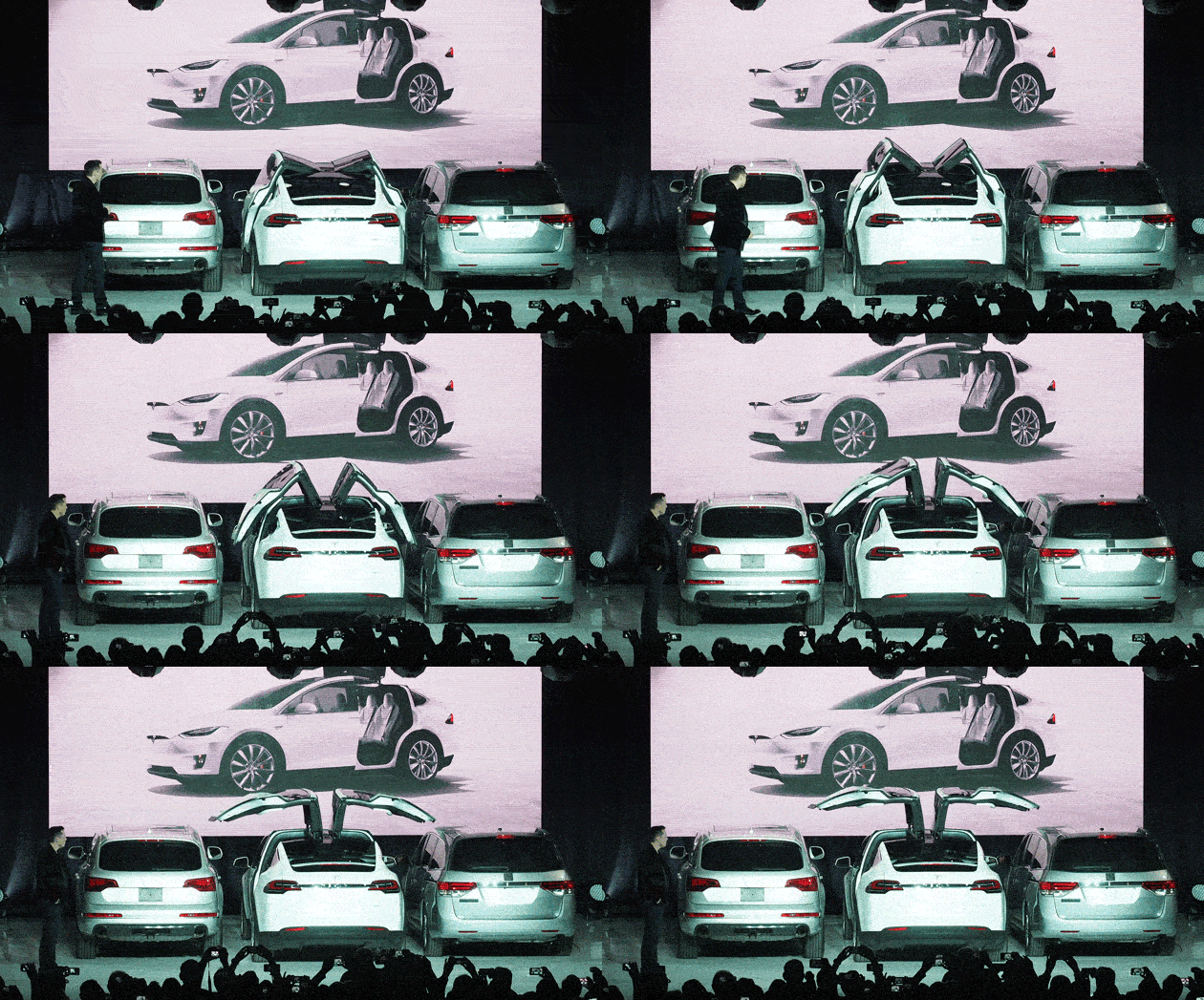
They also opened the slide doors on the minivan on one side, showing that the mini van door blocks the entryway, whereas the wing doors don't.
I think in tight spaces, the wing doors have sliding doors beat. It has disadvantages, but purely from a space usage perspective it's a pretty good solution.
They are far superior to normal car doors for this situation. You'll quite likely find yourself unable to use the driver's door, but still able to get out the back!
The site says the minimum distance required is about a foot which is reasonable given that the protruding rear view mirrors would be close to half of that.
I certainly cannot get out of either of my cars with just 12 inches of space. The door thickness alone in around 6 inches. No way is my body squeezing through a 6 inch opening in anything short of an emergency and it's very unlikely even then.
Trailers are a real pain to deal with. A lot of SUVs really aren't but this is an extreme case. I find it a bit ridiculous to call a vehicle an "SUV" if you can't put a roof-rack on.
Eh, SUVs are the new minivan and everyone knows it. If you really want to strap a kayak to the top, buy a car with a roof rack regardless of what it's called.
You can't find pictures because the car was released yesterday.
In the presentation the middle row seats inclined forward. On the Model X webpage it says the back row seats fold flat. You could definitely fit a whitewater kayak in; a downriver kayak would be tougher. Perhaps you need the configuration with two seats in the second row (instead of three) -- that should be enough room to fit a kayak between. That said, I imagine the second row seats will fold down.
My wife and I both own Mitsubishis: me, a 2013 Lancer, and her, a 2012 RVT because she wanted a crossover/SUV with "more space". We're able to fit significantly more in the Lancer. The RVT is basically a hatchback on a higher suspension and bigger tires.
All it takes is a billionaire genius with twin kids and a car company to finally engineer a real solution to the hassle of having room to put kids in the car seats.
I sure hope some of these ideas come in a slightly more affordable version. Amazing how many of the innovations are just everyday things like crash safety, air quality, blind holster your phone, trailer hitch that doesn't suck, and easier to get kids in their car seats - yet they have me drooling as even after 100+ years of mass auto production there are so many daily frustrations with cars.
In all seriousness, how does the Model X improve buckling your kids over a sliding minivan door? Never had trouble with this, I've owned a car, truck, SUV and minivan with young kids.
Biggest headache? The kids buckling themselves. The seatbelt always locks (they pull too fast), the buckles get smushed into the seat bench, and before you know it I have exited the car, just to help them put it altogether.
Out of curiosity, how tall are you? I think he said a big part of the problem with minivans is that you can hit your head on the roof while trying to lean in to snap the buckles. With the falcon wing doors, the roof flips up too. Obviously if you are blessed to be average height, that may not be a problem for you.
As a tall person, I am excited that Elon is tall and getting them to consider the problems of not being average height =)
73 inches - owned a 2006 Honda Odyssey, don't remember bashing my head ...or maybe I did and can't remember because of said bashing.
Most everything in my world was designed for someone 3-4 inches shorter than I. I kid with my wife if I ever build my own house (post kids), everything will be taller.
Yep. I love the performance of Tesla's cars, but a humble minivan already has (far less attractive) sliding doors with very large openings.
To be fair to Tesla, Elon Musk did address this around two-thirds of the way through his presentation yesterday, saying "when the minivan door is open I can't even get through that space." I suspect he'd also say the Model X's doors provide a vertical opening in addition to a side opening, which can be useful for adults in the second or third row.
On the other hand, I've driven a Honda minivan quite a bit and I can't think of any times when I couldn't squeeze through the available space when the minivan door was open in a parking lot. So there is a bit of solving a problem that may not be very much of one.
The Model S (and presumably the X, at it uses the same wheelbase) is a _very_ wide car, wider than most minivans, so I suspect your Honda minivan is just narrower and won't run into this problem as much as those that drive the model X (or the S drivers today)
I am confused by the fancy doors. The driver door seems to open as usual, no? Doesn't that mean that in a tight space I am no better off than with a regular door ?
"SUV" doesn't mean anything specific. Look around you on the road: SUVs are the new minivans. People buying new cars today grew up in minivans, and the last thing you want to drive is the thing your mom drove. Give it another 20 years and I bet we see the minivan come back in style as kids growing up with SUVs now think of them as the soccer-mom-mobiles that they are.
It is a marketing term that means "we're going to sell you something you'll probably think of as a big car, but which only has to meet light truck standards". There was a time when something like a Jimmy or a Bronco was distinctly downmarket and likely to have utilitarian rubber floor mats rather than carpeting. (Yes, there were some "gentlemanly" vehicles in the general class, like the Range Rover and the Wagoneer, but most were all business.) CAFE regulations didn't include trucks, so we were sold trucks instead of cars. Now people want trucks that look like cars from the inside.
Actually, a lot of my whitewater paddling friends favor minivans over SUVs for a combination of being able to haul a lot of gear and ease of shuttling people.
The SUV term has been steadily stretched to cover vehicles that are less and less designed for anything other than a paved road and have less and less storage space.
SUV = obese car. This is an obese car, therefore its a SUV.
There are snarkier ways, like a car is a vehicle where 75% of the seats are empty almost all the time, whereas a SUV is a vehicle where 85% of the seats are empty almost all the time, so the cutoff is around 80% usually empty.
Slightly more seriously a SUV can be defined as a car that has a towing rating approved by the mfgr. I've never owned a car where the mfgr approves any towing weight at all, and I've never heard of a SUV that can't at least tow some minimal weight.
Counterpoint: my Volvo has a 1540lb towing rating approved by Volvo. It is not an SUV.
The lines are ambiguous. "SUVs" nowadays range from minivans that don't look like minivans (crossovers) like the Ford Edge to actual SUVs like the Jeep Grand Cherokee. My personal definition is if you can take it off road on a trail with no mods and there is no bed, it's definitely an SUV. If you can't realistically take it on a trail, it's a crossover.
The same very, very unadjustable, very sparse seats that the model S has. I won't provide reference [1][2][3]'s here, but there are absolutely much, much better seats with many more adjustments available in the lower end 3 series / A4 / C class cars ... and this is a car with a 6 figure price tag.
The seats. I have never understood the seats in the model S (and now X).
edit: OK, so another thing ... the stick-on spoiler has always annoyed me on the model S. Very cheap and lame. I see that the new Model X has a retractable spoiler ... when will that arrive on the Model S ?
Model S owner here. Love the new X but two things disappoint, in terms of design: the new front-end is ugly, especially the white version of the car. And the long straight wire that runs from the top of the car to the auto-pilot hardware and rear-view mirror, planted in the middle of the windshield's sea of glass, is hideous. I can't believe Elon let that slide. Jobs would never in a million years have allowed that stupid wire to obstruct the view. Worst case, hair-thin electric conductors embedded in the glass, something. But that wire's got to go.
Really like the car. Just a tad concerned that the huge front window will break/shatter a lot if you hit some debree (or there is just a lot of junk on the roads where I live).
I'm mostly wondering if you can open the falcon doors by hand or if it has to be done by computer. Seems kind of slow to me. Not to mention emergency situations.
If I had a family, and disposable income, this would definitely be my vehicle of choice. That said, I liked this bit: "There are three modes: circulate with outside air, re-circulate inside air and a bioweapon defense mode that creates positive pressure inside the cabin to protect occupants."
Warships and armoured vehicles have used internal overpressure since the 1950s, it's a basic aspect of NBC defence. And it was one of the reasons NATO warships were so sparsely equipped with portholes, no point having overpressure if Seaman Jones can leave a window open.
Anyway, it really shows to me what a completely pointless vehicle this is. Yes it's a technical tour-de-force, but it does nothing to move EV adoption forward. The people buying it will primarily be existing Tesla or Cayenne Turbo owners, not lower-middle-class wage-commuters who produce our daily pollution. Only slightly more useful than car-show concept vehicles in that regard.
If Tesla were to attack the low-end, where the majority of car sales occur, then I'd pay attention. But the proft margins are razor-thin there. Low-end being Fiesta / Polo territory, looks like we'll have to wait for the Chinese manufacturers to move in there.
> If Tesla were to attack the low-end, where the majority of car sales occur, then I'd pay attention.
Then you are not paying attention. Tesla strategy is to start at the top, with higher margins and lower volumes (meaning lower costs) and gradually move down. According to Musk the Model 3 will be available next year and cost $35k.
Not sure they can deliver. Their house-battery product was relatively cheap. But it was also ill-conceived and impractical. Largely because of capacity. It was more of a UPS than a house-power-plant, because of the extremely limited time it could run the whole house.
Consider: a large fraction of the Tesla car cost is the battery and associated systems. There's a minimum range that's considered acceptable, and even their current models barely achieve that. Using smaller/cheaper batteries to make the car cheaper will violate the minimum-range requirement. No-win here, so far.
The doors actuate on two hinges and have sonar to detect both horizontal and vertical clearance during all movements. They will adapt to both low ceilings and low side clearances, and need only about a foot of space on either side of your car to open. In the video, Musk talks about garages with small ceilings and then shows a video of the doors opening in one. If there's enough space for you to pull in and get out of your car now, there's almost surely enough space to open the doors in this one too.
If there is too much snow on the roof to use the falcon doors then you should have the driver get in up front, push on the accelerator for 4 seconds and then push on the brake. Now you can circle back and get the kids.
Normal people don't all buy new cars, and they don't buy the average new car. They either buy used or they buy an entry-level new car, say in the 25k range at most. You can get a freaking Audi for 35k. Audis are not entry-level cars for normal people, they are luxury cars.
They are following their roadmap, the Model 3 is next at $35k. Not cheap, but certainly affordable for many. Average new car price is $33,560 [0], so it's pretty amazing if they can hit that price with an electric vehicle. Also amazing considering Tesla shipped their first car in 2008 and have completely rejuvenated the electric car market.
Are there any advantages to the gullwing doors compared to sliding doors other than "sliding doors aren't cool"? They say "minivan style sliding doors open at most halfway", but there are plenty of minivan doors that open quite wide.
Looking at the video, it's quite clear that accessing the third row of a full size minivan is quite a bit easier than accessing the third row of a Model X.
Can anyone explain me why Tesla as a silicon valley company is lagging behind in autonomus driving?
BMW, Daimler and many more have already working things in much cheaper cars.
Edit: can't understand the down voting. Criticizing Tesla isn't endorsed here?
As i mentioned there are many car makers which have these things since years. And they are much cheaper. Just look at the websites what you can buy from BMW, Daimler etc.
Tesla had (and has) to solve a difficult problem. The manufacturers you mention are all using standard internal combustion engines. Is it surprising that the can focus their attention elsewhere?
Making a good electric car is a HUGE challenge (see: the entire history of electric cars pre-Tesla). They need to keep their focus there. Once Tesla is delivering on the affordable mass market Model 3, then I think they'll turn up their focus on self-driving.
That's the thing that first came to mind when I saw the pics of those doors opening... sure they look cool, and probably work ok if you're outside away from anything, but seems like there are plenty of situations in which they just wouldn't have the space to open enough to allow exiting (at least without crawling on the ground).
Examples might be a small garage or a parking space hemmed in by other vehicles.
Sliding doors take almost no extra space to open fully, and even normal swing doors can be used when partially open (the exact degree of course depends on how skinny you are...).
The video shows it opening when parked so closely to two vehicles that a person can barely squeeze through, and when parked in a garage with a low ceiling. One of the cars they parked it next to is a minivan with sliding doors, which you couldn't get into when open, while you could get into the X. As Elon puts it, paraphrasing, "this is the best aperture possible".
Did you watch the unveiling event? It is a dual hinged door and can do some pretty trick stuff with ultrasonic sensors to alter hinge and lift angles to open in pretty tight spots.
Great, bioweapon defense mode so the Masters of the Universe can all hop in their cars and safely leave a big city under bioweapons attack, while the rest of us lie gasping on the sidewalk...
Bioweapon defense mode in luxury vehicles is the first step towards bioweapon defense mode in commodity vehicles.
Also, it's really for polluted cities, skunks, and driving past freshly fertilized farms. I don't think anyone expects to active bwdm for an actual bioweapon threat.
Not really. The average family + 1 friend "just" fits in a 5-seater SUV. Having a 7-seater means being able to bring along more than one person. "Hey, we can all ride together!" becomes a very normal part of conversation. Bundle that with the fact that everyone can ride together and everyone saves 100% money on gas, well, it's a no-brainer people will start carpooling more since there are more seats.
Yes, not that many have a lot kids, or kids with friends, or visiting grand parents... :)
But yes it is a niche, but not small. There is a lot of 7 mvp cars where I live, Vauhall Zafiras, XC90s etc. And in most of these the third row seats are cramped pop up seats.
"Most" is a bit of an overstatement. (Fortunately) many SUVs still don't have third-row seating. To be honest, I find the shift from minivans--which do a much better job of seating a bunch of people--to SUVs that consume a lot of interior space with seats a bit unfortunate.
"Most" as in the direct competition to the Model X. Yes, some manufacturers have large 8 seaters (Yukon, QX56, Pilot, Sequoia) but those are all massive vehicles and I don't think the Model X is competing with those. I think the competition is the smaller SUVs such as the Q7, SRX, MDX,GX, X5, GL550, and XC90, all of which are 7 seaters.
The pilot is pretty popular as an 8 seater. It's rear seats fold flat giving you a reasonable cargo area when you don't have the 3 people in the third row. The seats themselves aren't very cramped, but getting in/out is not great.
The $30K vs. $100K isn't the real comparison though. The pilot starts at $30K, but goes to $48K. The MDX is only 7 seats, but is also basically a Pilot for $58K.
A Model X should come in around $80K, assuming it is just a bit more than a comparable Model S, which starts at $70K.
I think one of the things the Model S has done is get someone who might spend $50K on a car to spend quite a bit more than otherwise, because of its coolness factor. I think the Model X will do the same thing, and get people who would otherwise drive something less expensive (in the $50-60K range) to reach upwards to $80K or so because of the cool/wow factor.
I've got a Pilot now; and like it. I need to see the X in person. Right now the falcon wing doors are not a selling point for me and lack of rear-seat entertainment system make it less compelling than it otherwise might be for the money.
I can't wait to see how well they do in the Paris-Dakar Rally, because of course they'll back up all their hype by going out and handily beating the competition, just like the Tesla Model S completely dominated Touring Car racing and showed the GT class at Le Mans what innovation is all about. /s
What I'm talking about is the long-running automotive tradition - a useful one - of subjecting an automobile to competition by which to identify weaknesses, opportunities for improvement, and publicly showing that the vehicle is capable of rising above every-day use scenarios through its engineering prowess.
Using your logic, why is Aston Martin in GT / ALMS racing? Why is Mercedes Benz in F1 racing? Why is Volkswagen in off-road racing?
The list goes on and on and on. The only time Tesla has gotten to a podium is because Elon Musk paid for it to be there for the press. I suppose it makes sense not to take Tesla endurance racing, because it'd be embarassing.
So with the falcon wing doors you couldn't open up passenger seats in your standard garage. I'd suspect people who could afford this wouldn't have a standard garage anyways though.
This is one of those things where if what you said is true, then the engineers would be brain-dead morons. I suspect it's more likely that it does work in most standard garages, than Tesla's engineers have never thought to try it in a standard garage.
A standard garage seems to have quite a bit over two meters in height, which should be enough to open the doors. They also have sensors and adapt both hinges to obstacles next to and above the car.
Let's say you take your AWD SUV up to your cottage in the mountains, or to a ski resort, and you've got 6" of snow on top of your car. What happens when you open the doors?
He showed it in a standard garage setup, but I would fear my garage door opener would be in the way... Hopefully the ultrasonic sensors would see the garage door opener and not hit it.



This, however, really makes me wonder WTH is going on there:
HEPA Air Filters "There are three modes: circulate with outside air, re-circulate inside air and a bioweapon defense mode that creates positive pressure inside the cabin to protect occupants."
EDIT: Very fair points about driving by skunks or nasty smells. The naming is what gets me though. If it was called Noxious Smell Defense Mode or something, that would make perfect sense. Looking at Wikipedia, a "medical grade HEPA filter" can filter out 99.97% of particles at least 0.3 micrometers in diameter. Dunno if the Tesla filters are also using UV irradiation, and I also couldn't find any documentation of the particulate size of skunk odor, so it will be interesting to see documentation on what exactly it can filter out.
EDIT2: Watched a bit of the intro event video. Looks like it has a specific set of activated charcoal filters for sulfur type particulates, so certainly seems like it could be a skunk odor killer. :)