A flood may well be the best explanation for the Atlantis myth, a flood may also be the best explanation for the Noah/Utnapishtim myth. However since we know of many prehistoric floods, it's pure speculation to arbitrarily link them both to the same flood event.
There was only one flood event that affected the entire world, simultaneously, permanently inundating millions of square miles and displacing people who had lived on those millions of square miles for tens of millennia.
It was identically the the same flood event that sank Doggerland. Whether and which legends may be proven to trace to it are of overwhelmingly less moment than the global and indisputable fact of its occurrence, and its impact on ancestors of every person alive today.
Fear of being accused of promoting Atlantis historicity blocks progress in archaeology rather as much as the inaccessibility of the inundated sites.
> There was only one flood event that affected the entire world, simultaneously, permanently inundating millions of square miles and displacing people who had lived on those millions of square miles for tens of millennia.
Do you have sourcing for this, or somewhere I can follow up on the idea? I'm familiar with the idea of there being a single event for many of the flood stories of Mediterranean area, but not so much the world, or the evidence of it, and it's and interesting idea.
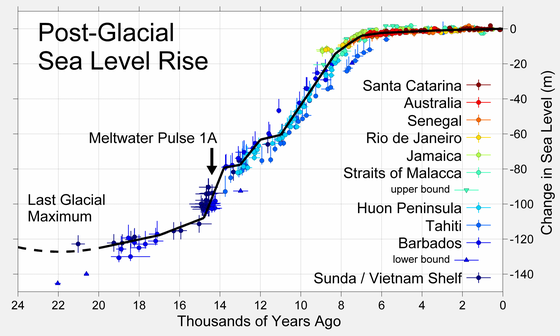
[1], particularly "Past Changes", and [2], showing the actual sea level vs. time over 24ky. The Younger Dryas period coincides with the rise from 78 M to 65 M below present sea level. The rise from ~15kya to ~14kya, "Meltwater Pulse 1A", was more dramatic, from 110 M to 80 M below.
Current sources [0] put the (final) flooding of Doggerland as late as 6500–6200 BCE (based, in part, upon the dating of archaeological finds from the region) — which is much later than the Younger Dryas — with suggestions that its submergence may be connected with the Storegga Slide (a big coastal landslide off of Norway).
Of course this doesn't necessarily discount the possibility of some earlier flooding event which may have had global impact — but it does rather imply that it wasn't a- or the- global flooding event that caused the final demise of the low lying lands that made up Doggerland.
On the topic of the end of the Youger Dryas period, these links may also be of interest to a neophyte scholar of that topic: YD overview [1], YD impact hypothesis [2].
The YD impact hypothesis has historically been somewhat contentious — as [2] notes in its criticism section — but there is some interesting modern research into the topic, which seems to support the hypothesis. Although it is the subject of ongoing dispute, claims and counterclaims.
Antonio Zamora [3] has been producing original research, some papers, a book (which I've not read), and a whole set of ongoing videos on the topic [4] — many of which focus upon the origin of the Carolina Bays (and similarly: the Nebraska Bays), which he claims are likely caused by debris from a comet impact on the Laurentide Ice Sheet, ~12.9kya.
See also the work of Richard Firestone — search for 'Richard Firestone comet' to find his paper, criticisms of it, and some responses from him.
Being British, and somewhat interested in Neolithic archaeology, I find the history of Doggerland to be quite fascinating — it has also been the topic of a Time Team episode, which is worth a watch ("Britain's Stone Age Tsunami" and/or "Britain's Drowned World" - can likely be found online somewhere?).
But I also find the Younger Dryas Impact Hypothesis to be quite a fascinating topic also — in part because it is somewhat on the fringe of our current understanding and knowledge, whilst perhaps not being fringe science per se. YMMV, obvs ;) — But clearly that period was kinda the start of our 'modern' known history, being roughly the start of agriculture (see the Fertile Crescent, Gobekli Tepe, etc.), the Neolithic ('new stone') age, etc., and also approximately coincides with the die-off of the megafauna and the Clovis culture. It was clearly a period of some truly great changes, across the globe.
On that topic — YD, and the YD impact hypothesis — one may or may not find the work of Randall Carlson [5] to be of interest. He has much to say on this matter, but oftentimes some of his timelines and dating may be questionable (e.g. some of his flood hypothesis tales don't tally with work of geologists such as Nick Zentner — who has some truly excellent geology lecture videos on YouTube [6], if that's your bag — he is truly engaging, informative and funny).
Carlson also discusses various other esoteric topics, including mythology, symbolism and ancient mysteries, which some might claim otherwise weaken the views he expresses. But personally I quite like the guy, and all of his subject matters.
Doggerland, like other lands cited, progressively disappeared beneath the waves over centuries and millennia. When each bit was lost depends on its altitude, so the curve of sea depth in the graph over 24ky does not match the rate that any particular area disappeared.
The Younger Dryas was a period in the middle of the process. The timeline of the Impact Hypothesis places the strike at its beginning, resulting in a huge meltwater pulse that disrupted the Atlantic Ocean current system. The first Gobekli Tepe was built precisely at its end, but no coinciding geophysical event has been identified.
Current work suggests the impact causing the Carolina and Nebraska bays occurred much less recently, maybe 600kya.