The "unreplaceable RAM" will only get "worse" from your perspective. Meanwhile, many people, myself included, are very happy to have better efficiency/performance by co-locating the all of the silicon.
Once Apple invests in 3D chiplets, it is very likely that RAM, CPU, and GPU will be all be the same component. This is also likely necessary to eventually get memristors into commercial SOCs. I think maybe even the SSD might get pushed into the chiplet if they can manage the 3D real-estate. Ideally, even colocate the UWB and cellular modem[1] onto the single 3D chiplet or maybe have two SOCs one for compute+storage and one for wireless.
Previously, RAM, CPU, and GPU were all connected by the motherboard with copper(or similar) based wires. Because the wires can't overlap on the motherboard, there could only be X wires connecting the CPU/GPU to the RAM. To replace the RAM, either disconnect it from the slot or de-solder all X wires if needed, then replace the RAM chips.
Based on what I've read the M1 is a single MCM using a silicon-interconnect fabric, where the RAM and CPU/GPU are to each other's left and right[1]. This reduces the length of the wires a lot, which is a lot more efficient and improves performance. However, it still means you can only have X "wires" going from the CPU to the memory because the "wires" can't overlap. In theory (with very expensive equipment), you could "disconnect" all X "wires" and "pick up" the RAM chips and swap them for new ones.
A 3D chiplet[2] has the components stacked on top of each other i.e. the CPU/GPU is on top of the RAM, i.e. the RAM is below the CPU/GPU. Technically you could keep the legacy number of "wires", i.e. X "wires" between the CPU and memory, however, because the "wires" now go up and down (rather than left and right) they can never overlap and you can now increase the bandwidth by having X100 or X1000 more "wires" between the CPU/GPU and RAM. While, theoretically you could still "disconnect" the up and down "wires", because there are sooo many more "wires" between the stacked chips everything gets more difficult, and replacing them gets even even more expensive. At which point, from my perspective, basically puts them in the category of "single integrated circuit" or "monolithic integrated circuit" (which is probably a better description than my previous use of "single component").


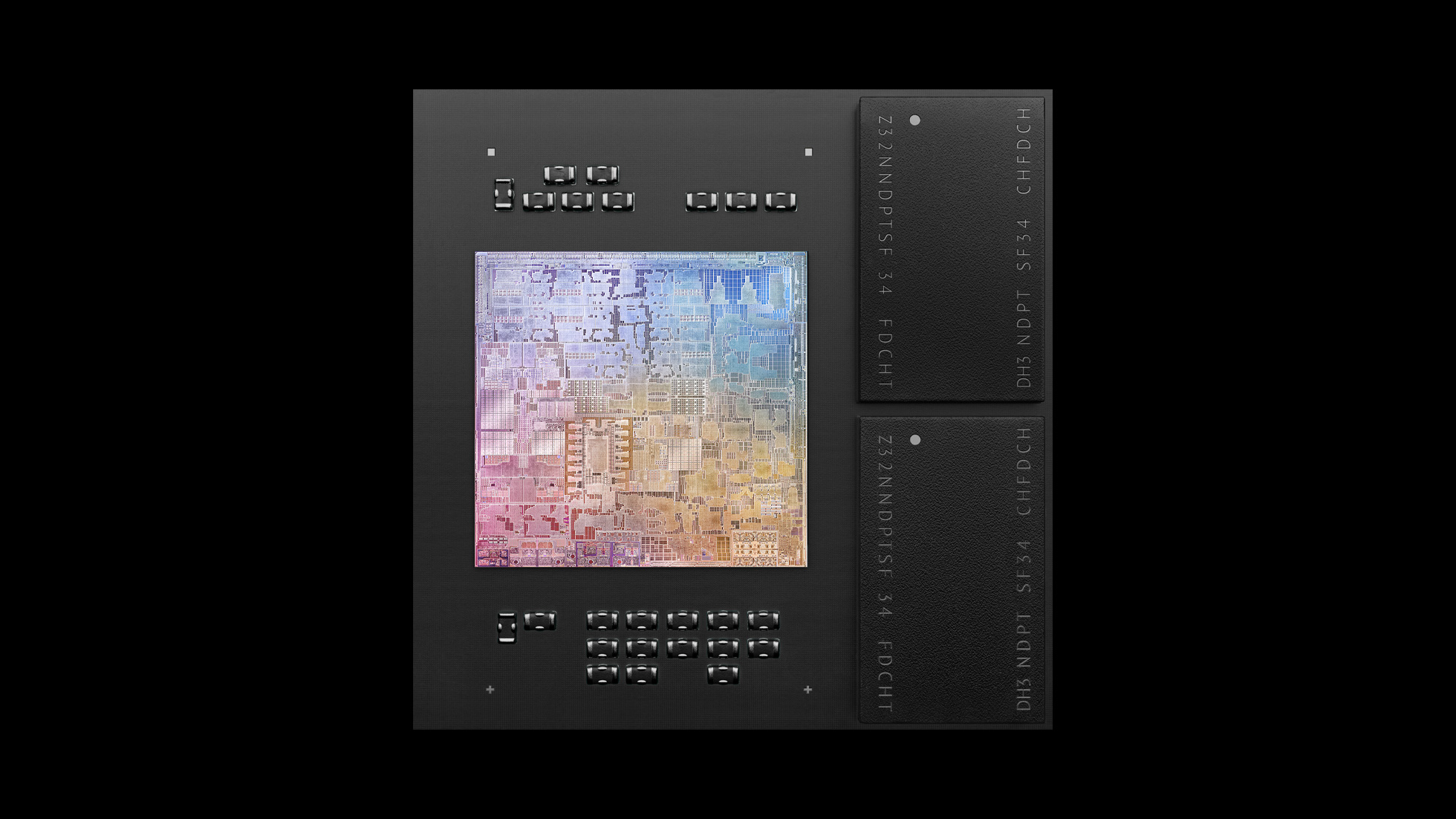
Once Apple invests in 3D chiplets, it is very likely that RAM, CPU, and GPU will be all be the same component. This is also likely necessary to eventually get memristors into commercial SOCs. I think maybe even the SSD might get pushed into the chiplet if they can manage the 3D real-estate. Ideally, even colocate the UWB and cellular modem[1] onto the single 3D chiplet or maybe have two SOCs one for compute+storage and one for wireless.
[1] https://www.bloomberg.com/news/articles/2020-12-10/apple-sta...