I posted about this before and one commenter said something that stayed with me. Something along the lines of if all the people that feared having children due to climate change didn't have children, the only people having children would be those who had no fear of climate change. This would obviously affect the overall perspective of those in our society and skew them toward non-believers who don't push toward action on climate change.
> if all the people that feared having children due to climate change didn't have children, the only people having children would be those who had no fear of climate change
How correlated are the climate views of the parent and child correlated in the West? (I’m also sceptical the real reason isn’t economic insecurity.)
Long term, I don't think this will matter though. If your house is underwater, your farm stops surviving winter, or your heating/cooling costs become untenable, you'll be force to change how you live regardless of what you believe.
That's happening right now though, and people are still fervently climate change deniers. When it comes to conspiracy theories or cults, no amount of evidence or rational thinking is going to change someone's mind. It's not a tool they use to perceive the world.
Indeed. People who will believe anything instead of facing change will just get MORE ANGRY as that reality forces it's way into their life. They will hit back harder, become more radical, and be willing to push for harsher measures against whatever scapegoat they have found.
I think we’re still at the phase where people aren’t being affected enough personally. Once Florida is actually struggling with flooding to the point where thousands are forced to lose their homes, I could see some of those people start to believe.
> Farms that stop surviving winter due to it being warmer?
Is that all you think climate change does? Make the whole planet uniformly a degree or two warmer?
It changes climates in a variety of ways, commonly making wet areas dryer, dry areas wetter, and producing larger temperature variations.
Here in Florida, the last two years have been some of the worst orange harvests on record due to frosts in the winter. These cold snaps are largely driven by the breakdown of the polar wind currents.
> underwater houses whilst you're at it.
Miami here in Florida recently had to dedicate billions of dollars to installing new water pumps because of the increase in flooding in the last decade. The problem is worsening every year for South Florida: https://www.miamiherald.com/news/local/environment/climate-c...
Local climate change happens constantly. There is no scientific evidence that global warming is enhancing variations about the mean increase, which is 0.13C per decade for the global troposphere[0]. Local climate change, especially extreme year on year changes like in California, is not noticeably affected by global warming, and thereby not by the human contribution to the global CO2 increase.
The frosts the last few years have been from arctic cold blasting south, which is directly attributable to the weakening Polar vortex [0], which is directly linked to higher global ocean temperatures and sea ice loss [1].
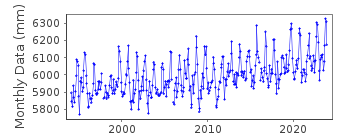
Also, do you really find that study credible? "tide-induced events increased by more than 400%" in one single year? Sea level rise is a slow and steady process, but these guys are claiming it tripled in the span of a single year. That hasn't been reported anywhere else.
The plot you posted shows a clear growth over the last 20 years.
> Also, do you really find that study credible?
I just looked for a local study. In either case, South Florida just this year had "once in 100 year" floods. At this point I would need studies to prove climate change isn't a key driver.
Yes, but that's not what I said. Sea levels do rise globally at a slow rate, but it can also be offset by the land itself rising and falling (isostatic rebound), by minor changes to instruments (because the actual changes we're talking about are tiny), temperature changes affecting the volume of the ocean etc.
In that particular city and beach, you can see that tides went down between 2000-2005, then remained more or less stable until 2015, then went up a bit and stabilized at a new level. CO2 levels meanwhile go up very steadily. This data clearly doesn't indicate something CO2 driven given the various trends including declines that have happened within the time since the gauge opened in 1995. These look like natural changes, which are expected because especially when zoomed into these tiny differences everything is always changing.
In either case, South Florida just this year had "once in 100 year" floods
If they happen every 100 years then why is human CO2 emissions to blame? Even climatologists don't claim there was much CO2 impact in 1920 or 1820.
What if your house wasn't buried... but the increased sea levels have made your pacific island inhabitable? How much water and food can you afford to ship to your perfectly safe home?
Hawaii and other tropical paradises do ship in a massive amount of products they consume, with most of their actual industry being tourism. There are problems with global warming but I wouldn’t rank this as #1
Results highlight a net increase in land area in Tuvalu of 73.5 ha (2.9%), despite sea-level rise, and land area increase in eight of nine atolls.
Note how dishonest the scientists are. Their abstract starts by saying "Sea-level rise and climatic change threaten the existence of atoll nations" before getting to the part just quoted where they admit their data says the islands are getting bigger.
This kind of brazen dishonesty is pervasive throughout modern academic science. It's not just the "lab leaks are impossible" crowd, you see it in many fields. Data tables don't match summaries which don't match abstracts which don't match IPCC reports which don't press releases which don't match TV news. Here, climatologists used picturesque Pacific islands to motivate major social changes without even bothering to measure whether their claims were true or not up until very recently. And when they did, and discovered the claims were not true, this fact was promptly buried and given no coverage. The misinformation gets repeated - which isn't your fault. After all, how were you to know?
I know you think this is some big gotcha that indicts the entire concept of climate change, but it is really just you desperately finding some factoid that backs up your idea where you can't see the forest for the trees.
The climate is clearly changing and it is really causing massive disruptions and costing trillions of dollars. The evidence is overwhelming and it is impossible to ignore at this point. This little gotcha doesn't change that or matter at all.
You can keep saying it, but that doesn't make it true. The global troposphere has increased its temperature by only 0.52C in the last forty years. Local climate change is a reality and happens continuously. Changing humanity's CO2 output won't significantly affect it. The "trillions in cost" is due to civilization putting pressure on marginal areas, like Florida, by overbuilding directly on the hurricane-prone coastline and on land that is actually subsiding. Global sea levels are rising about one foot per century during the top of the current interglacial era. Here in New England, we handle nine foot tides daily.
sigh. You can see the global temperatures rising. Wildfires in Canada were out of control this year. Last year it happened in Australia. These temperatures and this level of fires aren't normal occurrences.
There are 13,458 florida keys homes sold recently according to Zillow. The prices for the homes are almost at record highs. The homes bought from the "Voluntary Home Buyout Program" were for homes impacted by Hurricane Irma not by rising sea levels.
Solar output has been decreasing as global temperatures increase.
Over 20 years ago scientists weren't just predicting temperature increase, but also making a wild prediction that global temperatures would not revert back to the mean and would increase well beyond our max temperatures. That has happened.
You can't be sure at all that global warming is false based on the available information. If you are wrong and we do nothing humanity will cook.
I don't personally want a leopard to eat my face. I don't spend my whole life doing climate research. The people who do spend their lives on this say this climate change is happening, and they were right 20 years ago predicting the global temps would increase over our previous max. Idk if they were right exactly with magnitude, but their predictions were more accurate than the other side of this debate.
The people saying global warming wasn't going to happen were wrong. They are heavily funded by the people releasing all the greenhouse gasses. They lack credibility and they have a worse track record.
Although there is erosion near Tebunginako village centre, there is an accreting area north of the village centre where trees are systematically being planted to reclaim the accreted area. This situation implies the natural northward migration of a sand bulge along the beach
The article presents this as a narrative about climate change because that creates clicks, but it's misinformation. The fact that most of the Tuvalu islands have grown over the past 40 years shows that climate change is not sinking the Pacific Islands, even if some very small ones do disappear or move due to natural forces.
From a quick look, your other links aren't more reliable unfortunately. These sorts of islands are prone to erosion and movement of the coastline, which would occur regardless of whether humanity was here or not.
But it's our actions that are causing the erosion. Our anthropogenic climate change has caused these coastlines to change. People are being affected by our actions. Over just 200 years instead of 10s of thousands.
Please prove that it's human actions that cause coastal erosion, because I'm pretty sure coastlines have always been moving and shifting in response to erosion. That's how beaches are made, isn't it?
Also, even if that were to be true which I doubt, so what? They were supposed to sink beneath the waters as they rapidly rise due to melting polar ice. That was the doom scenario that was used to motivate people, but it hasn't happened. In a rational world that should cause us to toss out the other predictions made by such "experts", not try to retcon what was said to fit whatever actually happens. Especially because a change like "maybe a beach migrates northward a bit in some islands, others grow a bit, others shrink a bit" is nowhere near important enough to make disruptive changes to the lives of everyone on the planet.
The supposed flooding of low lying Pacific islands have been one of the primary emotional stories told by environmentalists, governments and the UN for decades. The poor innocent islanders having their homes destroyed by massive sea level rises created directly by rapacious westerners in their gas guzzling cars.
The falsification of these claims is therefore no mere "factoid" or "little gotcha". It means all the people and institutions who made these claims were wrong and wrong whilst asserting 100% confidence in what they were saying. It is not just a falsification of a scientific hypothesis but the falsification of their self-proclaimed expertise too.
Now think about how many other "gotchas" are lurking out there in the science. Because for sure this isn't the only one.
In reality there is no evidence for "massive disruptions costing trillions of dollars". None. Zero. It's a fiction that's been made up out of whole cloth and now way too many people just can't let it go.
> This would obviously affect the overall perspective of those in our society and skew them toward non-believers who don't push toward action on climate change.
That's not at all obvious. Children are expensive to have and raise, both in money and time. That gives those without children an advantage when it comes to accumulating power and wealth and influence. That might be enough to counter the influence of the parents, especially if kids continue to be heavily influenced by social media.
That's been the trend regardless of what metric you choose, people with higher income have fewer children, more educated people have fewer children, etc.
The data reported by that study doesn't even support the hypothesis, both the hybrid and adjusted fertility rates of women with <12 and 12 years of schooling are shown to still be higher than those of women with college and advanced degrees. Unless I'm misinterpreting something all this suggests is that there's a partial reversal, not an upheaval, of one of the most widely studied trends in fertility worldwide. The study does point out that childcare costs have outstripped wages of women with a high school diploma or less education though, which is alarming.
If idiocracy (https://www.imdb.com/title/tt0387808/) ever happens (or has already happened ;-), it is primarily because of the "smart" set doing exactly this. I was shocked at how few of the students in my evolutionary biology graduate program were planning to have kids. Having two kids or less is the definition of unfit parents (unless you are propagating clonally).
Humanity has to cope with these little things called ethics, morality, and empathy. While it may be the definition of evolutionary "unfitness" in the scientific sense, the ability to exercise foresight, to predict the suffering coming from one's behavior, being averse to bringing a life into the world without having a reasonable answer to the issues you can reasonably forsee, and having the will to act on said understanding are all socially desirable traits that also fly in the face of natural selection.
In a conflict over livability and finite resources unrestrained growth is a losing game for everyone, guaranteed. The only variable is when.
Given the tech already exists for genetic screening, IVF, cloning, etc., if that scenario ever looks like[0] a real risk I'm sure we'd very quickly rehabilitate the whole "eugenics" brand.
[0] Perception is everything: It's very very easy to ignore the uncomfortable bits of history, no matter how important the lesson
Of course beliefs aren't passed down genetically, but they are likely to be passed down through a parent raising a child. It happens with adopted children too. For example, if both of your parents are Republicans, you are much more likely to be a Republican than if both of your parents were Democrats.
> A friend with similar opinions worries that the Quiverfull movement will result in Christian nationalists taking over.
I'm less worried about that, because I grew up in that subculture - my parents were early adopters, before the label had been coined - and the extreme religious belief doesn't really stick. So far as I am aware, none of the kids in my cohort have followed in our parents' footsteps. Many of us abandoned religion entirely, and those who kept with it have found more conventional expressions; none of us have gone on to raise enormous families of our own.
It makes sense, when you consider why people are drawn to join extreme religious movements in the first place; of course the kids they raise are going to have a very different experience and perspective on life, and they're likely to go looking for what they need in a different direction.
Turns out "regular" american Christianity didn't need an excuse to push for Christofacist nationalism. It's attempting to take hold literally right now.
I didn’t describe “doing things to help other people” in general, but particular pathologies disguised as those.
There are many pathologies that pose as “doing good things” — and I think it’s interesting that you didn’t respond to my particular examples, but a strawman.
We live in absolute best time in human history to expect your kids to have a good life. Climate change is tiny compared to the technical and medical revolutions humanity has experienced.
The problem is that everything is relative to where you are. Humanity has experienced rapid and nigh-unending improvements in quality of life, from ancient history riiiight up to the present. People are now looking into the future and the only apparent path forward involves a decline in that quality of life.
It might be a quirk of human psychology to not be able to really "feel" the difference between relative and absolute, but it doesn't matter. Its just how people see the world.
> People are now looking into the future and the only apparent path forward involves a decline in that quality of life.
I'm not sure I could agree with that statement. Regarding global warming, sure, although we can't be certain to what degree. But many other aspects, such as treatment options, simply weren't available before - and for sure many other will appear (as will new diseases, but still...).
> People are now looking into the future and the only apparent path forward involves a decline in that quality of life.
There is always something to worry about Peter Lynch said in the 90s. And yes I worry about climate change. It’s a big problem. However, technology innovations as a whole go up exponentially since the industrial revolution. I don’t see clear evidence why that would stop now.
Because having a neat smartphone or a fast GPU completely counteracts the rising cost of food, housing, the rising blatant inequality and utter lack of political will to address it, the lashing out of an entire section of the population against any "others" that were born different and a rising animosity towards education, reality, and intellectuals of all stripes.
To the chagrin of hyper capitalists and tech boosters, being able to run a million computations a second in your pocket is NOT a replacement for affordable food, housing, and a society that believes in helping other people. Candy crush doesn't fill your stomach. Cheap entertainment doesn't stop you from getting arrested for sleeping on the sidewalk because you were thrown out of your tent on the side of the road. Different products and market segments do not replace each other in the majority of cases.
Previous generations could live a full life on a single, boring, average salary, including paying for occasional entertainment and splurges. Microchips don't magically unfuck the rest of the economy, and arguably have only worsened income inequality, the imbalance of power due to individual wealth, and the hatred of the destitute and "have nots"
In the end - there's basically no serious scientist saying the world is going to be destroyed from global warming. There's going to be more extreme weather. Life in hot areas in third world countries is going to suck more.
But add up all the deaths and inconveniences from this, assume it gets worse, and the world is still incredibly better off than it was in the 1980s.
Nothing will "destroy" the earth because that's a stupid bar to pick. A few hundred thousand people running from bad situations is helping to drive a new push towards actual facism. If democracy crumbles under the hatred of outsiders when millions of people have to leave india and similar places because you cannot survive without a base level of wealth, I would consider that "OUR world destroyed"
Almost definitionally so, because the world isn't going to be destroyed from global warming. Unfortunately the "scientists" we actually get aren't serious and many of them say exactly that.
James Hansen told Congress on Monday that the world has long passed the "dangerous level" for greenhouse gases in the atmosphere and needs to get back to 1988 levels. He said Earth's atmosphere can only stay this loaded with man-made carbon dioxide for a couple more decades without changes such as mass extinction, ecosystem collapse and dramatic sea level rises.
"We see a tipping point occurring right before our eyes," Hansen told the AP before the luncheon. "The Arctic is the first tipping point and it's occurring exactly the way we said it would." Hansen, echoing work by other scientists, said that in five to 10 years, the Arctic will be free of sea ice in the summer.
Ten years later in 2018 there were no mass extinctions, ecosystem collapse and the Arctic had plenty of ice in summer. But the world is still going to be destroyed, this time within 5 years.
We Have Five Years To Save Ourselves From Climate Change, Harvard Scientist Says (2018)
The chance that there will be any permanent ice left in the Arctic after 2022 is essentially zero," said James Anderson[, a Harvard University professor of atmospheric chemistry]. "Can we lose 75-80 percent of permanent ice and recover? The answer is no."
The Arctic is still full of ice, there is currently more than there was at this time in 2012 and we are still not toast.
No one thinks the world is going to get 'destroyed'. You're really donwplaying the 'more extreme weather' and life in hot areas is 'going to suck more'.
More extreme weather doesn't mean you can't go outside and play. It means mega-droughts. It means crop failures. It means extreme flooding. It means paying more for everything as more people fight over fewer resources. Wealthy countries will be able to somewhat deal with drought in parts of their territory, but poorer countries will experience more famine and hunger. More people will die from heat-related illness.
>But add up all the deaths and inconveniences from this, assume it gets worse, and the world is still incredibly better off than it was in the 1980s.
In the 1980s, an American with a high school education could expect to make a good living and maybe have a stay at home parent.
Most modern Americans wont be able to buy a house much more raise a family on a single income. Everything is getting rapidly expensive while wages stagnate or decline through inflation.
In the 1980s we had double digit inflation and a high unemployment rate. Things were not better then, especially if you weren't a white male. The rent to income ratio is at about the same level (30%) as it was in the 80s.
There is a lot more to the story than that. How many people entered the workforce in the 80s with more than a years salary in student loans? Inflation adjusted home prices have more than doubled since 1985. Inflation-adjusted median wages were 20% in 1985 than they are in the present.
It's a whole generation where people know they'll never own a home or be able to retire, unless they don't have kids.
A lot of the technical and medical revolutions have meant you can focus on the one kid having a good life rather than needing another five to be confident enough of them will be around to providing for you in later life...
agree, looking at human history and climate history(30k thousand years back) we are in a blissful time with human lifespan being close to an all time high, war and famine are at all time lows. Medical advances are letting people who would have died or had a horrible existence lead normal lives. I read a ton of history and science books and I feel like people just have no idea how bad things used to be. And we go back even further there were things like the ice age, imagine how miserable your life would have been living through thousand year long winters with no warm weather at all.
Humans will always adapt to the current status quo. It is why we have been such a dominant species.
The conditions of 30K years ago are interesting to consider, but also largely irrelevant to a current population adapted to the current status quo.
It will be of little comfort to reflect on the extreme environments of the past when current standards of living decline relative to what they are today.
We’ll adapt to whatever new local lows are to come, but for many people this conversation will always be about change relative to now and current expectations about what it means to live a “normal” life.
Higher GDP means little to nothing to the average consumer, and more tech is absolutely not automatically better. We're still coming to terms with the harms of the current and last generation tech, to say nothing of the extreme shifts ahead as AI/ML continue to explode.
Murder rates are rising, and there seems to be very little political will to make the systemic changes needed to address this.
Why would life expectancy continue to climb? Setting aside issues related to extreme weather and/or forced migrations in some regions, and taking into account recent trends like extreme spikes in colorectal cancer in younger adults for reasons we have yet to understand, and increasing awareness of the health impacts of various chemicals, plastics, etc, it seems problematic to assume higher life expectancy.
Health outcomes may improve in certain categories, but it seems almost certain that it will degrade in others.
I mostly agree, but I think your response misses the point that tons of people _believe_ that climate change is an existential threat - regardless of what the truth is.
I think a lot of people (myself included) would feel more at ease if we as a society were doing _anything_ to combat the projected worst case scenarios or at least give the illusion that we have things under control. It feels like every week there is a new story about some concerning weather event (fires, heat waves, droughts) giving more evidence to the doomer perspective.
News stories aren't evidence. They are written to make you click and then subscribe. The doomer perspective is simply wrong. There is no increase in extreme weather, just reporting of it.
This document goes through all the data for the UK and shows this to be true using the government's own numbers and charts:
e.g. "Since the naming of storms began in 2015, they have gained more
attention in the media and amongst the public, with the consequent misapprehension that they are becoming more common.
In reality, wind storms have been declining in both frequency and
intensity since the 1990s"
This page presents charts for number of heatwaves, forest burn area, hurricane frequency and energy and tornados in the USA over time. They all show no problems and in some cases declines in extreme weather.
But reporting this sort of thing is left to non-profit bloggers because the news industry wants you to be scared, all the time, because scared people read the news a lot. This can result in insane outcomes, like the Washington Post telling you that a lack of hurricanes is "terrifying"
Note that realclimatescience.com is nothing to do with realclimate.org (run by actual climatologists), but run by Tony Heller, an electrical engineer who calls himself Steven Goddard (see https://www.desmog.com/steven-goddard/)
You packed two bits of ad hominem misinformation into one sentence there, bravo! He once used a pseudonym like so many of us on this forum still do, but has gone by Tony Heller for many years now. And he wasn't an electrical engineer, he was a microchip verification engineer who worked at IBM.
Now do you have anything to say about the actual data, which is what's interesting here?
Describing somebody as an electrical engineer and noting that he goes by a second name that readers may be more familiar with is an ad hominem?
If the "data" is genuinely interesting then I'm happy to leave it to the experts to analyse it.
Neither claim is correct, both are intended to denigrate him (an electrical engineer is someone who does electrics for buildings or grids, not someone who works on CPU design and you know it). And they're both about the author of one of the links, not about the actual subject in question, which is pretty much the definition of ad hominem.
> If the "data" is genuinely interesting then I'm happy to leave it to the experts to analyse it.
The "data" is the government's own data and if you delegate to people who have a clear profit motive to exaggerate/lie about what it says, and a track record of doing so, then you're going to continue to believe things that aren't true. In which case you should let the rest of us get on with actual analysis and debate instead of trying to kick up mud about the people doing it.
With being climate change friendly turned into a social more, survey style research like this is going to be fraught with issues. Of course they self identify as good little citizens who aren't anti-science, and without a decent rubric of what that means, their self identification is meaningless.
> It is largely the responsibility of corporations to make good climate decisions, parents say. Just more than half, 51%, of parents say companies have “a lot” of responsibility to hold themselves accountable to do the right thing for the climate, and only 36% of parents say the responsibility to push companies to act sustainably lies with the customer.
This is telling. Though they say they're willing to act, ultimately they're pushing more of the responsibility onto amorphous others.
A better design would be to longitudinally follow those who initially self identify as climate change conscious and then follow behaviors more quantitatively like do they have fewer children than outgroup cohort, does their annual travel * average MPG of their vehicle result in less CO2 (having a hybrid and driving 30K miles/yr is just as offensive than driving a hummer 5K miles per year) etc.
We can regulate 100 companies, or ask 8 billion people to individually change their behavior. Which of the two pushes responsibility onto amorphous others again? Which do you think is more likely to succeed if attempted?
I'm actually in favor of what you're saying, but would attribute that contribution to putting the onus on government (not businesses). To me businesses taking responsibility looks more like 1% for climate change and social responsiblity, which I think companies do poorly due to (seemingly) conflicts of interest.
I think we agree in principal on a good path forward, but I disagree that the study says people think the government should regulate more.
maerF0x0 is saying that survey respondents are saying what they think they're supposed to say, but they don't really care, which is why they think other people should be the ones to do something.
You are saying it's easier to make a small number of powerful people do things than make lots of people do things. In other words, that's the best way to force 8 billion people to do things they don't want to do. That may be so but isn't really related. In particular, if most people don't actually care because they don't think a lot of the claims are true but are afraid of being cancelled for saying so, then there's no moral basis for controlling those 8 billion people by manipulating 100 companies.
It's simplistic to say "choice!" or "no choice!" like we can boil the whole thing down to one or the other. Yes, you pretty much need to have a car. But plenty of people resisted any effort to, say, build transportation, or even build stuff like HOV lanes, tooth and nail, and that continues to be the case.
Are you sure those are two different things? Those 100 companies provide energy, food, transportation, consumer goods etc to many of those 8 billion people. By regulating them you are pushing change on their customers as well.
It's easy to worry about the tiger and think the village warriors will take care of it. It's much harder to fight the tiger yourself, especially when the tiger is an amorphous slow-burn.
Meanwhile half the tribe is sure that the tiger is their friend, would never eat THEM, and actually you are the enemy for wanting to prevent the tiger from eating other people. Tigers have been eating people for a million years, how dare you try and pervert the natural order!
I was often asked if I wasn't afraid of having kids because of the horrible things awaiting them.
But when was the right time in the history of humanity to not be afraid to have kids if not in the western world today?
Our civilisation might be reaching the end of its course. But even if it ends up tragically, my children still have a better shot at a nicer life than 95% of humans that ever lived.
While I agree it's correct, at the same time we have much more awareness of all evil things that await the child, and this is magnified to an extreme degree by the media.
I would guess that the majority of people playing this down in the comments are not themselves parents, or can't see what makes climate change different from everything else humans have faced in the last few hundred years.
I have two children, and knowing what I know now, I carry a certain level of guilt for bringing them into this world.
I consider myself a fairly moderate and regular person, and I would absolutely not have any more children.
I have two children. I carry absolutely no guilt for bringing them into this world. They are happy to be alive, and I am confident they will improve the world.
Climate change is overhyped in my view. War, weapons, and disease pose a far greater threat to humanity in my view.
Well... yes... and climate change is going to be responsible for more and more of that as it affects food scarcity, habitable land, drives refugees (which has political ramifications with xenophobia and nationalism), and conflict over finite resources.
Please consider this. As a parent of a teenager I know a fair number of teenagers are crushed by fears of what climate change will do.
It's a horrific burden, it will crush a child's soul. We can make the environment cleaner with our technology, but changing the weather to prevent climate shifts that occur on a geological time scale and involve a nuclear furnace of a scale beyond our wildest imagination is not within our control.
Teaching your children that all the beauty of the planet is going to die because "people are bad and can't get their shit together" is a completely fucked parenting strategy and a horrible, awful, thing to do to children.
Even if it's true it's much kinder to let them live out this normally happy time of their life in blissful ignorance.
They are being indoctrinated using computer projections of disaster. It's a total travesty. While local climate change is always with us, the reality of global change is lacking, and the projections have been pushed out year for year over the last forty years now.
I don't think it would be possible to control the child's access to information such that you can prevent them from learning about global warming, though that does seem like the sort of thing insular religious communities try to achieve with some success.
You can talk to them. It is not kind to tell children there is no hope.
Tell them there are always problems and we've always solved them. Tell them things are going to be ok. Let them take on the burndens of adulthood when they are psychologically mature.
To predicate, it's totally fair to feel how you feel. I don't have children and I've gone back and forth on if I ever will. I have seemed to land on having children though, in part because of the technological advancements that we have seen in the past decade and how I can only assume based on historical evidence that those advancements will continue at a feverish pace.
The price of solar electricity has decreased 89% in the last 10 years. That's only going to continue to drop, and as long as we can figure out cost-effective ways of storing green energy I don't see how companies (and governments) can justify not entirely switching to carbon-neutral or eventually carbon-negative ways of doing business.
> I have two children, and knowing what I know now, I carry a certain level of guilt for bringing them into this world.
could you elaborate on this a bit more? what do you know now that causes you to feel guilt for perpetuating your genetic lineage—which is the most natural, low-level thing that living organisms could have an inclination to do?
and if you don't mind my asking, how old is your eldest child, so as to establish the time period in which your views were changed and your feelings of guilt began?
By 2050, if we are very lucky we will have kept temperature rise no higher than 2 degree average - though that will be uneven in its application. That world will see a shift in weather patterns which will affect water, agriculture, and habitability. Some place worse than others. That will lead to political instability income countries, wars, mass migration. Even in wealthy countries that will be less crippled than that, the migration alone is often seen as a rise of nationalism and xenophobia. Right-wing governments don't typically leans towards women's rights, tolerance, cooperation, secularism, or environmentally friendly policy. This is already happening but at a smaller scale. Even the extreme changes in weather is the US are very appearances; from hurricanes, tornados, to wildfires.
Look to the roots of the Syrian civil war and some of the contributing factors - you will see crop failure from climate change as one major factor (not the only one of course). Look at the huge numbers of immigrants crossing over the Mediterranean, and the tension that is rising mount some EU nations (see Italy, Greece, Turkey). Look to the southern US border getting worse, and who is using that for political capital? We are already seeing the spiral of many major ecosystems that have kept the Earth somewhat stable, from the Amazon, barrier-reefs, arctic regions...
This is just the start. We are in the very early days of something that has only begun.
Perhaps it isa failure of imagination, but I think people do not understand or appreciate the various things that are affected and intertwined with climate change.
how is it possible to believe that modern man has the capability of understanding such massively chaotic systems as the entire planet's climate and the sum of all total contemporary human anthropology, let alone chaos and game theory—so as to be able to make such bold claims about the specific certainty of specific future social injustices? even if man did have this capability, how would it be remotely possible that only negative outcomes are possible, and that no positive outcomes are possible, to the point of reaching what seems to be abject nihilism, elevated to the level overriding one's innately primal biological drive to perpetuate one's genetic lineage, not just as a precondition to procreation, but, in your case, to the point of causing an overwhelming sense of regret in having procreated as many as fifteen years ago?
I can understand the perspective that anthropogenic climate change is a significant factor in various things in our complex systems, but I have trouble making the logical leap from there to what, again, seems to be abject nihilism caused by complete certainty of an imminent doomsday scenario, leaving no possibility any other outcome—which, no offense—is something usually reserved for cults. (religions usually at least proffer the possibility of salvation in such scenarios!)
it may be useful to introspect and examine what led you to such beliefs, as this specific sort of paralyzing terror is often something that one reaches through overexposure to fear-mongering mass media in a 24/7 online news cycle, and promise-making(-and-never-fulfilling) politicians looking for reelection.
I live in South Texas and 2 days ago we set an all time record high heat index and today we passed it by 2 degrees. You talk about modesty in the face of overwhelming complexity of climate systems, well then we really should have stopped fucking with them before I was even born. I don't see nihilism in fearing the unknown feedback effects that we may have already set into motion; I see it in doing that and saying something like, "maybe it will all just work out anyway" or "hopefully some kid born today will innovate a way out of it". Hope isn't a plan.
Haha, everyone I know who says this is not saying this because it's the truth but because it's rationalization. Having hit 35, the number of people who stated this position and have changed their mind is 4/5 and I estimate that the last will change their mind too.
The no-child holdouts (4 so far) have all stated it as a personal desire not to have children.
Therefore, my position is that in my socioeconomic class climate change as a rationale is associated with people who have a constraint that they do not feel comfortable sharing. When the constraint is removed, they change their mind.
The constraint seems to be associated with age: either higher income or a change in spouse opinions.
I maybe living in a bubble, but none of my friends, including ones freaked out by climate change, didn't base their decision to have kids based on that.
If your friends are deciding to have children, then I think you are indeed in a bubble given that fertility is falling in most places in the world now.
Fertility is lower in developed countries and people have in general kids later. But it’s BS to claim that having friends with children is a bubble. We’d fertility to fall orders of magnitude more for that to be the case.
At least, if you're unsure, that's one argument for not having kids. I'm pretty convinced that today's kids will have it more difficult than us (assuming us = middle class in developed countries). Resource scarcity more than just climate change.
Following the comments around decisions to have "more" children, the article veers into talking about parents' views about companies, e.g. have they reconsidered working for a company based on their climate stance, will they pay more for a sustainable product, do companies' sustainability practices influence who they purchase from, etc, all of which seems to frame behavior of individual corporations as the center of the climate crisis.
Example questions they could have asked with a different framing, but didn't:
- have you avoided buying categories of products or services to reduce your environmental footprint? (i.e. perhaps some whole industries are bad, rather than individual companies being good or bad actors)
- should a global minimum carbon tax be implemented? (i.e. policy, not individual corps)
- would you vote for or against a politician based on their climate record?
- should firms with very high emissions be liable for loss and damage to property from climate-related droughts, floods and storms? (i.e. is this a justice issue?)
- should governments of countries with very high per-capita emissions pay reparations to countries who disproportionately are impacted by climate change?
- should any level of emission qualify as "environmental terrorism", and should responsible parties be subject to the ICJ? (i.e. insofar as the climate crisis has been avoidable, is it an act of violence?)
- is any level of long-term economic "de-growth" an acceptable price to pay for limiting climate change?
Of course, much more interesting would be to also ask the people who are not parents, who might become parents, or are committed to not become parents.
I understand the sentiment, to an extent, but I find myself simultaneously wondering how our great/grandparents didn't become similarly disillusioned by World Wars, Great Depressions. To them, it could have very well been the end of the world more than once or twice. I'm sure there were certainly those who saw that and thought "nope, not bringing life into this mess" — but us being here proves at least some people thought otherwise.
The baby boomers are commonly defined as being born from 1946-1964. Griswold v Connecticut which affirmed the rights of _married people_ to use contraceptives, was decided in 1965. Unmarried people didn't get the right to use contraception until 1972. Roe v. Wade wasn't until 1973. Even after those were decided, my understanding is that in a lot of places there was a strong stigma against family planning (i.e. just because you had a legal right to use contraceptives didn't mean your doctor would prescribe birth control). So for the generation you're talking about, the choice was often effectively not "should we not have (more) kids?" but "should we, a married couple, not have sex for a period of decades?" which is a lot tougher to choose.
Somewhere between 7k-15k years ago there was a massive flood that changed the world. Every culture has stories of this flood in their mythology, e.g. Atlantis, and there is rich geological evidence for it.
What caused this flood?
Scientists theorize there was massive and rapid increase in temperature which quickly melted glaciers from an earlier ice age.
How did that happen? No one knows.
Why are there ice ages and why do they end?
No one knows.
Please do not tell your children their lives are meaningless unless we solve the intractable problem of climate change.
We can make the planet better in terms of clean air. water, and land, but changing weather patterns is orders of magnitude beyond us. We do not and likely never will have the technology to control the behavior of the massive nuclear furnace of the sun.
You’re making a huge false equivalence. We’re talking about anthropogenic climate change specifically. Implying that it is the same as ancient weather patterns from before the Industrial Revolution is comically dishonest.
> but changing weather patterns is orders of magnitude beyond us
I mean, we're doing it right now ....
What does the flood myth has to do with the thread btw ?
I'll tell you how you sound: "guys forget what science tells us now, the bible and aztecs talk about a flood a long time ago s..so....so hm so I guess climate change doesn't exist ?"
The Ice Ages are well confirmed scientifically, but not understood.
The dominant climate of the earth is cold. We get relatively brief warm periods, "interglacials", of which we are in one now. Ice ages are theorized to be prompted by shifts in the Earth's orbit[0].
CO2 is measured in hundredths of a percent for impact on the climate. Does it really seem reasonable that our little human technology, an infinitesimal fraction of the energy at work in the Solar System is making a huge difference?
Somehow this reminds me of China‘s decision to stop all overseas exploration and conductance of open-sea trade [1]. Cultural self-flagellation seems like a pattern for saturated empires.
I wonder how many of them are putting money into various kinds of Direct Air Capture (DAC) efforts: https://austinvernon.site/blog/carboncapture.html and how many realize that climate mitigations are possible. I subscribe to Climeworks, but that is only one company in the space.
I've complained about this before, but "if you actually believed X, you'd be doing Y" is almost never a valid inference. In almost every case, including your comment, it's a failure to understand what your opponents actually believe and instead just projecting your own misunderstandings onto them to feel smug and think that they can be dismissed. Comments of this form should just be downvoted by default as unproductive.
I think it is a reasonable conclusion that if someone claims they care very much about some thing X but does nothing about that thing when possible routes out exist that any accurate model of their behaviour does not place a high coefficient on their belief about X.
In practice, in conversation, this is about smiling and nodding. If pressed, I might say "I don't believe you" but that would be socially ungraceful and, since most statements X subject to this condition are meant to be a socially graceful way to deflect, it is unlikely that I would have to do this.
So, sure, I'm not going to challenge anyone but I'm not really going to expect you to behave like an environmentalist if you say you care about climate change but then do nothing about it. And I probably won't believe anything about your reasons for why you don't want kids.
In what situation does investment in DAC make sense over replacing fossil fuel infrastructure?
To run DAC, you need power. Why use dirty coal power to run DAC instead of using that money to replace the coal power?
What if the DAC plant is powered by green energy? Use that energy to replace fossil fuel consumption.
What if it’s powered by a 100% renewable grid with surplus that’s isolated? Move currently fossil fuel dependent industry to this grid! Put a data center there instead of somewhere that burns coal.
Sure, we should research it, but until we’re running 100% renewables it always makes more sense to build a solar farm instead.
Maybe an apt analogy: building DAC infrastructure right now is like sending a contractor to a currently burning building to install a fire sprinkler system.
Let's say I'm avoiding having more children due to the risk of climate change making the world a bad place to live. If I put money into fixing climate change, why would that make me more likely to have children?
My contribution doesn't guarantee or noticeably change the liklihood of climate change being solved.
The reasonable thing to do would be to still not have children, and if the world doesn't end up horrible, know let the next generation have kids knowing that climate change won't be an issue.
> Let's say I'm avoiding having more children due to the risk of climate change making the world a bad place to live. If I put money into fixing climate change, why would that make me more likely to have children?
They did not claim that putting money into fixing climate change would make you more likely to have children, you missed the point made by the comment you were replying to.
The "cope" part they were referencing was that the people surveyed simply used climate change as an excuse for not having children, and it wasn't their real reason (with the real reason being one of bajillion possibilities, just probably a less "socially cool" sounding one, but that's irrelevant). The grandparent comment reasoning was that if those people actually cared that much about climate change and wanted to have children if it wasn't for climate change, are they doing anything to address that problem (with the primary method being funding climate change reversal initiatives)?
Mind you, I do not necessarily agree with that reasoning entirely, but you are attacking a strawman here.
>The reasonable thing to do would be to still not have children, and if the world doesn't end up horrible, know let the next generation have kids knowing that climate change won't be an issue.
If I dedicate every free penny I have to fighting climate change, that will do absolutely nothing compared to the impact of unreported gas leaks in natural gas pipelines.
Humans aren't good at thinking at scale, so we easily imagine (or wish) that individual donations can make a difference, when we are fighting systematic problems.
Or to give another example, home glass recycling does nothing when every nearly company has switched over to selling their products in plastic bottles.


Kurzgesagt has a great video that touches on this - https://www.youtube.com/watch?v=LxgMdjyw8uw