Why would Ozempic, a chemical affecting a specific receptor found in specific parts of the body, affect alzheimer's? I'm just asking questions here I don't understand what the mechanism of action is that this would be disappointing news.
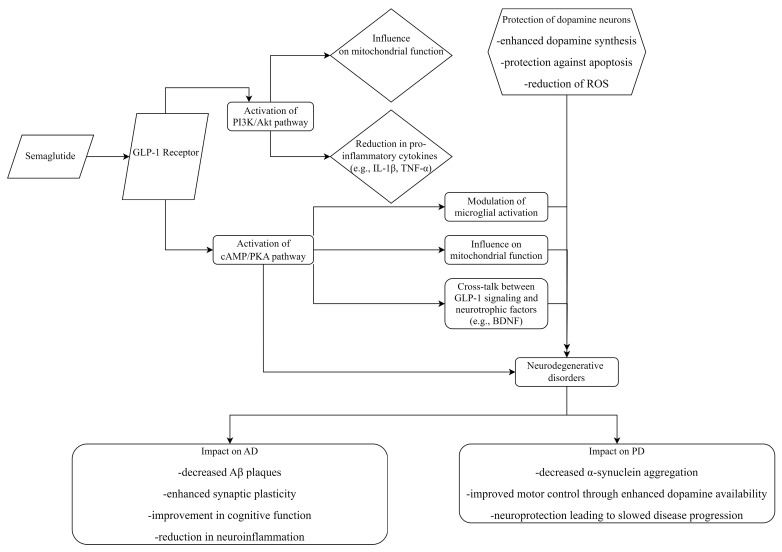
Semaglutide (Ozempic) has potential therapeutic effects in neurodegenerative disorders through "modulation of neuroinflammation, enhancement of mitochondrial function, and promotion of neurogenesis". It has shown benefits in animal models of Alzheimer's and Parkinson's. So they're not just testing a random drug, but something that could work.
Generally this is the answer when there's an announcement like this. Some early paper or analysis showed some (often weak but potentially very interesting) correlation between $new_drug and $scary_disease/$scary_disorder. Doctors and scientists go off and study that in more depth with better controls or more data points and we learn a little more about the world, if you miss the initial paper(s) the follow up can seem a little random.
This new study that did not find a causal link was part of the attempt to find out how. The original study was more of an observation than a deep dive.
You could think of it similar to a study that shows something like "People who don't watch network TV have fewer strokes", which could be an interesting correlation, but the causal effect might be something more like "people who are more health conscious tend to avoid sitting down for extended waking periods" which ultimately has nothing to do with TV.
I know we can tell that a chemical does a particular thing in the body, but can we tell that it does not do anything other than that thing? The body is ridiculously complex, and as far as I know we don’t know how every part (or combination of parts) works.
Edit: I mean in the theoretical “this targets the x receptor” kind of way, not in “we tested this and found no causal link” way.
That's why I'm genuinely asking why this would be disappointing, like what was the evidence that this does affect Alzheimer's. You would expect by X does not affect Y by default, so clearly there had to be a theory why you'd spend 2 years on a study to rule it out.
Personally, living with two T1D ( type 1 insulin dependent diabetic, the autoimmune disease not to be confused with the i am old, fat and over eat disorder) when your blood sugar is too high or low , you act weird , you are in a fog . Long term effects of the swings and sustained levels cause brain damage, not necessarily traumatic brain injuries but damage nonetheless.
So i can see the correlation for T1D and undiagnosed T2D cases Alzheimers. Now having a parent with both T2D and Alzheimers when they were taking rebelsis there was a change in their overall mood and activity , but i saw the change was "hey your sugar is under control, and no i am not your buddy from the army" . To be clear the difference is the fog of being unclear about what's going on like you're drunk , vs the grand delusions of seeing a different person that's not there .
This should have been obvious for the researchers.
Significant, sustained weight loss can prevent or reduce the effects of conditions known to increase the likelihood or hasten the onset of Alzheimer's, like diabetes and high blood pressure.
This is anecdotal, I don't have proof but it's something I think is somewhat related. Is that obesity and nuerodegenerative diseases are somewhat related. So that's a guess as to why some people might have though a weight loss drug would potentially be related in some way with alzheimers.
This could just be false though, I can't recall where I heard this information. So do some searching before quoting me.
As I understand it, one of the reasons GLP-1 agonists seem to affect so many different things is that evolutionarily, it does not seem at all surprising that a huge number of things are hooked on the hungry/full signal.
I’m one of those people who have a nonspecific disorder. I get plenty of exercise both aerobic and strength training. It helps with maybe 30% of my pain.
People who play armchair doctor only make things worse for those of us who are actually disabled.
My workout routine was prescribed by an MD who specializing in pain, specifically targeting my areas of pain. Then it was reinforced over eight weeks, four days per week, six hours per day by a team of two physical therapists and one occupational therapist in a pain management program. The program follows the bio-psycho-social model of pain management.
That said, I’m not going to share details with you because your other comments in this thread indicate that you intend to argue in bad faith.
However, if anything I said seems interesting, feel free to google! The bio-psycho-social model is very interesting, it’s the first real advance in pain management since we lost opioids as an option.
These kinds of disorders — the ones you think aren’t real — are really disabling. I genuinely hope that you (or really anyone) never find yourself in this position, it’s truly miserable.
I would be concerned if it has not solved your pain. Physical therapy did very little for me and the exercises they recommended because it is so weak. HIIT and core strength training was far more beneficial for pain
Needing a cane, barely able to walk either from obesity or being so frail you can barely move, pallid skin. It is quite obvious, my son and his friends have a derogatory name for them
I’m commenting about how “tHiS iSn’T ReAl!!!” comments are so hilariously off-base, so much so my own child and his friends comment on how absurd the number of 20 to 30 something cane people are everywhere
And you don't think, "hey this is a learning opportunity for them, I can teach them the value of minding their own business, not judging people based on how they look, not making assumptions about people based on what I see" ? I don't think you're really helping your point the way you think you are. You said yourself they call them derogatory terms.
I think it says something more about society that a significant chunk of our young adults have convinced themselves they have some sort of unspecific, incurable, un-diagnosable malady. It's actually super fucked up
I think it says a lot about you that you look at people and automatically assume your assessment of them is accurate. That you allow your child to talk shit about them.
I trust my eyes more than anything, and I see more vaguely-disabled people than ever, especially the 20-40 age group. I'm sorry you can't accept this, nor understand why this is not good
So your eyes alone tell you that these young adults have convinced themselves they have some sort of incurable malady? Impressive. You still also dodge answering why you think it’s acceptable for your kid to call people derogatory terms.
> Notice the absurd number of young, frail people with canes and masks.
I don't notice an absurd number of young, frail people or young people with canes. There are a larger number of people of all ages masking than was the case pre-pandemic (especially outside of the ethnic groups where precautionary masking was common pre-pandemic) but...I don't think that's particularly a sign of changes in health status as it is of changes in perception of external environmental conditions and associated health risks.
I kind of think if it fixes a fundamental issue - too much weight.
Another problem it seems to help with is addictive/impulsive behavior. This might lead to wrong choices in diet or activity.
I suspect that many many functions of the body are degraded or disabled by too much weight or wrong choices, and fixing those problems might let the body cure and maintain itself properly.
Obesity may increase the risk of Alzheimer's but it's far from a requirement for the disease. I can't find a link between Alzheimer's and being overweight except in case of obesity.
The article describes data showing a correlation between Ozempic use and slowed progression of certain brain conditions. The study aimed to determine whether that effect came from Ozempic itself or simply from weight loss. Once researchers controlled for weight loss, the effect disappeared. In other words, correlation, not causation.
That's an important caveat. But effectively it sounds like Ozempic typically results in a better diet, and a better diet typically results in slowed progression.
It's disappointing to the manufacturers and consumers because many boomers are taking it already to treat 40+ years of poor and/or indulgent consumption (and more will now that they've negotiated a price reduction).
Glp-1 drugs inhibit drinking and compulsive behaviors and I'm not sure the mechanism of action is known