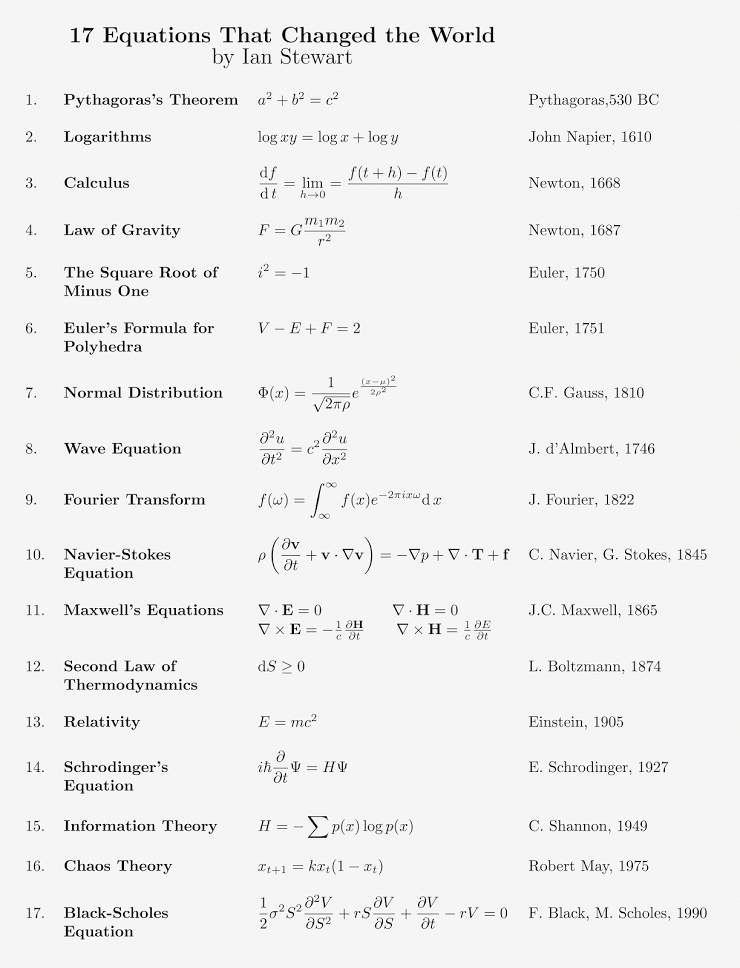
Interesting. But why on earth is Black-Scholes equation on that list? It's not like Long-Term Capital Management took over the world with it. It's a fragile model and does not deserve to be on the same list as these beautiful and useful ideas.
Black-Scholes is relevant to any HN readers with stock options, but I agree that it doesn't belong on the list. And why isn't F=ma on the list? That seems really fundamental. (Maybe they didn't want Newton over-represented, but I'd pick that over gravitation.) And is Euler's Formula really important enough to be on the list? (genuine question) I'd put De Morgan's law on the list because of its importance to computers, but technically I guess it's not an equation.
You could lump it under #3, Calculus. Newton originally expressed using differential calculus as F = dp/dt, and developed his second law as an application of his newly-developed calculus.
> Newton originally expressed using differential calculus as F = dp/dt, and developed his second law as an application of his newly-developed calculus.
You used Leibnitz notation, Leibnitz kicked Newton's arse, and Newton was a complete arsehole.
"Changed the world" can be for better or worse. Much as TIME's "Man of the Year" doesn't (necessarily) go to the person who had the greatest impact for good (Stalin (twice), Hitler, Khrushchev, Nixon & Kissenger, Ayatullah Khomeini).
The financial meltdowns of the mid 1990s and 2000s certainly had significant global impact, to the point of getting a lot of people to question what they thought they knew of economics. Fairly famously Alan Greenspan, who admitted that he was waylaid by the whole thing. I just happened across his recent book whose title is intruiging, though by reviews and what little of it I skimmed, the content is less than overwhelming: The Map and the Territory.
I'd need to find the backstory on the title, but it is strongly reminiscent of Robert Pirsig's Lila, the opening chapter of which starts with the author navigating a river by what turns out to be the wrong chart. Confusion over our mental models and reality being a major risk factor to current affairs.
These are equations that changed the world, for better or for worse.
Black-Scholes opened up a whole world of asset pricing that much of the financial system today is based on. It can be argued that it did indeed have a deep effect on the state of the world through developments in modern finance.
Yeah I was also a bit surprised. LTCM's "Long-Term" was ~ 4 years (1994-1998) with a total loss around $4.6 Billion. That time seems to be very small compared to the ~ 2500 years of the list. And $4.6 Billion? It's not even one third of WhatsApp!
The level of financial impact from that equation is enormous. It's not just LTCM. Every bank in the world now uses derivatives to hedge risk. Every mortgage is dependent on people being able to offload the risk.
Saying Black-Scholes is imperfect is like saying Newtonian mechanics doesn't account for Relativity. Black-Scholes was the formal starting point for pricing derivatives, or the offloading of risk. Everyone has advanced well beyond it. Blowups not withstanding, without Black-Scholes our lives would be very different.
I would argue that it's generally a massive failure, and that history will view these models as extremely naive when it comes to judging risk.
Comparing it to Newtonian mechanics is unfair. Newtonian mechanics actually work, just not for everything. To have a risk model that doesn't work for risk is something completely different.
There are lots of reasons why Black-Sholes doesn't work. Also lots of reasons why incentive problems cause people to misuse financial models. But that doesn't change the reality that our lives are dramatically changed as a result of them.
It's pretty worthless to just present a picture of these equations without any explanation of what their significance is or how they "changed the world". The image format is particularly bad since you can't even copy/paste the text into a search engine if you want more information. Twitter isn't really a good medium for presenting mathematical and scientific concepts.
I only have a bachelor of science degree with a major in computer science. Mostly through my interest in physics and mathematics, and hence the electives I took, I have a somewhat intimate familiarity with all of 1-5, 9, 13, and 14. I have at least basic knowledge about 7, 11, and 12. I have no idea, really, about 6 and 15-17. I'm a bit embarrassed about #15, given what I do. I have heard good things about Shannon's original paper, so I should give it a read. The ones I never listed fall into a half-half area, where I am aware of their meaning, but not very familiar with them.
At the university I obtained my degree from, just as I was graduating they were removing the requirement for computer science majors to take 6 credits in third or fourth year mathematics courses. All that is required now is first year calculus courses, with linear algebra and statistic in second year. The credits are moved to electives, so interested students can still take mathematics courses, but I feel like few of them will.
It was posted elsewhere in these comments that a proper treatment of these equations is found in Ian Stewart's book "In Pursuit of the Unknown: 17 Equations That Changed the World". I had heard of this previously, and now look forward to giving it a read.
Edit: To be clear about something, plenty of my knowledge of these equations came from my choice of electives in second and third year physics courses. So, my moaning about the removal of required mathematics credits isn't precisely relevant.
It was one of the few major disappointments of my time at university that I didn't get to take the proper course in electrodynamics (equations in 11). I have always meant to obtain Griffiths' text on the subject and give it a fair shake, and still plan to do so. Entertainingly, I looked it up quickly on Amazon and see they released a fourth edition in 2012, which has mixed reviews and seems to suffer from the usual publisher hijinx.
Yes, I'm capable of looking them up. I was only pointing out which equations were hit upon during my education.
Actually, one thing your post made me realize is that I did touch upon equation 6 in a fourth year algorithms class. I didn't know it as related to polyhedra, as we used it in relation to vertices, edges, and faces in complexity analysis of geometric algorithms.
It's extremely easy to find a free PDF download of the book. I'm assuming the free PDF has been authorized, how does one even tell these days short of contacting the author?
A nice list, although I'd quibble a bit about dS >= 0 being on there. That entropy increases is important, but the equation itself doesn't really have a mathematical relation like the others.
No. 16, 'Chaos Theory' is actually called the 'Logistic Equation' and it is used in biology to model populations. It does exhibit transition to a chaotic regime for certain values of k, but it's improper to refer to it as 'Chaos Theory equation'.
Yep, if anything the Restricted 3-Body Problem (R3BP) should be considered the "chaos theory equation", since it was Poincaré study of chaotic solutions in the R3BP that led to the discovery of sensitivity to initial conditions. Smale's horseshoe map would be another apt equation, since it succinctly describes the dynamics of chaotic systems, through the twisting and warping of the map. The Lorenz attractor is another important example that highlights the concept of deterministic chaos.
I don't quite get how chaos theory changed the world. All of the other equations I get (although whether Shannon's equation changed the world or merely described the change is probably arguable.)
Understanding deterministic chaos has been the cornerstone of a wide range of fields, including physics, medicine, economics, and business. There are a wealth of everyday applications. Control systems in the real world have to deal with the underlying structure of the dynamics that govern how such systems naturally behave in the feedback loop.
There are a few different resources you can find that list practical applications of chaos theory. Here are a few that I found that I think you will find interesting:
It has very important epistemological implications: it means a phenomenon may follow a deterministic law which, due to its mathematical properties, would nevertheless make long-term predictions impossible. So even though you would have a mathematical model for the phenomenon, you wouldn't be able to make real-world long-term predictions. The problem lies in the sensitive dependence on initial conditions.
If I had to pick the single equation for relativity it would be the definition if interval. You can derive the rest from that, and it is IMHO the most beautiful expression of it.
As a grad student in physics, I'd vote for the inclusion of the Dirac equation or Klein-Gordon (can't put the whole standard model in there) and may be the Einstein Field Equations.
Other than that, I agree with most of the list. I haven't heard good things about Black and Scholes, though.
EDIT: Oh, and I thought of another. No doubt:
[X,P] = i h/2pi
Definitely more important than Schrodinger.
No surprise about that. I imagine a large portion of us completely ignore posts directly to youtube with no context outside of the title. Personally, I also wouldn't have shared around a video consisting only of floating images and text with technoish music playing. Seems like that is the youtube channels niche, though.
Interestingly, the formula for the Fourier transformation is wrong in both of these posts. In the image, the integration is from infinity to infinity, and in the video the limits of integration are negative infinity to negative infinity.
It's really, really strange to me that F=ma is not on the list. Also very important, but missing: Hooks law, Ohms Law, the Ideal Gas Law. The binomial theorem and Taylor series are just as important as Fourier series, if not more so.
A very strange, almost arbitrary list. Thumbs down.
While this relationship is profound, i'm not sure it has led to any industry or academic shifts in understanding. Every equation on this list has single handedly expanded a respective field of study by its discovery.
Neither one of them should be on there. Both rest upon the false assumption of human rationality. They are delusions masquerading as mathematical truth.
That's an interesting perspective. And it's a perspective that would be familiar to any student of cybernetics and social systems theory: http://en.wikipedia.org/wiki/Second-order_cybernetics so-called second order cybernetics. Fascinating stuff I think.
Interestingly, around the same time the book these equations were originally collected in (as pointed out in another comment, this is Ian Stewart's In Pursuit of the Unknown: 17 Equations That Changed the World), the book Nine Algorithms That Changed the Future: The Ingenious Ideas That Drive Today's Computers also came out. They were actually published ~5 months apart, but I remember them being close together on Amazon recommendations, list of other books people viewed, etc. at the time.
I haven't read that one either. Looking at the index quickly, it doesn't look like Simplex is in there.
Black-Scholes' is a big deal in economics and finance. Their innovations were risk-neutral pricing (the r terms in the equation) and replicating portfolio argument. These completely changed how to price all securities you see, not just options. The idea was so radical their paper was unable to be published for years.
In my opinion, the Schrodinger equation is by far the most important. It provides an accurate prediction of almost all earth-scale (and smaller) phenomena except gravity. Although I suppose some of the heavier elements require KG or the Dirac equation to account for relativistic effects.
Poorly documented functions which use single character variables. Maths notation is great for brevity but fails utterly tests for readability and ease of comprehension.
You're trolling, right ? Are you kidding ? "Poorly documented" ? I use most of them on a regular basis. I haven't had first hand exposure with only Black&Scholes': But I looked the thing up when I was a freshman as I was interested in stock prices, and was interested in Louis Bachelier, Brownian motion. The rest is well documented through the whole Engineering curriculum. There are a couple I haven't used in a while (Schrödinger's and relativity (hint: Who is Poincaré)).
These "single character variables" are known for whom they matter. You can't have brevity and delimiter-separated names. Equations taking a whole line (or more), good luck with that.
"Maths notation is great for brevity but fails utterly tests for readability and ease of comprehension".. Okay, clearly trolling.
Next thing you know, IEEE will hire Will.i.am or Apple fanboys as consultants to make things "beautiful".
I'm pretty sure you're not supposed to comprehense it just by looking at it once. Maths(and physics) is not programming, and to be honest all of those ``functions'' are pretty well documented, both in books and articles online.
Those are the sourceless Maxwell Equations I'm assuming in vacuum. The divergence of H isn't zero either (divergence of magnetic field strength is) unless the magnetization is divergence-less.