Dropbox sells one thing: easy to use drive space in the cloud.
Dropbox failed to do one thing: give people compelling reasons to put a growing amount of stuff there so they would keep paying for and upgrading their accounts.
Imagine these scenarios:
- A user dumps their photos into dropbox and automatically is granted a flickr quality site with all of their photos there and organized. They can add metadata in the site and dropbox just makes it "work". Now I want to keep putting photos up and need to keep upgrading and paying for my account. Dropbox could have taken on Flickr and any number of other photo sharing sites.
- A user dumps their music collection into dropbox and automatically get a private site they can use to listen to their collection. Now I have to keep paying for their service and upgrading to add new music. Dropbox could have taken on any number of music services.
- A user dumps the music they created into dropbox and automatically get a soundcloud like experience to share their music. Now I have to pay to keep sharing my creations and upgrading to add more. Dropbox is now taking on soundcloud, and any number of other music sharing services.
- A user dumps their videos into dropbox and automatically gets a youtube like channel they can use to share their works. Now Dropbox is taking on youtube...and video takes up a ton of storage.
Give a storefront now people can sell their music, art, videos and now their livelihoods are tied to paying for Dropbox to exist.
And on and on and on. Dropbox could have been hugely disruptive to any number of other sites and instead is a languishing file sharing site that's targeting enterprise customers (meanwhile enterprises are actively trying to block dropbox from their systems as it's an easy exfil route) -- and it's in a crowded space competing with companies who are making it necessary to have their file sharing services because they're tying all kinds of productivity applications to their storage (OneDrive, Gdrive, etc.) that enterprises are willing to approve even given possible exfil risks.
The problem with all those things are: bandwidth. Storage is cheap, bandwidth is expensive. Dropbox wants you to stick stuff with them and then never touch it. Then they would only need slow disks and slow networks.
Once Dropbox tries to become Flickr/Soundcloud/Youtube, they have the same problem those services have: massive money loss. Playing media at scale is hard and expensive. Especially when Dropbox's niche is easily mutable data. Dropbox doesn't exactly have a massive advertising empire that could subsidize and take advantage of Youtube.
So the one place they did expand into is productivity tools. No one's going to massively share a text document/slideshow/spreadsheet, nor do those things eat very much bandwidth, and it plays into their mutability advantage very well.
Dropbox customers are clearly willing to pay more than the absolute minimum possible. Dropbox is relatively expensive. So instead of not offering a service that customers want they could simply charge for bandwidth.
Also, Dropbox does support partially syncing large files, so mutability is not necessarily that big of a problem (depending on the file format I guess).
The mutability comes into play when you want to serve the content. Youtube/Flickr pretty much operate on full replacement, when you're done fiddling with your files you publish them and they never change. This makes it easier to serve the content cheaper through caching and CDNs.
That partial sync is pretty much Dropbox's technical advantage right now. Change a bit and it tries only sync a bit. Now imagine how difficult that would be to serve with multiple layers of caching.
They even had (almost) this feature and disabled it, right? Originally, your Dropbox folder came with a Public folder which had content accessible (directly) from the web. You could host your website there. Some time later they found people are hosting their websites there which costs them bandwidth, and removed this ability. (Now you can share individual files using special links.)
If dropbox can't make money offering their product (easy to use cloud storage), then they should shut down business operations tomorrow, full-stop.
While you are correct that there are technical challenges with delivering lots of media to lot of consumers, these challenges have been handily addressed many times by many companies. In addition Dropbox relies on people installing clients on their devices. For people who are "in their network", why not just use a bittorrent-style method to move the files between users directly?
Most media that people put online isn't consumed. It's a power law distribution. So most of the vacation photos or cover-band songs aren't going to really use any egress bandwidth. But putting those things up consumes space, which pushes users over tiers, which encourages them to upgrade.
When the latest dropbox-tube influencer's videos get watched by 100 million people, that's all 100% advertising to viewers that this person is a "dropboxer", some percentage of which will feel inclined to also start using the service, creating a virtuous cycle of customers who then go and make reaction videos to the first person's reaction videos, which mostly likely will get 10 views but will consume that user's storage -- which sells dropbox's primary service offering.
Finally, why wouldn't dropbox turn a network of people's shareable media into an advertising network?And generate more revenue? It seems hilariously obvious to me that they would do that. After all, isn't that how Google funds 98.999% of all of their offerings?
Dropbox makes a profit (just barely). Google is still dodges investor questions on YouTube profitability which suggests it doesn't. Flickr/Soundcloud have been fighting for survival for years now.
The power law distribution is problematic because unless you can predict which content becomes a hit, you either treat all the content like it would (extremely expensive), as if it wouldn't (extremely slow and still expensive), or some smart predictive in-between (which is a very hard problem that you can see Netflix/HBO and even Youtube suffers from). You can see Dropbox is working on smart-sync too, because it's pretty critical for keeping costs down.
Besides, you really don't want things to go viral. Viral is expensive to serve and expensive to engineer for.
I think torrent-style distribution is a brilliant idea. Not sure how people will feel about their phone data or metered connections being used, nevermind the engineering challenges of getting torrenting working on a cellular connection.
You're asking Dropbox to essentially become Google without the profitable part (search ads). Way easier said than done. There's very little profit to be made from being a commodity, it's not clear that becoming an umbrella of multiple commodities is any different.
Dropbox is certainly positioned to make a good product, so is Google/Microsoft/Amazon/Apple. But until people actually start paying for good products so they're profitable products, they won't be built or will keep disappearing to be replaced by subsidized/free mediocre products by Google.
I am a fairly happy paying user of Dropbox for what it is, and I do not share most of complaints in the thread. But I think your suggestions are excellent! Please apply to Head of Product there!
Dropbox had a great, gmail like onboarding process for free users. And they made graphics people happy with their sync tech.
Then they stopped and focused on segmentation to chisel more margin and missed the boat. It’s a shame.
The enterprise sales force that I dealt was a bunch of overpaid folks who didn’t seem motivated to sell. Microsoft and Google gobbled up the enterprise market. And eventually, Adobe will steal the creatives too.
Yup, image versioning was a big deal. No one else had it at the time. Graphics people were indeed happy. I wonder if they tried to strike a deal with Adobe to back lightroom or photoshop with Dropbox.
> A user dumps their music collection into dropbox and automatically get a private site they can use to listen to their collection. Now I have to keep paying for their service and upgrading to add new music. Dropbox could have taken on any number of music services.
Considering that Amazon offered this exact functionality, and decided it wasn't even worth maintaining, I don't think it's obvious that Dropbox missed something by not doing it at all.
> A user dumps their music collection into dropbox and automatically get a private site they can use to listen to their collection. Now I have to keep paying for their service and upgrading to add new music. Dropbox could have taken on any number of music services
I recently dumped my music collection that previously was on Google Music on Dropbox; I'd easily pay twice what I'm paying for space to get a music app from them that played my stuff on there.
I think they're halfway copying Box's strategy and focusing on B2B.
The first two scenarios might have been huge selling points a decade ago, but Spotify replaced music downloads with streaming (not that Dropbox couldn't have made a stream your own music app), and Flickr faded away. I'm not even sure how people save their photos, these days. Just leave them on their phones?
My sentiments exactly. I, however, see more value along the lines of file related workflows and third party apps. Google Drive now has third party apps. Workflows on the other hand, I have only seen in NextCloud.
Third party apps would have helped them remain focused. That ship has, almost certainly, sailed though.
Totally agreed. I pay for Dropbox myself, but I don't know that I've shared a file with it in a decade or so. I just use Paper, which they continue to fail to market, despite it being absolutely amazing.
I see your point , I just visited the Paper product subsite and I still don't know what it is despite watching several videos. Some sort of collaborative task / list management?
Dropbox feels more bearucratic internally than Google, a company two orders of magnitude its size. I feel like it is a perfect case of all the “VC-style” advice of “CEO job changes every 6 months and you should adapt” going haywire; mistaking the focus to be building an abstract hierarchical HR org, while completely losing the ability, vision, or desire to build a product that people love.
Reminds me of Steve Jobs’ quote on monopoly businesses, except it happened before they got a proper monopoly. https://youtu.be/lmFlOd0MGZg
In fact, the early success may have been a curse there, thinking they have the genie in the bottle when they really had not.
In Japan you can be investigated by Antitrust and there's no proper definition of monopoly there. The only criteria is "superior bargaining position" which anyone can agree Apple does have today - https://globalcompetitionreview.com/jurisdiction/1006143/jap...
> For Party A to have superior bargaining position over the other party (Party B), Party A does not need to have a market-dominant position nor an absolutely dominant bargaining position equivalent thereto, but only needs to have a relatively superior bargaining position as compared to the other transacting party. When Party A has superior bargaining position over Party B, who is a transaction counterpart, it means such a case where if Party A makes a request, etc, that is substantially disadvantageous for Party B, Party B would be unable to avoid accepting such a request, etc, on the grounds that Party B has difficulty in continuing the transaction with Party A and thereby Party B’s business management would be substantially impeded.
First of all it would only apply within Japan law, it would need to take into account how Apple market practices relate to other players on the Japanese market and only the opinion of a judge actually matters.
Secondly, it doesn't scale, because Android and Windows own the worldwide market share of consumer platforms.
> Then came "Google Drive" and nobody turned back to Dropbox after that.
I wish it were true, but neither Google nor Apple have the most basic, brain-dead feature: "Give me a link that I can give anyone, and they can download the thing without jumping through any hoops."
They both require people receiving a file to jump through the hoop of having accounts with them in order to do this most basic action. It's the reason I'm still regrettably paying Dropbox. Anything calling itself a cloud drive should have basic feature where you can send anyone a link and they can download the file with no other requirement than an internet-connected browser.
second that! rclone is an amazing piece of software! With a few simple bash scripts and rclone, my google drive serves code snippets (albeit without code highlighting) and screenshots!
there are also armhf and aarch64 builds of rclone!
Never understood Dropbox, because as a Linux user, you can already build such a system yourself quite trivially by getting an FTP account, mounting it locally with curlftpfs, and then using SVN or CVS on the mounted filesystem. From Windows or Mac, this FTP account could be accessed through built-in software.
Somehow I am doubtful that you can trivially build what dropbox does. I am on their pro plan, I have tried running Syncthing on my own servers but the cost is quite prohibitive.
I have about 300GB of photos there. Some of the files change, sometimes generating quite a lot of space - e.g. I think calculating the deleted files it is quite possible that I have few terabytes of data at any given moment. I looked into getting that space on Digital ocean and it would be way more expensive.
That is not including the price of my own labor, how much time would I spend on managing my own solution? Can I guarantee the same level of safety as Dropbox does? They have people thinking about security, I don't even have time upgrade my servers - beyond automatic update..
We did not even get into weird corner cases... Couple of months ago I was running some machine learning experiments and misconfigured the logging process and ended up with about 15m small log files in my dropbox folder. I had contacted the support and it was dealt with. Had I been using something like SVN I would have to manually purge the history or something like that.
IDK, I am very happy for the value I am getting out of my money. For me the biggest value is that it works and I don't have to do anything about it.
Whenever someone quotes the old HN comment that GP linked, you can be sure that they are pointing out the absurdity of thinking you could "build such a system yourself quite trivially".
In case you or others missed it, the parent commenter is quoting a comment that was posted on HN's original thread announcing Dropbox in 2007, where the poster questioned if Dropbox would ever generate income.
Hindsight is of course 20/20, but this comment is often laughed at because it was so terribly bad at predicting Dropbox's success.
Dropbox is successful because 90% of their users have no idea of what you just said and the other ~9% can't be bothered with all that stuff and just want to pass files around.
Yeah, this isn’t true at all. The Dropbox 2TB plan is cheaper than any cloud provider per-GB, and the sync algorithm gracefully handles a dozen+ edge cases that a naive pile of shell scripts would not.
I say this as a Linux user and paying Dropbox customer.
E-mail attachments are one of the worst ways to share large documents. For one, it pushes the hosting requirements for the files to their e-mail provider/recipient. Large attachments will count against a user's mailbox storage limits and can DoS their inbox. The management of that space then falls to the recipient. I also don't know if any e-mail servers that actively dedup attachments. So unless the underlying file system is doing block level dedup a large attachment lives in each recipient's inbox on the server(s). These are reasons pretty much every ISP and e-mail provider has pretty strict limits on attachment sizes.
I certainly do not want anyone sending me attachments that are a couple hundred megabytes. I don't want to have to prune my mailbox or choke my mail client downloading the attachment. IMAP and POP3 suck for downloading a lot of data. I'd much rather have a resumable HTTPS link I can download whenever I want. Better yet would be a service that let me preview the document before downloading it. Some sort of dropbox-like service maybe.
I use Dropbox as a consumer only. I pay for the Dropbox Plus plan, and that does everything I want - albeit at a higher price than I'd like, but it always seems like their marketing is so heavily geared towards business use.
Every time I go on the site I seem to get some hint that I should consider upgrading my entire team to some enterprise plan.
I miss when it was just "buy a load of space online".
I was a loyal Dropbox customer early on. At some point, they stopped caring about individuals and put all of their effort (especially marketing) into businesses. As a paid user, it was annoying to see upgrade nags in the app and on the website. I just wanted a damn folder that would sync properly.
That’s still all I really want, but being force fed features I didn’t need pushed me away. After their horrible rebranding, I got sick of looking at the ugly new icon on my iPhone. It was the straw that broke the camel’s back.
I now pay something like $10/mo for iCloud storage which works pretty good. Maybe Dropbox no longer needs (or wants) me as a customer, but it’s something I would’ve happily continued to pay for potentially decades to come.
I recently uninstalled Dropbox after years of use. The upgrade nags were over the top, and the number-of-device limitations on the free plan made it no longer usable for me.
I like the app, and would happily have paid something for it, but as a mostly private user, the lack of a plan between 2 GB / free and 2 TB / $10/month just didn't make sense. $3/month for 5 GB would have been an easy choice.
Now I'm using SyncThing, which I don't love, but gets the job done, is free, and doesn't limit me to a couple devices. I have a folder that syncs to my web server that replaces me sharing things on Dropbox, which works, but is a little cumbersome. (That said, sharing links might be a fun thing to hack into SyncThing.)
What really irritated me was the suddenly imposed three device sync limit. Being forced to pay for 2 TB when I didn't need any more space than I already had just to get my files on all my computers really rubbed me the wrong way. Like you, I wish there was a 5 GB / $3/month plan.
On top of that, they're losing sight of the deep OS integration that made them so appealing to Steve Jobs. When a screenshot is automatically saved to Dropbox I'm no longer presented with the option to "Show in Finder" but instead "Show in Dropbox" which instead of snapping open a Finder window slowly launches their kludgy app that isn't at all visually or functionally harmonious with macOS.
Although I never had more than 3 devices connected to Dropbox at sane time; but Dropbox Camera Upload used to rename all the photos to time & date it uploaded; I will have same photo with it's correct time n date took as name in my phone, & it's copy with a different name in Dropbox. I used other sync apps to connect & sync my Camera folder to Dropbox, like FolderSyncPro. Apps like that can connect from any number of devices.
Same here. I used it to sync my Keepass database, currently 1.6 MB, across a sliding window of about 10 devices (sliding because I like trying new OSes and phones). That ground to a halt with the 3-device limitation, so I migrated to Syncthing.
I would have loved to pay for Dropbox; in fact, in 2008 I did upgrade to 50GB for one year because I liked the company and wanted to help it survive the downturn. But if I had kept that up, I'd have paid $1,200 by now to sync less than 5 MB.
Interesting you mention $3/month. I pay almost exactly that at vultr.com to keep an IPv6 Syncthing instance running so that a copy of my stuff is globally available.
I have a bit over 8 gigabytes of space in my Dropbox. You could get extra space by creating VMs, then inviting your secondary email accounts to Dropbox and installing Dropbox in a VM. I don't know if this still works.
I’m at the same point too. My Dropbox personal expires in a week and I’m not going to renew for $120/year. They’ve really priced themselves way too high for me. I just need a 100-200gb for photo backups from my phone. With Amazon, Google and even MS offering better pricing I really have not reason to stay.
MS in particular has great pricing. $99/year for 5 copies of Office and 1tb of storage. I can’t see the value of Dropbox any more.
I ended up doing $3/month for 200gb iCloud, $20/year google for 100gb and $20/year for 100gb amazon. I’ll try them all out and see which I like in a year.
Zoom really strikes me as the Dropbox of 2020. Took over a field full of mediocre products with one that "just works" for the casual user. 'to dropbox' was a verb too. Zoom will probably suffer the same fate, where the big corps catch up in UX and the little dedicated product can't keep up with the service you already have access to. When Google manages to properly integrate Gsuite with whatever chat service comes after Meet/Hangouts/Allo, then Zoom's days are numbered.
I don't think this is all that different from Dropbox. For years, Dropbox was able to outperform all the big players who tried to compete because their core sync technology was rock-solid.
Still to this day, I find my ICloud sync folders can be fairly unreliable (files will take a mysteriously long time to appear once in a while) - I've never had anything like that sort of an issue with Dropbox (although I haven't used it in a while).
If your premise is that Google will stop being so frequently incompetent at product and deliver a killer competitor for Zoom, then it's far more likely that Zoom's future is a bright one.
> Zoom really strikes me as the Dropbox of 2020 ... Zoom will probably suffer the same fate
Nobody killed Dropbox either, they have continued to expand year after year. Dropbox has grown its business every year for the past decade plus. You act like the competition wiped them out, when nothing like that has happened at all: Dropbox doubled the size of their business over the prior three fiscal years (2017-2019). I'm pretty sure that reasonably qualifies as thriving.
Zoom is growing even faster than Dropbox did, they'll be larger than Dropbox in another few quarters. So how many years will it take for the competitors to catch up in a way that considerably slows Zoom down and how large will Zoom be at that point?
Video conferencing is not a multi-billion dollar company.
File hosting is not a multi-billion dollar company.
The company that does all three of these things in an integrated fashion is. No single feature constitutes a platform or ecosystem, and there's certainly no defensive moat.
These single-purpose companies are just minnows to the bigger fish that have gargantuan budgets, extensive engineering headcount, and rich product ecosystems to pair these features with.
That's a naive perspective of the role Slack plays in many organizations.
For example, much of the monitoring and alerting workflows in our company run through Slack. We use it more than email. We can rollback production deployments with Slack commands as well as interact with our staging environments - and that's just the tip of the iceberg for the workflows we've built out with Slack's APIs.
That sounds about as natural as using Xbox Kinect gestures. Additionally, your SLA is now also tied to Slack's, which is a multiplicative downgrade.
Not every integration makes sense. I know some companies doing business logic automation in Google Docs, and I'm also reminded of Twitch Plays Pokemon. Just because you make a choice to integrate with a product doesn't mean it's widely adopted, practical, or wise.
Or supported.
Edit: I want to clarify. I don't mean to be rude, and I wasn't in the room when y'all made these decisions. I just don't think Slack is the ship you want to tie yourselves to, especially not as your control plane.
If they are like me, they use chatOps as a way to consolidate and shortcut different commands and dashboards. But by no means are operations dependent on our chat. If chat goes down, then you will simply need to login to our ci/cd service to initiate deployments, rollbacks, etc.
That sounds painful for an ops person. When I did ops work I much preferred to have as little abstraction as possible seeing how critical each action is.
I would never want my production deployment rollback tied to my instant messenger plugin working.
How often are you rolling back production deployments that you need a Slack command to do it? Perhaps I am missing something but this does not seem like a good use of time for whoever put it together.
It's funny you'd say that when there are so many companies doing chat and video software and they're all billion dollar companies.
Quick math, assume one tool is charging $8 per employee per month (meaning $100 a year). It only takes one million customers to be a billion dollar company ($100M yearly recurring revenues at 10x valuation).
And one million customers is just a couple of fortune 100. The whole market is orders of magnitude bigger than that!
That's assuming there is a monopoly. The cost of providing a chat service is low and dropping. If Microsoft or Google can provide it for free on top of the communications services companies are already buying, why would anyone pay an additional $8 per user per month for chat?
Companies are paying as much as $25 per month per employee for minor tools. It's not uncommon that a company has 3 different tools doing the same thing. Enterprise are not rational actors trying to save money. Vendors don't go below $5 a month because they know enterprise will bear the cost.
It is 100% going to be Microsoft. Google is laughably bad at enterprise software and Microsoft really has no meaningful competition at this point. Teams is now crushing Slack in market share for the exact reason he mentioned - enterprise IT managers do not like the Unix approach of small targeted tools. They like product suites. Office 365 is as every bit as dominant today as Windows was 20 years ago.
Probably because the product suite components integrate much more easily than a bunch of separate tools from different vendors. And there are fewer particulars to know if you stay in one ecosystem. Maybe there is even a unified administration console.
They really did seem to be firing on all cylinders early on. Prior to their IPO, I thought it was weird they were spending time to migrate off of AWS versus continuing to build around their core offering. As it stands now, they could still target consumers with a higher end offering (lots of caching, etc.) if order to at least offer a superior experience to Google Drive, Microsoft, etc.
I love Dropbox as a product and happily pay for it. It always works. No fuss. No conflicts, it just works.
Something to be said about tools you forget that you’re even paying for, they silently make your life better.
Lately, they’re getting slightly annoying though. Designers at Dropbox - it’s a fucking file syncing tool, not a life philosophy. Get over the garish design non sense and allow Guido(retired)...ehhh engineers to do their thing.
The problem is the shareholders. Dropbox doesn’t need to grow. It can stay the same and continue to be helpful (and make money, provide a living to many employees). But the goddamn shareholders will ruin a perfectly good product. Public companies get hollowed out and the marrow sucked by the shareholders. I want a Drew Houston & Sons Co.; not Dropbox Incorporated.
I felt the same until they stopped supporting most Linux filesystems bizarrely - forcing me to reimage multiple machines. Despite years of perfect behaviour on non-ext4. I also think the price is very high for what I get. Only reason I haven’t swapped to something else is my life is locked into it from the early days. I’d love to drop it at this point. I don’t even need that much space - just something cross platform.
> As it stands now, they could still target consumers with a higher end offering
what I don't get is why they don't have a price plan in the 100-200GB range like google drive has for two or three bucks. I've set up like seven or eight of those for family members and relatives, it's a very good price point and size for the average user.
The free plan of dropbox pretty much is super small and the next thing is 5TB.
The theory is it would cannibalize their $10/mo plan. They have a lot of users who don’t have tons of files but value paid features. Google and Apple’s storage services are plainer offerings.
I'm on Google Drive mainly because they dpn't offer such a plan. Dropboxes client is better, but I'm not paying an extra $8/month for storage I don't need.
You are on Google Drive because you don’t need what Dropbox does. That’s not something they should worry about. They would need at least five of you for every $10/mo customer who downgraded to improve their situation, not factoring things like increased support cost and higher churn rates from lowest-price shoppers.
Unless Amazon decided that they want to give DropBox a huge discounted rate for the PR, it would simply cost too much to have stayed on the Amazon cloud.
I just recently was shopping for a solution for myself and considered google drive, Dropbox and Apple iCloud .
What motivated me shopping around was me running out of space on Dropbox which I have been (a free ) user for 8 years.
I really wanted to go with Dropbox but their pricing were the worse, I also got super confused about their site which didn’t try to sell to people but instead to enterprise only.
As a person that needs around 300gb and want it integrated with my MacBook/iPhone I ended up paying for iCloud .
Did you look at pCloud? Their pricing is decent, they have great link sharing functionality and rudimentary but workable media streaming. Their Linux client is miles ahead of Dropbox and any of the third-party GDrive sync applications.
I am a happy user of paid Dropbox, and I think many person are the same as me.
For me, OneDrive and Google Drive are not enough simply because of their terrible sync system. Back then when OneDrive was just launched the speed for me was absolutely horrible (like <100KB/s). Sure, I'd like if I could just buy space as I grow, as I remembered it was a hard decision to buy 1TB (back then) when I only needed 50GB.
I currently have >600,000 files in my Dropbox. I don't know if other system can reliably deal with this many files, Dropbox has proved it to me that it can deal with my files on Windows, Linux, and macOS.
>> [pg] That does count for a lot with us. It's surprising how many of the groups who apply have a cofounder who's not willing to quit his or her job. It's a worrying sign when someone who knows the company a lot better than we do isn't willing to bet on it. But again, there are always exceptions.
The conversation is about the dropbox founder quitting his job to wok on dropbox part-time.
The problem I see with pg's logic is that the founder and YC are not betting the same value on the company. The way I see it, YC is asked to bet some money, but the founder is asked to bet everything they got. If YC was asked to bet everything they had on that one company, they'd say no. In that case, having a plan B is not a sign of lack of resolve, it's a sign of sanity.
But I'm probably missing something. I really don't have the whatsitcalled, entrepreneurial spirit. It all looks like gambling to me and I hate gambling, especially when the odds are stacked against me; which they always are, otherwise it's not gambling. So I guess I don't get it.
I think one of the reasons it's a useful indicator is because most (if not all) startups require a huge level of commitment and focus from the founding team. If you aren't able (for whatever reason) to commit to it, it's a sign that you might struggle to be successful.
I'm not arguing that people who don't quit their jobs don't have amazing ideas; it's just that to make a startup work as a business requires so much effort, it's likely that if you're not able to quit to work on it, you'll lose out to a team that can.
PS: I'm saying this as a founder who quit his job (as did my co-founder) when it looked liked we had something, and I doubt Overleaf would be where it is today if we'd not. So I may be biased in that direction!
Just wanted to give a shoutout and say Overleaf has been a great product for me and my team so far. Incredibly easy and clear collaboration. And if I need to go look at change history over the last six months, it’s there within 2 clicks.
Not to mention, the UI is easy and (shockingly in this day and age) gets out of my way so I can focus on the content.
And easy pricing tiers. For just $15 a month I get a 10-collaborator project. Thanks Overleaf team!
I’m a huge fan of dropbox, partially because I’m an enterprise user of all their features (including paper and transfer!). In addition to Discord, I feel that it is one of the few companies that has kept their product simple and streamlined. Even modern tools like Airtable, Notion, Miro and of course Slack feel bloated and complicated. It’s a genuine challenge for large organizations to maintain simplicity so I respect what they were able to do.
> I feel that it is one of the few companies that has kept their product simple and streamlined
I'm a longitme paid Dropbox user for personal things and I have the exact _opposite_ feeling.
I want Dropbox to a be a single folder that is always synced perfectly to anywhere the app is. Things like link sharing, API access, "smart sync", etc are nice bonuses.
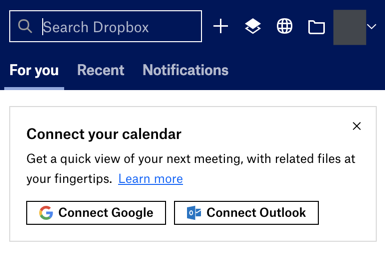
But, they had VC money (and are now public). They couldn't have been content with a complete product, there always needed to be _more_. I'm a paying user, but I still have "pay us more!" banners. They want me to connect my calendar [1]. They want me to use their writing suite with my (nonexistent) team. Their mac app has become increasingly invasive over the years. [2]
I constantly feel "left behind" by them as a customer. Their product motivation so far from the reason I joined them. Each year as my renewal date looms, I look for reasonable alternatives. Ultimately it has the best syncing and I've stuck with it, but I'd almost pay extra to get rid of all the extra junk that's "integrated" with the service now. Just sync my files.
How the hell is slack more complicated than dropbox?? I didn't see Slack Paper, or Slack photos which they then comoletely and annoyingly dropped support for!
Compared to Google Drive and OneDrive, Dropbox is like a zen masterpiece. I just install the Dropbox helper and I rarely if ever need to use the website or use any funky app integrations.
Slack used to be simple, now it’s a mess of different teams, with a thousand channels, each with threads and document tools and integrations and slash commands to remember.
I used Dropbox for a while, but their Linux client was a mess that randomly spiraled into 100% CPU usage for long periods of time.
Google Drive with Insync was better, but had absolutely no bandwidth limiting, so it ate all of my meager upload speed a lot of the time.
There are also the obvious issues of hosting your files with American companies, if you're not fond of various three letter agencies looking through your stuff. I do t have anything even remotely incriminating, but I am opposed to widespread secret surveillance on principle.
So I use pCloud, which is hosted in Switzerland. Their Linux client is great, their pricing is decent, they have reasonable media streaming built in (supports FLAC, too) and their sharing links are easy to use and don't require people to register accounts. They also have good undelete features (30 days standard, up to a year for an additional fee).
My company was largely run on dropbox as a crucial piece of infrastructure for many years before my arrival. As of a couple months ago, it has been cut out of our production pipeline entirely, but for many years, if you saw a digital out-of-home ad in certain places, it only got there because someone had added a media file and schedule to a dropbox folder. Looking back on it, it's pretty wild how much of their business relied on dropbox working reliably. Thankfully, that's all gone now.
I worked in a research lab several years ago that used Dropbox as their version control system for all the data analysis scripts they wrote. It took a while but by the time I left I had convinced everyone to switch over to git.
I resigned from Dropbox recently because they don't have a subscription that is right for me (I'm not a data hoarder who needs 1TB of synced space, I just need 50 or 100 GB max) and because (most importantly) added an artificial limit of max 3 devices sync for free tier.
I switched to syncthing and so far I love it. Now my data lives on 2 always online servers plus few laptops, vms.
I switched to Resilio (formerly BitTorrent) Sync [1] years ago and never looked back. It does have the restriction that at least one of your machines must be online to sync with others, but aside from that, it has been a solid replacement.
I would gladly pay for Dropbox if their service was more compelling than Google Drive.
And it could: Dropbox Paper is still the best editing experience I've ever had. If it allowed for better organization and search, it would blow Notion out of the water.
I dropped Dropbox when they enforced the 3 device limit on the free consumer plan a few years ago.
It sucks for them because I was very outspoken about them beforehand because I used it. Then it changed from endorse to absolutely tell people to stay away because it’s unusable.
Recently saw an appealing -40% discount on amex for dropbox. That could be cool - esp if stacked with a promo. Headed over to their subreddit in search of a special...literally an entire subreddit of complaints.


Dropbox failed to do one thing: give people compelling reasons to put a growing amount of stuff there so they would keep paying for and upgrading their accounts.
Imagine these scenarios:
- A user dumps their photos into dropbox and automatically is granted a flickr quality site with all of their photos there and organized. They can add metadata in the site and dropbox just makes it "work". Now I want to keep putting photos up and need to keep upgrading and paying for my account. Dropbox could have taken on Flickr and any number of other photo sharing sites.
- A user dumps their music collection into dropbox and automatically get a private site they can use to listen to their collection. Now I have to keep paying for their service and upgrading to add new music. Dropbox could have taken on any number of music services.
- A user dumps the music they created into dropbox and automatically get a soundcloud like experience to share their music. Now I have to pay to keep sharing my creations and upgrading to add more. Dropbox is now taking on soundcloud, and any number of other music sharing services.
- A user dumps their videos into dropbox and automatically gets a youtube like channel they can use to share their works. Now Dropbox is taking on youtube...and video takes up a ton of storage.
Give a storefront now people can sell their music, art, videos and now their livelihoods are tied to paying for Dropbox to exist.
And on and on and on. Dropbox could have been hugely disruptive to any number of other sites and instead is a languishing file sharing site that's targeting enterprise customers (meanwhile enterprises are actively trying to block dropbox from their systems as it's an easy exfil route) -- and it's in a crowded space competing with companies who are making it necessary to have their file sharing services because they're tying all kinds of productivity applications to their storage (OneDrive, Gdrive, etc.) that enterprises are willing to approve even given possible exfil risks.