Nothing particularly interesting or shocking about the parts that got un-censored. The important part seems to be 5.4, which was already readable before.
To me that section seems so suggest that production facilities in the UK should/could indeed be used to supply the EU, which is what the EU seems to want and AZ/UK are denying. But I'm sure there are a lot of highly paid lawyers looking at this from all sides right now.
Certainly one Belgian lawyer has already stated that he thinks the EU Commission don't have a leg to stand on here. Not that I expect that to slow them down.
Awkwardly it seems Pfizer might shift to supplying the UK from the US and the UK seem content that they have no contractual need to share the AZ doses from the UK facility. So the EU don't seem to have any leverage on this issue.
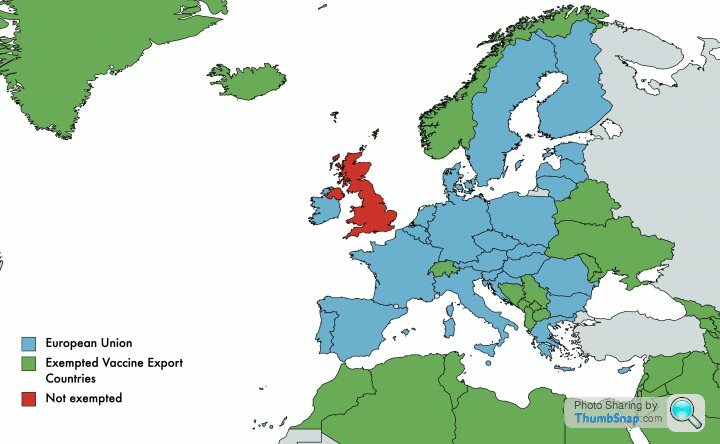
Some have tried to say this debate is EU vs AZ but this map suggests otherwise.
From what I gather from the media here in the UK one problem is that AstraZeneca's contract with the UK government is that they will not export vaccines produced in the UK until the British government's order is fulfilled.
Pretty smart stipulation by the UK government but it may be putting AstraZeneca, which agreed to it, in an awkward position...
Ah, that's an interesting aspect I didn't know about.
But if that's true it seems very hypocritical of the UK to complain so much about the EU's plan to introduce vaccine export controls, since they are doing the exact same thing already...
It's different though surely? UK had an exclusivity agreement with a private company (AZ). EU had their own agreement. There is now a contractual dispute between EU and AZ. In retaliation, EU wants to use export controls to prevent another EU company (Pfizer) honouring its legal civil contract with the UK. This is trade war sort of stuff. EU should go to court with AZ to settle the dispute. The UK isn't a party here.
An exclusivity agreement for, as I understand it, a production line that the UK basically paid to set up in exchange for that exclusivity. Which seems like a pretty normal commercial arrangement.
Of course. As I said in my other comment, there is a lot of politics involved, not least because of Brexit and, frankly because the EU did not do very well (they may be looking for a diversion...) here while the UK did.
To be fair, despite the heavy criticisms, it's not clear whether the EU objectively made any major mistake. The countries ahead of them in the vaccination effort did so by writing a blank check to the pharma companies - definitely not an ideal outcome either.
EU diversified their vaccine contracts, negotiated fair prices, generously funded the manufacturing rollout, avoided vaccine nationalism between member states, equitably distributed the vaccines amongst their members and the key point - holds the manufacturers liable for possible damages.
All of those points are entirely reasonable. One could argue that EU should have paid more, but there are two counterarguments:
Firstly, it doesn't really move a needle, as both US and UK have home-front-first clauses, leaving only Israel and Arab oil producers skipping the queue. Secondly, said countries could just amend their contracts, bid up the price, and everyone is back at square one.
Date of contract signing doesn't really matter either - a credible commitment to massive orders has been there from the very beginning.
European Medical Agency gets a lot of undeserved flak for being slow and bureaucratic. Pfizer was approved mere 10 days later than in the US, Moderna got approved earlier than in the UK, and now AstraZeneca earlier than in the US. Allegedly, even those slippages were caused by the companies simply prioritizing their US/UK approvals.
Partially, EU got unlucky - Sanofi vaccine flopped, AZ plant has technical problems, Curevac got delayed. In a world where Pfizer and AZ wouldn't underdeliver by an order of magnitude, EU plan would be praised and touted as a gold standard.
Partially, EU was always fighting an uphill battle - the corporations that cleared the approvals simply care more about their image in the US/UK, don't like to face competent regulators, and really dislike being liable. Afaik, they face no liability in US and Israel.
That being said, absent the EU policy, I'm quite confident that small countries like Latvia, Slovenia or Finland would end up with the short end of the stick.
The vaccine basically would not exist without the UK government helping putting together the organisation to make this, before AZ even got involved, plus the academic research funding. This vaccine is sold at cost and is allowed to be manufactured elsewhere such as in India. It seems perfectly reasonable that the UK can fund a facility to guarantee supply after all the investment and effort.
Again, why shouldn't the EU have done the same with the Pfizer/BionTech vaccine, developed and funded in the EU?
I'll give my answer: Because it would have been a catastrophe for many countries that depend on these vaccines - especially those that are now doing quite well. Israel, Canada and so on.
I personally find what the UK did ethically wrong. As it stands, there'll be no recourse for the EU that isn't as bad or arguably even worse.
British people patting their own back about the ingenuity of mandating exclusive contracts for UK facilities - which factually is the same as export controls - is in my eyes quite detestable.
The EU did everything wrong they could do wrong. But at the very least, they don't mandate an "EU first" clause.
It's not hypocritical at all. Keeping vaccine in the borders of the UK gives more vaccine to the UK, and importing vaccine from Europe gives more to the UK.
It seems like the gloves have come off wrt the idea of fair(ish) vaccine access across the board recently.
I'm usually not much of an aficionado of free market radicalism, but I suspect that the vaccine ramp-up would go better, eventually better for everyone, if it had started with a honest commitment to the highest bidder mindset that we can't goodwill out of existence anyways. Only suspect, because who knows what failure modes the other path would hold, but I think that for example early arrangements for mandatory sublicensing (in case of research success) would have been much more likely to have found their way into research subsidy contracts if nation state representatives had been in a gloves-off situation from the beginning.
Including similar language in their agreement would probably have made the EU's already terrible case even worse anyway, since it would almost certainly have only covered AstraZeneca's non-UK European facilities, and the whole problem seems to be that those can't produce nearly enough vaccine to cover EU demand. Note that the current clause about the initial supply of doses only covers manufacturing them within the EU; the part about the EU including the UK explicitly does not apply to that clause. (Indeed, the only mention of UK manufacturing seems to be exempting it from a clause banning the use of non-EU manufacturing sites.)
Somehow I doubt the UK would have been so happy to rely on in-EU production of the Pfizer/BionTech vaccine if they'd done that. As I understand it, the UK production facilities for the AZ vaccine exist mostly because the government wanted at least one UK-produced vaccine in case Trump pulled some kind of vaccine nationalism move and restricted exports. If there was reason to suspect the EU was the one likely to do that...
Yes it does. They used it to announce that they deliver 20% bottle because they are not billing 6 doses per bottle while at the same time arguing publicly that they contains 5. They are then hiding behind that contract the talks about doses, not bottles and best effort not hard delivery. They all have the same contract and are following Pfizer example.
BigPharma is screwing up UE big time and that is unacceptable.
Oh, there is also a paragraph in the AZ contract, that frees AZ from breach of contract if additional orders from the EU result in capacity shortfalls. Not that dditional orders would have been necessary, but hey, the press called for it.
No, the important section is 5.1. 5.4 includes UK only to say that production centres outside the EU need to be explained to and approved by the EU. UK factories are counted as EU for this point only.


To me that section seems so suggest that production facilities in the UK should/could indeed be used to supply the EU, which is what the EU seems to want and AZ/UK are denying. But I'm sure there are a lot of highly paid lawyers looking at this from all sides right now.