AstraZeneca is currently struggling to produce 2 million doses a week for the UK [0]. How does the EU expect to use UK production to shore up a shortfall of 49 million doses that they require in February/March?
The doses that exist in the UK only exist because of a manufacturing ramp up done under their own contract during the period of time that the EU was still negotiating a lower price. How does it make sense that a separate contract with AstraZeneca allows them to then get the doses produced for the UK re-allocated to another contract?
The Commission is only entitled to those doses that AZ have, after best reasonable efforts, produced for them under their contract. This attempt to grab doses only in existence because of another prior contract is a disgrace.
>> AstraZeneca is currently struggling to produce 2 million doses a week for the UK [0]. How does the EU expect to use UK production to shore up a shortfall of 49 million doses that they require in February/March?
IANAL but it seems to be part of the agreement. From the posted pdf:
5.4 Manufacturing sites
AstraZeneca shall use its Best Reasonable Efforts to manufacture the Vaccine at manufacturing sites located within the EU (which, for the purpose of this Section 5.4 only shall include the United Kingdom) (...)
In short, AstraZeneca agreed to use UK facilities to manufacture doses for the EU.
>> The doses that exist in the UK only exist because of a manufacturing ramp up done under their own contract while the EU was still negotiating a lower price.
Presumably, AstraZeneca agreed to provide a certain number (censored in the pdf above) of doses to the EU after AstraZeneca had initiated the "ramp up" you describe. They did not object to selling those doses that were manufacture during the "ramp up" to the EU. The contract doesn't mention any ramp up at all.
  > In short, AstraZeneca agreed to use UK facilities
  > to manufacture doses for the EU.
Section 5.1 of the PDF seems to imply that the "Initial Europe Doses" are to be manufactured within Europe [0] "following EU marketing authorization".
Section 5.4 which you quote from specifies that "this section only shall include the United Kingdom". As written, this section does not relate to the distribution of the initial doses in Section 5.1, but instead is about where AstraZeneca _could_ choose to manufacture the vaccine. That is why it explains the process by which they might get prior written notice for non-EU manufacturing sites, and discusses how they could be contracted with if they are unable to deliver doses.
I think that gives them some leeway to ask AstraZeneca to increase capacity in the EU, but it strongly suggests to me that the capacity has meant to come from EU facilities, particularly for the "Initial Europe Doses".
Somebody also linked to this [1] which implies that AstraZeneca stated that they would have no other contracts that should conflict with the "Initial Europe Doses", however, I can imagine AstraZeneca will argue that this is achieved by segregating production in the initial doses stage and that the problem is due to low yields in the EU facilities and not due to competing arrangements.
>> Section 5.4 which you quote from specifies that "this section only shall include the United Kingdom". As written, this section does not relate to the distribution of the initial doses in Section 5.1, but instead is about where AstraZeneca _could_ choose to manufacture the vaccine. That is why it explains the process by which they might get prior written notice for non-EU manufacturing sites, and discusses how they could be contracted with if they are unable to deliver doses.
I'm not sure. You might be right. However section 5.4 also says:
If AstraZeneca is unable to deliver on its intention to manufacture the Initial Europe Doses and/or Optional Doses under this Agreement in the EU, the Commission or the Participating Member States may present to AstraZeneca, CMOs within the EU capable of manufacturing the Vaccine Doses, and AstraZeneca shall use its Best Reasonable Efforts to contract with such proposed CMOs to increase the available manufacturing capacity within the EU.
"Within the EU" in this particular paragraph encompasses the UK, so my reading of this is that if AstraZeneca can't deliver the Initial Europe Doses as it plans, the Commission can propose alternative manufacturing sites that include UK sites. Which seems to cover the Comission's current request that AstraZeneca use UK-made doses to honour its commitment to deliver the Initial Europe Doses (to its best reasonable efforts etc).
Again, IANAL, so I don't know how to interpret this document correctly. I'm reading it as a lay person who does not understand the technicalities of legal terminology.
  > "Within the EU" in this particular paragraph encompasses
  > the UK, so my reading of this is that if AstraZeneca
  > can't deliver the Initial Europe Doses as it plans,
  > the Commission can propose alternative manufacturing
  > sites that include UK sites. Which seems to cover the
  > Commission's current request that AstraZeneca use UK-made
  > doses to honour its commitment to deliver the
  > Initial Europe Doses (to its best reasonable efforts etc).
Yeah, I understand this mostly the same way, but my read is that while they can make such a request, AstraZeneca can choose not to do this and isn't forced into taking away vaccines from one country contractually as part of "best reasonable efforts".
IANAL also, but I have tried my best to avoid making my own interpretations, and have generally been relaying my understanding of comments by lawyers on Twitter (e.g. https://twitter.com/ShipBrief/status/1355134952405397508). Writing my initial comment kind of forced me into a rabbit-hole of reading what people were saying...
> Section 5.1 of the PDF seems to imply that the "Initial Europe Doses" are to be manufactured within Europe [0] "following EU marketing authorization".
You are completely misreading it. That's not at all what section 5.1 implies. Section 5.1 says AstraZeneca should make its best effort to manufacture in the EU after market approval. That's in opposition to improving and relying on foreign production something expressly permitted by the contract. That has no bearing on where the dose should come now.
> Section 5.4 which you quote from
That's the section about where the dose can come and point that all AstraZeneca production capacity are part of agreement.
But the real sinker for AstraZeneca is section 13.1.e.
"[AstraZeneca represents, warrants and covenants to the
Commission and the Participating Member States that: ] it is not under any obligation, contractual or otherwise, to any Person or third
party in respect of the Initial Europe Doses or that conflicts with or is inconsistent
in any material respect with the terms of this Agreement or that would impede the
complete fulfillment
of its obligations under this Agreement;"
At this point, it is clear that AstraZeneca is trying to weasle out of its contractual obligation (unsurprisingly they are a pharma company after all). Short of an agreement being found and considering the EU doesn't have the time for a protractor trial, I think mandatory licensing or nationalisation of the production facilities are in order. But then again, this commission seems extremely weak so who knows.
Searching around on Twitter, I've not yet been able to find legal opinions that say the Commission is in the right. Since you are apparently french, what are legal experts saying there? Perhaps they see it differently. Can you show me these opinions?
  > But the real sinker for AstraZeneca is section 13.1.e.
  >
  > "[AstraZeneca represents, warrants and covenants to
  >  the Commission and the Participating Member States
  > that: ] it is not under any obligation, contractual
  > or otherwise, to any Person or third party in respect
  > of the Initial Europe Doses or that conflicts with or
  > is inconsistent in any material respect with the terms
  > of this Agreement or that would impede the complete
  > fulfillment of its obligations under this Agreement;"
It seems likely to me that (when taken in context of the rest of the contract) this actually proves the opposite of what you're saying. The most bullet-proof way that AstraZeneca could comply with this section is by segregating production of vaccines by country. There can be no conflicts between countries if vaccine allocations of initial doses are from separate factories. (I think the EU reading this as saying "there is no contract between AstraZeneca and the UK" is absolutely nonsensical since the UK's purchase order was widely publicised way before the EU signed.)
Even if they're not letting on, I think it's likely that the Commission understands that they have a different allocation. Their actions show this -- they recently raided AstraZeneca's Belgian Vaccine Plant in an attempt to evidence the claim that AstraZeneca gave away EU doses to the UK. If AZ did this, that would have been an actual breach of 13.1.e of the contract.
> What I wrote is a composite of a number of lawyer's comments on Twitter
A moment there I was worried my reading comprehension was failing me, thankfully none of the link you posted so authoritatively talk about section 5. They are mostly about down payments. Stop pretending you are posting a summary of things when you are talking about something else.
> It seems likely to me that (when taken in context of the rest of the contract) this actually proves the opposite of what you're saying. The most bullet-proof way that AstraZeneca could comply with this section is by segregating production of vaccines by country.
And what seems likely to you would be wrong. The contract says the opposite of what you are writing.
> I think the EU reading this as saying "there is no contract between AstraZeneca and the UK" is absolutely nonsensical since the UK's purchase order was widely publicised way before the EU signed
The EU experts wrote the contract. They don't have reading comprehension issue. AstraZeneca signed that their contract with the UK didn't contain conflicting obligations.
> AstraZeneca gave away EU doses to the UK
There are no EU doses and UK doses. AstraZeneca is manufacturing doses from different plants and has contractual obligations with multiple clients. The EU thinks their deliveries were mismanaged.
> A moment there I was worried my reading comprehension was failing me, thankfully none of the link you posted so authoritatively talk about section 5.
Everybody I posted has spoken about Section 5. Additionally at least one spoke about it in a link I posted. Your reading comprehension is failing you.
> The EU experts wrote the contract.
Interesting if true, but please source. I heard that it was Belgian Law.
In case you didn't notice, Belgium is part of the EU. The EU is not a jurisdiction for contract law. The contract will obviously have to rely on the law of one of the EU member state, here Belgium as it's where the comission is located.
> Interesting if true, but please source. I heard that it was Belgian Law.
EU commercial contracts are all drafted by EU civil servants i.e. EU experts. How do you think the EU works (apparently you don't have much idea)?
I replied inelegantly but my point was that, just because a contract is written in a country within the EU, it doesn't mean that the Commission's understanding of Belgian law is correct. The way you wrote "it was written by EU experts" implied that the law would necessarily side with the EU because of this -- you almost implied that it was written by the same people kicking up fuss. That isn't the case.
As I linked to earlier in the thread, the first Belgian lawyer I saw tweeting about the contract wrote "I cannot conclude that the Commission has [...] the right on its side. Quite the contrary." [0]
Another legal expert also recently wrote "[The European Commission appears to be wrong] Belgian lawyers so far seem to agree with this analysis." [1]
Finally, this Belgian lawyer also agrees [2] and gives more detail about why. He explains that "we have a classic distinction between obligations to achieve a result ("result") and obligations to use efforts ("means")" and that "using "best efforts", "reasonable efforts" or any other effort standard simply refers to an obligation of means".
I will not be the judge of this but I can say that I've yet to see a Belgian legal expert claiming anything like what you have. When you can't find a single expert to support your position that should be a red flag.
I assume a lot of people are reading it as “the EU is defined as just the U.K. for the purpose of this section” but you are right that it’s just saying “this section is about the U.K., not the EU”
That does not say anything about exclusivity of doses. It just states that manufacturing has to occur in particular places. What the EU gets out of this is parity between different purchasers within the group.
Also it doesn't seem reasonable to expect AZ to ignore other contracts.
Not sure I understand your second sentence, it might be saying what I am about to write. From reading several articles on the issue, the EU seems to demand that the slow-down in production be shared equally across orders. This puts AZ in a pickle: it would then mean they are not only breach of contract with the EU but also UK. Hence, they publicly reiterate the "first come first serve" argument which resonates well in the UK media and rallies support (I think AZ is pitting EU against UK in all of this). I do not believe the "first come first serve" principle is how supply chains like this usually work though. Totally not my field of expertise, but hearsay from some friends working in supply chain management.
It's not actually a "first come first serve" argument as I understand it - it's that contractually the UK and EU supply chains are separate, each contract only requires them to supply the contracted vaccines from that supply chain, and the EU one is in much worse shape yields-wise because the EU dragged their feet on signing the contract for internal political reasons leaving AZ with less time to fix the problems. (There's a contractual provision in the EU contract allowing them to supply some vaccines from the UK which the EU is trying to stretch into them requiring it.) The whole claim that AZ is doing first come, first serve and it isn't fair seems to be EU spin, and pitting the EU against the UK seems to be an intentional EU tactic. In particular, as I recall EU officials started making evidence-free claims early on that AZ had been exporting doses from their European facilities to the UK and this caused the shortage, something they deny and that no evidence has been found for despite raids on their facilities.
> As soon as we have reached a sufficient number of vaccinations in the UK, we will be able to use that site to help Europe as well. But the contract with the UK was signed first and the UK, of course, said “you supply us first”, and this is fair enough. [1]
It’s just an out of context quote and the problem is more complex than this, but I think it’s fair to say that you could interpret this statement as “first come first serve” and since the contents of the contract with the UK are still unknown, this also raises some questions.
And, more specifically, the interpretation of that phrase (as it's defined in the AstraZeneca/EU contract) under the laws of Belgium by the courts located in Brussels, Belgium.[0]
Assuming this aspect of Belgium contract law sufficiently resembles its US counterpart, the interpretation of variants of "reasonable efforts" is a rabbit hole with few rivals. In the book written by a leading authority on US contract drafting[1], the topic commands its own chapter:
Chapter 8 Reasonable Efforts and Its Variants
—
[0] per sections 18.4 and 18.5 of the AstraZeneca/EU contract linked to here
"Best Reasonable Efforts" is defined in clause 1.9 of the contract:
> 1.9. “Best Reasonable Efforts” means (a) in the case of AstraZeneca, the activities and degree of effort that a company of similar size with a similarly-sized infrastructure and similar resources as AstraZeneca would undertake or use in the development and manufacture of a Vaccine at the relevant stage of development or commercialization having regard to the urgent need for a Vaccine to end a global pandemic which is resulting in serious public health issues, restrictions on personal freedoms and economic impact, across the world but taking into account efficacy and safety; and (b) in the case of the Commission and the Participating Member States, the activities and degree of effort that governments would undertake or use in supporting their contractor in the development of the Vaccine having regard to the urgent need for a Vaccine to end a global pandemic which is resulting in serious public health issues, restrictions on personal freedoms and economic impact, across the world.
On this basis, AZ can argue that they have indeed made reasonable best efforts to manufacture the vaccine within the EU: I believe most vaccine companies are struggling to fulfil their targets at the moment because of things like a shortage of supplies, worker sickness because of coronavirus, etc. It would seem to be difficult for the Commission to point to a company who's doing it any better except perhaps US-based companies.
Furthermore the contract does not mark their UK manufacturing facilities as being exclusively for the EU - AZ can then argue that this contract is naturally subject to available resources in their UK manufacturing facilities and so, given this is a condition precedent, their obligations under this part of the contract have not become due just yet.
The term is capitalized, which means it is defined in the first section of the document, more precisely on p. 3 in that case:
1.9. “Best Reasonable Efforts” means
(a)
in the case of AstraZeneca, the activities and degree of effort that a company
of similar size with a similarly-sized infrastructure and similar resources as
AstraZeneca would undertake or use in the development and manufacture of a
Vaccine at the relevant stage of development or commercialization having regard
to the urgent need for a Vaccine to end a global pandemic which is resulting in
serious public health issues, restrictions on personal freedoms and economic
impact, across the world but taking into account efficacy and safety; and
(b)
in the case of the Commission and the Participating Member States, the
activities and degree of effort that governments would undertake or use in
supporting their contractor in the development of the Vaccine having regard to the
urgent need for a Vaccine to end a global pandemic which is resulting in serious
public health issues, restrictions on personal freedoms and economic impact, across
the world.
As an close observer, I’ve lost a lot of respect watching how the EU in general has handled the whole covid and vaccine mess. They got a away with a lot of shit because USA/Trump/India was a bigger and more obvious bogeyman/disaster. Multiple times there were stories that were just factually untrue that were parroted by leaders in Europe about covid or the vaccine effort. The same bogeyman stories came out about masks being hijacked, Drugs being boarded by Indians or respirators being seized and the USA “buying” all the vaccines and drugs and leaving Europeans to die. Meanwhile the USA and European covid rates pulled equal and Europe now has the dubious honor of leading total cases by 4 million.
What is now true is that Europe has staked itself to a inadequate short term supply, and is now hell bent on limiting vaccine to the UK to make up for its distribution woes.
In the United States it’s looking like a half of project warp speed failed. The GSK vaccine is dead on arrival (2.1 billion) and novavax hasn’t even fully recruited their US study. 4 out of eight billion for vaccines unlikely to make a difference in the USA but the other 4 looks like enough to vaccinate the whole population by late summer.
Hopefully it looks like Europe is going to get Novavax. Despite the USA spending $2 billion prepping that vaccine, it probably won’t be available until early fall in the states at best - so the US company will instead supply Europe. Astra Zenca made mistakes on their studies, and we still don’t know what the over 65 response rate is. It’s being approved because people are hoping that it’s effective. It’s a crappy place to be. But between those two vaccines, there might be enough. The
The entire vaccine mass is a reflection of lack of cooperation between Europe and USA right now.
> AstraZeneca is currently struggling to produce 2 million doses a week for the UK [0]. How does the EU expect to use UK production to shore up a shortfall of 49 million doses that they require in February/March?
open-source the vaccine, the recipes, processes, etc. everything needed so EU can look for a capable manufacturer on its own?
The EU's approach to resolving this dispute makes absolutely no sense.
Regardless of the fact that, this contract does not, to my reading (IANAL), support their position that they have a claim over the UK-produced vaccines: pursuing a legal resolution seems silly because getting a judgement in your favour will take weeks or months. That is far too long for the timelines the EU wants.
Then, even if such a judgment is forthcoming - you still aren't that much closer to getting more doses because as any solicitor will tell you, possession is nine tenths of the law and the doses are in the UK. There is no realistic chance of any export occurring without the approval of the UK government. The UK has a very serious outbreak of coronavirus too.
Instead of getting on their high horse and starting an enormous public row why don't the EU: a) recognise that this is one of many vaccines and that perhaps, while important, is not singularly important to the effort b) make an arrangement with the UK government to have some kind of expedited access to vaccines? The UK will soon have a surplus of vaccines (and in fact has extra stock already by some accounts - people are being given unused doses). There is an existing trade issue that is causing problems for the UK that I am sure that the UK would like to get sorted...
This kind of over-legalistic attitude is how the EU got into this hole in the first place. Waiting for a single purchase agreement was a mistake because the vaccines have (mostly) turned out to be extremely cheap and the fact that many companies are working on vaccines likely means that none will be able to charge over the odds.
I don't think the EU is really expecting to receive a legal remedy. If they were, they wouldn't be publishing the contract or making such a public fuss. What you're seeing with this publication, with the aggressive statements by senior EU politicians, and with the imposition of border controls, is the application of political pressure, not legal pressure.
I think the EU's behaviour is mostly driven by internal political reasons. Their vaccination programme has been highly inept so far, partly due to the failure of the commission. But no government admits failure when there's a possibility of assigning blame elsewhere. The more EU citizens can be convinced that it's all AZ's fault for missing deliveries, and the dastardly post-Brexit UK holding doses hostage, the less scrutiny will be be applied to their own role in creating the situation.
> The UK will soon have a surplus of vaccines (and in fact has extra stock already by some accounts - people are being given unused doses).
Eh, that's just a sign that you have to administer an entire box of vaccines after opening the box.
After all, some no-shows are inevitable and it's not like they can turn away the people at the end of the queue to avoid starting a new box given the people in the queue are there by invitation.
I think your proposal is what will end up happening.
Johnson has refused to commit to blocking exports of the vaccine. He's a long way from my preffered politician, but people who describe him as a British Trump are wrong. He is no idiot (1). He knows he's been handed a politically interesting situation and is also aware of what state the UK is in with regard to vaccine supply (one of the best in the world at this time) and what benefits some careful political manoeuvering will be able to bring in this time.
Allow me some hyperbole, but the optics of 'Generous UK offers salve to unfortunate vaccine-poverty stricken EU' - whilst sickening would make for some lovely press in the right-wing tabloids and might even go a little way towards his desired 'comming together' of a divided nation.
(1) Yes - Brexit was indeed idiotic but I truly believe he never actually wanted it, and it just got him his longed-for premiership by unfortunate accidental means.
I think the 'political optics' win for Johnson is going to more likely be: "We are the first major country to reach near full vaccination".
Bibi in Israel is facing intense political ambiguity, and they are paying 3-4x (for the vaccines) what other countries are paying, and have apparently been doing some behind the scenes shenanigans for acquisition, I mean it's Isreal, that's what they do (no offence to those who might take it that way but they are the most realpolitik country on planet earth). They are way ahead of anyone else and I suggest this is Bibi's political salvation plan.
Boris, similarly.
It's a little bit conspiratorial, but wouldn't be surprised if there are some behind the scenes actions by UK gov. to make sure the UK is first.
Also consider that the EU is frankly playing a losing hand and they look really bad from this.
This is a major existential crisis and if China, US and UK end up with full vaccinations months ahead of the EU it's going to be very, very damaging.
At minimum, the EU has to make a very big public stink about it to ensure people know/believe that the EU is doing what is possible, to mitigate the damage and possibly to be able to push the blame a little bit to others.
Finally - there's nothing wrong with the UK offering the EU help, and that it would also end up being good PR. The problem with the claim is not that it's 'sickening' but rather it's frankly not a huge material PR win. It's a nice thing but it's only worth a news cycle or two.
Having the UK immunized a few months ahead of the EU, irrespective of the underlying realities, is going to be something that will be remembered and analyzed for a decade.
Frankly, in the end, I actually think it's far too risky for any EU/UK politicos to be playing underhanded games, the blowout would be devastating. I just think it's a matter of operational reality that the UK is doing well on this (note they are doing very poorly on infections), though I do feel EU has dropped the ball on securing vaccines from a wider base. Even Canada has put in options to purchase from a variety of sources.
He fumbled and stumbled into premiership- but now he's going to be capable of "some careful political manoeuvering". The man who made his career as a journalist by badmouthing the EU? I find this very unlikely.
He took a razor-thin majority and turned it into a huge one. He’s PM because he ruthlessly executed a plan to become it. He won almost every brinkmanship point with the EU that he took on over the last year.
He’s not who I want as PM, and I think his record is dismal, but if you think he “fumbled and stumbled” his way in then you’ve fallen for his con: he’s bright and ruthless.
He did so against the weakest opposition, overwhelmed with infighting and a lacklustre leader, seen in a generation, campaigning solely on the notion of "Getting Brexit Done (tm)" (barely) after 4 years of MPs arguing about it. Traditional Labour seats were lost based on Brexit fence-sitting. They will revert, especially as those constituents are slowly realising that getting Brexit done meant screwing them over. Johnson's Tories didn't so much win, it was essentially a one horse race.
*Edit: That said, speaking as a staunch remainer, as much as we need to accept that we can't have our cake and eat it, the EU must recognise the same. It's their own fault that they're in this position.
May squeaked by because hardline brexiters (Johnson/Rees-Mogg/Farage acolytes, of which there are fighteningly many) saw her a someone pandering to Brussels and remainers. She was an unpopular PM on all sides, where as Johnson is just a populist.
> ...he’s not a sharp political mind with a keen sense of the political mood is insane.
He's a chancer. As an example, he refused to go on the Marr Show, relenting to only to capitalise on a national tragedy so that he could wave his populist flag. You could call that 'sharp', I'd call it cowardly. His saving grace was Cummings, and with him mercifully out of the picture, we'll see the real Boris.
As far as I can see he was greatly helped into power by Labour repeatedly choosing an unelectable leadership in the form of Corbyn, Abbott, McDonnell, et al.
They were extremely popular with a small vocal minority but when you’ve got Dianne Abbott having say she no longer believes that “every defeat of the British state is a victory for us all” why would anyone vote for them to be in charge of the British state?
So instead we’ve got the Tories and ministers like Nadhim Zahawi, who changed his family office rental company into “Warren Medical Limited“ ...right around the time he was put in charge of vaccine contracts.
It was a choice between the openly corrupt right and anti-British, student politics of the hard-left.
> As far as I can see he was greatly helped into power by Labour repeatedly choosing an unelectable leadership
I don't disagree on this, but Corbyn predated the Brexit referendum, and BoJo made his series of choices that left him in power knowing full well what the opposition looked like. He certainly had a fair share of luck, but the idea of him bumbling accidentally into No 10 is both naive and playing exactly into his hands.
You only have to look at the way he tried to manipulate the search results on the whole bus thing by later claiming he liked to paint buses on broken packing crates.
Or the speeches he made in favour of the EU but later reversed when he saw he could turn Brexit to his favour.
I think he’s a very calculating and manipulative man, and not to be trusted or underestimated.
A man (or a woman) can be very calculating and manipulative, sly as a fox and fast as a rabbit, but at the same time a greedy fool who stubmles and fumbles and never gets what he wants:
Or, most of the time, gets exactly what he bargains for. In the case of Johnson, that's being Prime Minister in the middle of Brexit and just before an unforeseen pandemic that kills dozens of thousands of his citizens.
He must be thaking god very hard for AstraZeneca right now.
Boris Johnoson is an educated man and I don't doubt his intelligence. What I was referring to was his decision to back Brexit and go against David Cameron during the 2016 referendum, which to my mind is what put him in line for the premiership. The way I see it -it's entierly an interpretation from what I've read in the news- Johnson had wanted to be Prime Minister in the place of the Prime Minister ever since he joined the Tory party. When David Cameron proclaimed a referendum, Boris Johnson spent some time on the fence, trying to decide whether he should back Brexit, or back Cameron. His criterion must have obviously been the chances of becoming Prime Minister in the place of the Prime Minister, depending on the choice. Eventually he decided to go against David Cameron and back Brexit, which from my recollection was seen as a big bail on Cameron. I believe, neither Johnson nor anyone else could predict the outcome of the referendum at the time, so Johnson basically gambled. He would very likely be sidelined for a long time if he chose wrong. He happened to choose right, fell on the side of the penalty kick and positioned himself in the line to the throne.
But none of this happened thanks to his careful planning. Johnson was lucky to be associated with the Euroskeptic Tory right as an attack journalist writing defamatory pieces for EU institutions, before he joined the party. Then he struck gold when David Cameron put his head in the mouth of the wolf with the 2016 referendum.
Yes, I guess it's a bit of a push, and maybe I'm grasping at straws here. But the man is insincere in everything he does, and I'd include his badmouthing the EU in that.
He'll do what he thinks is best for his vote share, and my, admittedly amateur, reading of this situation is that he might well make a trade off in that direction. Although the latest news from Northern Ireland might be rocking the boat a bit too much. We'll just have to see I guess - but these days I'll expect anything.
>> Regardless of the fact that, this contract does not, to my reading (IANAL), support their position that they have a claim over the UK-produced vaccines: (...)
See my other comment here. IANAL either, but it seems this was part of the agreement. From the pdf above:
5.4 Manufacturing sites
AstraZeneca shall use its Best Reasonable Efforts to manufacture the Vaccine at manufacturing sites located within the EU (which, for the purpose of this Section 5.4 only shall include the United Kingdom) (...)
AstraZeneca agreed to use the UK sites to produce vaccines for the EU.
It's a big step from agreeing to use UK sites as part of "Best Reasonable Efforts" to the EU having the right to recieve certain manufacture from UK sites.
Anyway, as I said: it's totally irrelevant as no amount of litigating the contents of their contract will get them what they want. They want doses that are inside the borders of a third country. That third country also has designs on those doses the EU is not in their good books.
It requires a political solution, not a legal one - but try telling the commission that, apparently.
For the time benig the dispute is between the EU and AstraZeneca. The UK has not said at any point that they will stop vaccine doeses from being exported from UK manufacturing sites to the EU.
If the EU contractually agreed to use the UK sites to produce vaccines for the EU on a best efforts basis but they also contractually agreed to prioritise delivery to the UK when they signed with them months earlier (which seems likely to be the case), then I'm not sure how that helps them.
IANAL either, but from including similar wording in numerous contracts on the advice of lawyers, I'm reaosnably sure that committing on a best efforts basis would not require breaking your other contractual obligations.
> Regardless of the fact that, this contract does not, to my reading (IANAL), support their position that they have a claim over the UK-produced vaccines: pursuing a legal resolution seems silly because getting a judgement in your favour will take weeks or months. That is far too long for the timelines the EU wants.
The EU probably isn't going to finish vaccination this year.
To explain what this is: The EU mistakenly uploaded a censored version of the contract earlier today where some blacked out parts could be reconstructed using PDF metadata.
To be fair, I've grown paranoid about PDF metadata and redactions, so I prefer taking screenshots and making a new PDF out of those as long as the document is only a few pages in length, or using imagemagick or similar to flatten it. I haven't found an easier way to be absolutely sure that my annotations are permanent, and this metadata issue is perhaps even trickier.
If you have a scanner, the easiest way is to take the redacted version provided by your attorneys, print it, then scan it through a document feeder to PDF. Nobody's reconstructing anything from that.
Agreed. I work on a solution for extracting data from random documents ( invoices, payslips, you name it ) for natives pdf in the wild ( not scans) we gave up : and just rasterize to send to an OCR software... It's also probabilistic, but way more reliable.
Nothing particularly interesting or shocking about the parts that got un-censored. The important part seems to be 5.4, which was already readable before.
To me that section seems so suggest that production facilities in the UK should/could indeed be used to supply the EU, which is what the EU seems to want and AZ/UK are denying. But I'm sure there are a lot of highly paid lawyers looking at this from all sides right now.
Certainly one Belgian lawyer has already stated that he thinks the EU Commission don't have a leg to stand on here. Not that I expect that to slow them down.
Awkwardly it seems Pfizer might shift to supplying the UK from the US and the UK seem content that they have no contractual need to share the AZ doses from the UK facility. So the EU don't seem to have any leverage on this issue.
Some have tried to say this debate is EU vs AZ but this map suggests otherwise.
From what I gather from the media here in the UK one problem is that AstraZeneca's contract with the UK government is that they will not export vaccines produced in the UK until the British government's order is fulfilled.
Pretty smart stipulation by the UK government but it may be putting AstraZeneca, which agreed to it, in an awkward position...
Ah, that's an interesting aspect I didn't know about.
But if that's true it seems very hypocritical of the UK to complain so much about the EU's plan to introduce vaccine export controls, since they are doing the exact same thing already...
It's different though surely? UK had an exclusivity agreement with a private company (AZ). EU had their own agreement. There is now a contractual dispute between EU and AZ. In retaliation, EU wants to use export controls to prevent another EU company (Pfizer) honouring its legal civil contract with the UK. This is trade war sort of stuff. EU should go to court with AZ to settle the dispute. The UK isn't a party here.
An exclusivity agreement for, as I understand it, a production line that the UK basically paid to set up in exchange for that exclusivity. Which seems like a pretty normal commercial arrangement.
Of course. As I said in my other comment, there is a lot of politics involved, not least because of Brexit and, frankly because the EU did not do very well (they may be looking for a diversion...) here while the UK did.
To be fair, despite the heavy criticisms, it's not clear whether the EU objectively made any major mistake. The countries ahead of them in the vaccination effort did so by writing a blank check to the pharma companies - definitely not an ideal outcome either.
EU diversified their vaccine contracts, negotiated fair prices, generously funded the manufacturing rollout, avoided vaccine nationalism between member states, equitably distributed the vaccines amongst their members and the key point - holds the manufacturers liable for possible damages.
All of those points are entirely reasonable. One could argue that EU should have paid more, but there are two counterarguments:
Firstly, it doesn't really move a needle, as both US and UK have home-front-first clauses, leaving only Israel and Arab oil producers skipping the queue. Secondly, said countries could just amend their contracts, bid up the price, and everyone is back at square one.
Date of contract signing doesn't really matter either - a credible commitment to massive orders has been there from the very beginning.
European Medical Agency gets a lot of undeserved flak for being slow and bureaucratic. Pfizer was approved mere 10 days later than in the US, Moderna got approved earlier than in the UK, and now AstraZeneca earlier than in the US. Allegedly, even those slippages were caused by the companies simply prioritizing their US/UK approvals.
Partially, EU got unlucky - Sanofi vaccine flopped, AZ plant has technical problems, Curevac got delayed. In a world where Pfizer and AZ wouldn't underdeliver by an order of magnitude, EU plan would be praised and touted as a gold standard.
Partially, EU was always fighting an uphill battle - the corporations that cleared the approvals simply care more about their image in the US/UK, don't like to face competent regulators, and really dislike being liable. Afaik, they face no liability in US and Israel.
That being said, absent the EU policy, I'm quite confident that small countries like Latvia, Slovenia or Finland would end up with the short end of the stick.
The vaccine basically would not exist without the UK government helping putting together the organisation to make this, before AZ even got involved, plus the academic research funding. This vaccine is sold at cost and is allowed to be manufactured elsewhere such as in India. It seems perfectly reasonable that the UK can fund a facility to guarantee supply after all the investment and effort.
Again, why shouldn't the EU have done the same with the Pfizer/BionTech vaccine, developed and funded in the EU?
I'll give my answer: Because it would have been a catastrophe for many countries that depend on these vaccines - especially those that are now doing quite well. Israel, Canada and so on.
I personally find what the UK did ethically wrong. As it stands, there'll be no recourse for the EU that isn't as bad or arguably even worse.
British people patting their own back about the ingenuity of mandating exclusive contracts for UK facilities - which factually is the same as export controls - is in my eyes quite detestable.
The EU did everything wrong they could do wrong. But at the very least, they don't mandate an "EU first" clause.
It's not hypocritical at all. Keeping vaccine in the borders of the UK gives more vaccine to the UK, and importing vaccine from Europe gives more to the UK.
It seems like the gloves have come off wrt the idea of fair(ish) vaccine access across the board recently.
I'm usually not much of an aficionado of free market radicalism, but I suspect that the vaccine ramp-up would go better, eventually better for everyone, if it had started with a honest commitment to the highest bidder mindset that we can't goodwill out of existence anyways. Only suspect, because who knows what failure modes the other path would hold, but I think that for example early arrangements for mandatory sublicensing (in case of research success) would have been much more likely to have found their way into research subsidy contracts if nation state representatives had been in a gloves-off situation from the beginning.
Including similar language in their agreement would probably have made the EU's already terrible case even worse anyway, since it would almost certainly have only covered AstraZeneca's non-UK European facilities, and the whole problem seems to be that those can't produce nearly enough vaccine to cover EU demand. Note that the current clause about the initial supply of doses only covers manufacturing them within the EU; the part about the EU including the UK explicitly does not apply to that clause. (Indeed, the only mention of UK manufacturing seems to be exempting it from a clause banning the use of non-EU manufacturing sites.)
Somehow I doubt the UK would have been so happy to rely on in-EU production of the Pfizer/BionTech vaccine if they'd done that. As I understand it, the UK production facilities for the AZ vaccine exist mostly because the government wanted at least one UK-produced vaccine in case Trump pulled some kind of vaccine nationalism move and restricted exports. If there was reason to suspect the EU was the one likely to do that...
Yes it does. They used it to announce that they deliver 20% bottle because they are not billing 6 doses per bottle while at the same time arguing publicly that they contains 5. They are then hiding behind that contract the talks about doses, not bottles and best effort not hard delivery. They all have the same contract and are following Pfizer example.
BigPharma is screwing up UE big time and that is unacceptable.
Oh, there is also a paragraph in the AZ contract, that frees AZ from breach of contract if additional orders from the EU result in capacity shortfalls. Not that dditional orders would have been necessary, but hey, the press called for it.
No, the important section is 5.1. 5.4 includes UK only to say that production centres outside the EU need to be explained to and approved by the EU. UK factories are counted as EU for this point only.
What I don't understand: Most comments sound like the EU wants to take doses away from the UK.
But wasn't the source of the whole argument that doses produced in the EU (with EU money and for which the EU assumed they were reserved for EU use) were exported to the UK before EMA approved the vaccine, so that now only 31 vs 80m promised doses are delivered in Q1 for the EU while AZ delivers everyone else in full?
I can get behind the critic of the tone, but if this description is correct, AZs went at least against the spirit in the contract.
Everyone else (US, UK with AZ contract) prohibits exports of domestically produced vaccines, while e.g. Pfizer/Biontech supplies everybody out of the EU.
I don't think you can blame the EU now to follow everyone's example as their (naive) idea of generous grants but few rules obviously didn't work out to get the population vaccinated asap.
I don't know about the legality, but I can say that if you want to take forever to lift the ban on the vaccine, you lose moral justification for complaining about things being slow. If they approved in November, I'd feel differently.
The UK is a small country. Their "Britain first" clause, in absolute terms, has little impact.
If the EU had done the same with the Pfizer/BionTech vaccine, then the only countries with any vaccination success would have been the US, the EU, and whoever made a deal with either China or Russia (assuming efficacy there).
The EU has a moral obligation to supply the world, given that the BionTech vaccine was the first to be available and still is the one with the highest success rate.
So, personally, I am glad that the EU did not follow the UK with an exclusivity contract. It would have been a literal disaster for many countries, including the UK.
I am less happy about the EU's reaction. There is really nothing to be done right now, AZ played the UK and EU against each other. The EU should remember this - and also the UK's "Britain first" contracting very well indeed. However, this grandstanding and sable-rattling is unbecoming and will accomplish nothing.
Several British people, even here, don't even acknowledge that the overwhelming success of the UK's vaccine efforts are in large part due to a vaccine funded, developed and produced in the EU, and the EU's unwillingness (or inability) to prioritize its own population. In turn, they also don't acknowledge the qualitative difference of the UK's priority contracting with their own vaccine.
Lacking such perspective, how would one perceive the idiocy that the EU now perpetrates?
What is happening now is a diplomatic disaster. The EU should have just published the numbers of how much vaccine was sent elsewhere, how much of the vaccine successes are due to doses produced in the EU, how the "trade balance" of vaccines looks between different countries (say with the UK), and how the EU's deficient vaccine program can be seen in that light.
Then, the reader could eventually draw their own conclusion about the moral and ethical behavior of certain countries in a global pandemic.
No matter what AZ did, cutting large parts of the world off from the main supply of the most efficient vaccine is still not justifiable. And threatening this is simply absurd. Yet, the EU commission did just that.
That's the shameful part.
The naive contracts are not, at least not in the bigger picture.
> If the EU had done the same with the Pfizer/BionTech vaccine, then the only countries with any vaccination success would have been the US, the EU, and whoever made a deal with either China or Russia (assuming efficacy there).
Nope. The AZ vaccine has been massively deployed in the UK - I know because several members of my family had the AZ vaccine weeks ago and long before it was approved in the EU.
> So, personally, I am glad that the EU did not follow the UK with an exclusivity contract. It would have been a literal disaster for many countries, including the UK.
Completely wrong - there is no exclusivity over the AZ vaccine. AZ/Oxford have been working with manufacturers around the world to build capacity and it's being sold at cost (unlike the other vaccines). Given the lower cost and easier storage it's will be hugely deployed in the developing world.
The truth is that uniquely, the AZ vaccine's development and initial manufacturing was fully funded by the UK government and then being made at contractors to be sold at cost in 12 countries (including in the EU).
Many months later, with manufacturing in the EU having ramp-up problems, the EU commission panic about their lateness, spot doses being manufactured in the UK for the UK population and say "we'll have those" using a dubious interpretation of their contract.
This seems to me to best sum up the problem with the Commission's position:
> Isn’t the logical absurdity of their interpretation that if AZ were only producing 10 doses a month the Commission is entitled to all of them - notwithstanding that they knew that the UK had entered into a contract months before them.
And note that those 10 doses are of a UK developed vaccine being made in the UK and probably in a manufacturing facility funded by the UK government months before the commission decided to sign this contract.
(And this is not a comment on where the vaccines should go just that the Commission are on very dubious ground with this line of argument - that their contract unilaterally overrides all others).
None of that is really relevant. Both AZ and EU agreed to this contract. If AZ has signed a contract that they cannot fulfill, then they have commited a fraud.
There was clearly significant risk associated with an unprecedented ramp up of vaccine production and I expect that AZ, Pfizer, J&J etc are all working round the clock to try to deliver as soon as possible.
Fraud implies bad faith which I expect is a long, long way from the truth.
It's not really a contracting issue. It's also not a legal one, because legal enforcement of anything is completely irrelevant for the time scales that matter.
The EU is in a position where none of these things can be fixed now.
The fact that the vaccine was developed in the UK and is produced in the UK can not be an argument. In light of the UK's reliance on the EU vaccine, all this does is show the UK contract with AZ as ethically deficient.
After all, the EU is currently the only supplier for the UK for the Pfizer vaccine - the one that kickstarted the UK's early success. How would the UK's vaccine program look now, if the EU had acted similarly from the start?
Sure, the EU could have mandated exactly this last year. But they shouldn't have. It would have been wrong and morally despicable.
The EU SHOULD now deal with their choices with grace. They don't, which is the real shame.
But if you are British and feel smug about your government's cunning, then I seriously doubt your moral compass.
> The problems began soon thereafter. Negotiations with vaccine producers bogged down, and it wasn't until November that the EU was able to reach a purchase agreement with BioNTech/Pfizer and with Moderna, the manufacturers of the two most successful vaccines thus far introduced. The EU negotiating team, according to people familiar with the talks, was intent on pushing down the price. There was also allegedly an extended disagreement on liability issues, particularly with Pfizer.
> While others simply acted with expedience and placed huge orders, the EU – right in the middle of the worst pandemic in a century – decided to bargain like they were at the bazaar. Von der Leyen, of course, didn't lead these negotiations personally. But she is the boss, and carries the political responsibility.
And raiding the company is sure to help things out.
I came here to say the same thing. Yet somehow people don't seem to question it. I think everything governments do should be public by default, unless there's strong justification why to keep something secret. Then that justification has to be public and periodically reviewed if it still applies, otherwise it goes public automatically.
I’m very happy they failed. I’m still scandalized they tried.
Where I’m unsure is whether or not there is a good reason for doing this that I’m unaware of. This feels like the kind of outrage where I might be wrong.
Let's take a step back:
- the EU has a binding contract with Astra Zeneca
- the idea is to manufacture vaccine before the EMA decision
- one week before the EMA decision AstraZeneca tells everybody that there are only 30% of the agreed doses
Now that is super weird, who would do something like this and communicate something like that in the last moment.
The EU is of course now under intense pressure because people are calling them every day and telling them that they are killing their citizens.
I think comparisons between the strategy of the UK and the EU or even better Israel are stupid, of course the UK and Israel are able to be faster...they are smaller. But the total volume of available vaccine limits the possibilities for the EU. If the total volume of the UK would be avalailable for the EU it would be a drop in the bucket. And I really don't get all the "race" reporting, it's highly unlikely that vaccination speed differences between one to 3 months will make any difference in mortality.
In 7.1., when they say the EU will provide funding at an amount equal to the "cost of goods", does it mean that AZ doesn't make profits on the vaccine they sell to the EU?
There is also a mention of a cost of good estimate and how if the cost of good was off by more than 20%, the EU should pay the difference...
Right, AZ is doing all of this at cost for everyone, not just the EU (until the end of the Pandemic); I feel sorry for AZ having to take this hastle when they're not making anything out of it.
At least they are getting paid. Pharmaceuticals generally lose money on vaccines. A big problem is many governments have historically reneged on their advance purchasing agreements when the viruses are not as bad as anticipated.
>does it mean that AZ doesn't make profits on the vaccine they sell to the EU?
During the pandemic period, which is defined to expire on 1 July 2021. A stupid contractual provision to include, since it creates monetary incentives to delay delivery.
(Not saying that's why this is happening. But if I were negotiating something like this, I'd include a bonus for early deliveries. It keeps interests aligned, and gives the supplier ammunition with which to add redundancies.)
I have read a number of comments where folks state that AZ is accused of shipping doses out of EU to other markets (I assume the U.K.). However, I don’t believe any evidence of this has been presented and it is a suspicion of officials in Brussels.
WSJ reports:
“ AstraZeneca says it hasn’t sent vaccines or raw materials meant for the EU market elsewhere. The company has used a German plant to pack bulk vaccine made in the U.K. into vials and ship it back to the U.K., people familiar with the arrangement said. That “fill and finishing” step isn’t the source of bottlenecks, they said.”
If you listen to UK BBC news, they spend half of their airtime saying how the UK government placed the order months before the EU, and that the EU is in the wrong, since they haven't even approved the vaccine yet(as of the last time I listened to the BBC news), so they shouldn't complain and so on.
I am surprised by the polarization and demonization of the EU they are promoting. Was not expecting that from BBC. And then they wonder why British people voted for Brexit.
I'm British. I do however believe we should vaccinate the most at risk groups, then be more generous with the UK production facilities for the EU's more at risk groups whilst slowing down our efforts for our own less at risk ones (which includes me). It's the humane thing to do.
That said, my sympathy for the EU (as an opponent of Brexit) has been diminished by their attempted bullying behaviour.
They initially wanted the UK in on their EU procurement. Unlike the EU members of the grouping we were to be excluded from any say in the vaccines chosen, the quantities, the pricing, the manufacturing, and the distribution. No say on anything; take what you're given. They left us with no choice but to do our own deals.
We did those deals faster and with less guarantees at that early stage, fronted virtually the whole cost of the AstraZeneca UK production, accepted liability rather than insisting (as per the EU) that the vaccine makers did, and paid much more, just to get a faster agreement (and we still had the same teething issues the EU are facing now; we weren't special in that regard). Despite all that risk, up front cost, higher prices, and accepted liability, the EU is now demanding that the instant they approve the vaccine they can dip into the supply that has cost the UK far more than most people realise we gave up in order to get that swift delivery.
The EU stumbled by not realising the urgency last year, then stumbled again by badly insulting the UK with the EU procurement "offer" terms which forced us to negotiate separately.
I have a great amount of sympathy for the EU people (I may not be in the EU any more, but I'm still European) but none of this is the doing of the UK - who are simply carrying on using the vaccines delivered - and the first 'shot' at actual vaccine nationalism has been fired not by the mad brexiteers but by the EU with their Northern Ireland border statements and not-export-control-really new 'monitoring' and 'agreement' position.
I really expected coming into this year to find myself part of a massive UK villain state facing a more reasonable EU. I didn't foresee a desparate EU attacking a UK just going about it's own business.
> That said, my sympathy for the EU (as an opponent of Brexit) has been diminished by their attempted bullying behaviour.
I'm a EU citizen and I'm with you on this one. Also, I now realise (meaning after Brexit has been actually put in place) that the officials in Bruxelles could have been more forthcoming towards us, the remaining EU citizens, about how UK's exit will effect us. All I was hearing were things like "those dastardly British, they'll pay for it!" while now one cannot receive a package from a relative or close friend in the UK without being flooded with customs forms to fill, to say nothing of the extra money one has to pay for the privilege.
The argument from EU side is that EU money was also spend across those four sites needed to produce.
There was expectation of shared cost and shared resources.
Az committed they had no competing contracts, and if any would happen they would be brought up for resolution.
So it seems the exclusivity has been claimed twice, both in cost as in rewards. Furthermore on the 8th of December UK taskforce said the first shots were from the continent, so the resources were shared after all, but apparently only one way?
About the vaccin buy-in, I never heard that story, but I might be one-sided here.
I listened from the Brexit side of the media and the final argument was officially 'they did not receive the email (three times)'
The unofficial assumption was that the UK wanted to prove something on their own.
This time it worked out, both from securing the vaccins and delivering them. (Good on them, less people dying is a good thing in my book)
But the different risk appetite I imagine hard to replicate to the continent, see the German advise for az vaccins above 65.
You're right the expected pre production did not happen, and we can talk all year about what happened. And the UK, approving it sooner, but also in a worse situation, could dip in first.
The way forward is to find a fair balance in sharing these resources again, until the issues are solved.
Maybe by vaccination degree of the vulnerable, maybe by population size, maybe recognising the UK ordered about 2 dosis per capita, and the EU only 1.
I heard AZ offered 39 million in q1 and the commission not yet being satisfied. But if we're talking numbers, we can get some way out.
I just hope the export ban threat or the article 16 hasn't damaged too much.
> I didn't foresee a desparate EU attacking a UK just going about it's own business.
That's imo a narrative from AZ pitting EU against UK, fueled by a susceptible UK media. US articles on this appear a little more measured. Is the EU attacking the UK? I think they are attacking AZ. It is an utter shame how this is turning political, and there are no excuses for the debacle wrt N. Ireland.
Having said this, as I wrote in a different comment, the way I currently understand the situation is that EU demands AZ proportionally reduce fulfillment of orders given their production problems. AZ would thus have to also breach their contract with UK on top of the breach of contract with the EU. AZ pushes the "first come first serve" logic of UK having ordered 3 months sooner, and the UK media, also the left leaning outlets, know that their readers are starved for some news that at least SOMETHING worked in the UK after the recent mess and gobble this narrative up. I don't know if the logic of who orders first gets deliveries first applies in these kind of contracts (IANAL), but I suspect it does not. If it does not, the EU seems to demand something from AZ that they want to avoid, but not attack the UK.
I find it extremely hard to navigate the media on this as it is a disgraceful, loaded, dishonest, political shouting match. Instead it should all be about how to best combat the pandemic of course.
On the other hand I am a EU citizen married to UK citizen, living in the US, so my skin in the game is mainly emotional.
I am not saying EU was/is always right, as they don't seem to be right in this case, but I was just hoping that BBC would be more subtle about it. I am totally fine with UK/AstraZeneca pushing back hard.
Just don't see the need for BBC to turn it to a "us vs them" thing. I think I am still living in denial in regards to Brexit. I guess I will have to get used to it.
It's hard to overstate how tight the british establishment is, media included. It's a small country, and power is concentrated in a vanishingly small number of hands, many of whom are married, or went to school together, or are close friends.
This is why when britain passed 100,000 coronavirus deaths, with the worst death rate in the world, nobody resigned, and nobody called for anybody to resign.
The BBC is part of this kind of tight, teflon kernel that's at the heart of why the UK is such a dysfunctional country these days.
> It's a small country, and power is concentrated in a vanishingly small number of hands
This is very true, I chatted at length with my neighbor who lived his entire life in the UK(up to a few years ago) and was shocked how stratified the society is. Basically there is small group of people(who went to Eton, are lords or knighted, from famous families) that form a clique that runs everything in the country. No matter how much money you make or how successful you are, you can never join that circle.
An example was told to me that even David Beckham (famous soccer star) is looked down upon by that segment and does not associate with them and could never join that part of society.
Err, same in America man. Bushes? Father and son were the president. Kennedys? Brothers were almost presidents, one was a President, the other governor. Clintons? Spouses were almost presidents! If that's not cliquey I don't know what is.
Your mate is also massively over-egging how bad it is, there is still an Eton clique (the present/last government being a good example), but we've had a range of recent prime minister's educated normally, outside of the Eton clique. Brown, Blair, even Thatcher just went to a Grammar school (generally a better school you have to pass exams to qualify for, which is semi-meritocratic, though gamed by the rich)
Our election system is even worse than America's though so we keep getting conservative governments who win 40-45% of the popular vote but somehow get landslide majorities.
Also, what do you mean by "small", it's got 70 million inhabitants. At worst a country with a population of a size of France and Germany might be called "medium".
I said small country in the original post, because while I imagine the US has similar levels of dynastic cliquey stuff going on, it's a colossal nation, so it doesn't hurt so much.
In the UK, I think Eton is more a symptom than a cause. The problem is, London is a world-class city that concentrates the entire political and financial establishment. It's also a city with very obvious parallel worlds, where if you move in certain circles, you meet the same people, so while it is a massive city, it sometimes feels quite small.
To me, the worst part is not that both Johnson and Cameron went to the same school, the same university, or even the same exclusive dining club - the bad bit is that because any given person with political, social or economic power in the UK is so closely connected with any other, there's a real incentive not to rock the boat. You get an enormous amount of cohesion, because if you go around making enemies, you're ultimately making things awkward for a lot of your friends and acquaintances.
On top of that, the fact most people in this world have similar backgrounds makes a lot of them 'on the same page' by default.
Err, same in America man. Bushes? Father and son were the president. Kennedys? Brothers were almost presidents, one was a President, the other governor. Clintons? Spouses were almost presidents! If that's not cliquey I don't know what is.
While the Bushes, Kennedys, and Trumps came from wealthy backgrounds, the rest of the recent presidents came from lower-income brackets.
Ronald Reagan grew up poor in Illinois. Bill Clinton grew up poor in Arkansas and went to college and law school on scholarship, and his wife grew up in a middle-class family in Illinois and attended public schools.
Obama and his wife grew up middle-class in Hawaii and Illinois, respectively. Biden also grew up middle-class, in Pennsylvania; his second wife came from an upper-middle class background.
> who win 40-45% of the popular vote but somehow get landslide majorities
In a system with four major parties, 43% is an absolutely huge popular landslide. How can you describe it as anything else? Ten percentage points above their nearest rival? How much more of a majority do you think it could possibly be?
> Perhaps you've heard of the problem of "vote splitting"
What vote do you think is being split? Some kind of generic not-Conservative vote? People vote for other parties - they aren't split among a vote not for the Conservatives.
If it really were simple vote splitting then coalitions would form, and they don't - because the other parties aren't a simple platform of not-Conservative and they disagree with each other as much as they disagree with the Conservatives. In fact one of the only two parties to successfully coalesce was the Conservatives!
As a concrete example - the second choice in most parts of Scotland isn't Labour, it's Conservative. Are the Conservatives and Labour splitting the not-SNP vote? If you think that then is any party that stands except the ruling party a vote splitter? Seems a silly definition to me.
> Well, try 51% for a start.
An absolute popular majority? I don't think that's realistic and it would be extremely unhealthy if that was the case.
Look, you obviously haven't sat down and actually read about this as you are clearly not aware that yes, every single election the combined 'left' vote, Labour, SNP, Green, Plaid Cymru, etc. is over 50%.
The left would clearly win the last election, but because of FPP and gerrymandering in the UK, that's been going on for decades, they don't.
It's one of the reasons they don't sort the house of lords, as the likely solution would be representative which would basically permanently end the Conservatives being elected for anything.
I've voted Red, Blue and Yellow over the years, so this isn't bias, I'm just tired of the latest batch of blue as they are utterly incompetent and part of the reason is the present, completely stacked, British electoral system.
If they could do this they'd form a coalition and form a government, but they don't.
Why do you think that is?
Because they don't really share many ideals, principles, or policies. You can look at them and call many of them 'left', but other than that they're not really compatible. Some are nationalist, some are unionist, some are progressive, some are regressive (often within the same party!) What do you think they have in common? What direction would they work?
For example are the Liberal Democrats part of your left block that would win? But when given the choice they coalesce more readily with the Conservatives in practice.
I'm not the commenter above, but I appreciate your polite and good-faith discussion of this issue, so I hope you don't mind me presenting the counter-argument in their absence.
> If they could do this they'd form a coalition and form a government, but they don't.
In order to form a coalition, parties need to collectively have enough elected MPs to hold a majority in the House of Commons. A major point we are making is that the electoral system in the UK allows the Conservatives to gain a disproportionate number of seats, unreasonably preventing the other parties from being in a position to form such a coalition.
As the House of Commons Library itself explains[0]:
"In 2019 the Conservatives got one seat for every 38,264 votes, while Labour got one seat for every 50,837 votes. It took many more votes to elect a Lib Dem (336,038) and Green MP (866,435), but far fewer to elect an SNP MP (25,883)."
(Note that the fact that the SNP are over-represented in Westminster is little comfort, given that they only field candidates in a minority of Commons constituencies, and I have covered the strength of their support in the Scottish parliament elections, with its different voting system, in another comment. Also, the SNP are principled enough to oppose FPTP despite the fact that they benefit from it in Westminster[1]).
To steelman your position a little, perhaps by "form a coalition" you mean some sort of electoral pact before an election. I mentioned in another comment that this has been tried in a few cases, but there are severe political problems with the idea of parties telling their candidates not to stand in specific constituencies, hoping that their voters will still bother to turn out and support the "second best" alternative. Not only is there no guarantee, under FPTP, that this strategy would work, but it would start to make a mockery of the idea of having political parties at all if some of them are actively avoiding standing candidates.
> You can look at them and call many of them 'left', but other than that they're not really compatible.
It's true that there are as many policies which divide these parties as unite them, but it's more accurate to say that a Principal Component Analysis would detect what we call the "political spectrum" of left and right wing parties as the most significant dimension of political opinion.
Just because you would need millions of political parties to fully capture all the individual political positions of every voter doesn't mean that there aren't broad trends, and in particular it is possible that a (weighted) random policy picked from a non-Conservative party could be on average more popular with the electorate than the equivalent Conservative party policy.
Ideally I would express this as candidates, parties, and voters in an n-dimensional space, so we could talk about drawing hyperplanes to define parliamentary majorities, but that's probably too abstract to be helpful. If you haven't played around with Nicky Case's "To Build A Better Ballot"[2], which helps visualise something similar in two dimensions, I highly recommend it.
> For example are the Liberal Democrats part of your left block that would win? But when given the choice they coalesce more readily with the Conservatives in practice.
We really only have one data point for how readily the Liberal Democrats form coalitions with different parties, and the specific political environment in 2010 is really not helpful to extrapolate that point from. Not only would Labour and the Liberal Democrats not have had enough MPs to hold a majority at the time, but the reputational damage of the coalition with the Conservatives has no doubt changed the political calculus that the Liberal Democrats would apply if a similar situation were to happen again.
> What vote do you think is being split? Some kind of generic not-Conservative vote? People vote for other parties - they aren't split among a vote not for the Conservatives.
I think there are a few factors that make things more nuanced than "People vote for other parties". As I mentioned in another comment, FPTP leads to constituencies where people feel that their vote doesn't count, so they either don't vote at all or vote for the "lesser of two evils", which both inflates the support for the Conservatives and also prevents new parties from gaining traction.
> If it really were simple vote splitting then coalitions would form, and they don't
That's a great point, but actually the UK has seen informal coalitions with parties standing down candidates in specific seats. This idea is so entrenched in British politics that it even has its own Wikipedia article.[0] The fact that the Conservatives have been the only major party since WW2 to form a coalition government is mostly due to the fact that in other general elections, the party with the most seats hasn't needed to form a coalition (perhaps with the exception of 1974), and it would make even less sense for the opposition parties to form one.
> Are the Conservatives and Labour splitting the not-SNP vote?
If you look at the 2016 Scottish Parliament election[1] (which uses a voting system that rewards honesty better), the Conservatives and Labour received 44.6% of the constituency vote, combined. That is less than the 46.5% that the SNP received. Even if you add the constituency vote share of the fourth largest party (by seats won), Scottish Green, they still don't match the success of the SNP. In any case, vote splitting is not such a concern under the Additional Members System.
> An absolute popular majority?
I apologise if my "51%" comment was unhelpful. You asked "How much more of a majority do you think it could possibly be?" and I wanted to highlight the fact that 43% isn't any kind of majority at all, but maybe you meant "plurality". In any case, I agree that it would probably be a bad sign if a party had a majority of the popular vote, and I would say it can also be a bad sign if a party gets a majority of seats without a majority of votes. Big parties effectively tend to be coalitions within themselves anyway, so I would prefer if the dynamics of those coalitions were played out on the national political stage, rather than as internal party scheming.
> Our election system is even worse than America's though so we keep getting conservative governments who win 40-45% of the popular vote but somehow get landslide majorities.
If we had a popular vote then UKIP would've had nearly 70 seats back in 2015, with a huge swath of representation for London. Somehow that sounds even worse than what we have now.
I think the point I am getting at is there is a group of people that largely descends from the British aristocracy that is extremely cliquish and has a large majority of its members in positions of power.
My neighbors wife knew Eddie Redmayne and his brother(I think both went to Eton) and although she said they were nice, they were in a totally different world and only really associated with people who also went to Eton/had large trustfunds. In England you would never see people like Elon Musk, Sergey Brin, Steve Jobs etc who came from middle class families move to the highest strata of society and be accepted by those in that highest strata.
I am by no means bashing England, I think the country is awesome and have family that lives there, I am just not keen on the stratified nature of its society.
While Jobs and Brin had middle-class upbringings, Musk's father was quite wealthy: he had a large and successful engineering business (South Africa's equivalent of Tutor-Perini, the multi-billion dollar construction company that built the ports of LA and Long Beach and much of its metro system among other projects) and was a millionaire before he was 30.
And yet British have James Dyson, Richard Branson and so on...
Old money vs new miney strife is an age old thing and I can assure you none of the tech barons is rubbing shoulders with former barons let alone American gentry.
The people who really control things in the US aren't politicians. That is way beneath the scions of multi-generational wealth. Even T* isn't in their club.
If anybody thinks they are really in control of things they are highly arrogant and out of touch at best or an outright delusional at worst. Especially when it comes to the US. Where even the overly rigid minutae obsessed military take pride in being considered unpredictable madmen who don't even pay attention to their own doctrines consistently and are at home in chaos. The people of the US aren't even consistently individualistic and would make herding cats look easy - you can get them to follow you with a tin of tuna.
There isn't "the" Man. Why would there be when even positions of petty power are contested for so tightly and dirtily and there are so many striving to rise? Consequences are not a strong deterrent - if they were the world would look very different.
Wealthy individuals may have power but nobody has control over the a process of contention across all layers with nominal goals served imperfectly with cargo-culting and skewed priorities.
All of this and there is nothing inherently special about the people - human nature and control oppose each other.
No it isn’t gerrymandered. And if it is very slightly accidentally gerrymandered in some places, that works against the Conservatives - Labour MPs often have smaller constituencies.
So no that’s not relevant or part of what is being talked about here.
The reality is that 43% popular vote for a single party in a system with four major parties, 10 percentage points more than their nearest rival, is nothing but an enormous popular vote landslide. The Conservatives are popular amongst broad sections of society, incomes, ethnicities, regions. All other parties serve limited niches so are fundamentally constrained.
Why don’t they form a coalition? Well I’m not sure they really have deeply shared values to do that. Many struggle to share values internally!
> And if it is very slightly accidentally gerrymandered in some places, that works against the Conservatives
You're right that there is comparatively little gerrymandering in the UK, but the political decision of how many members of parliament there should be does have a partisan bias. The Conservatives had planned to reduce the number of seats in parliament, which would have the effect of making each constituency (district) bigger and thus more rural. They had to abandon that scheme, though, after enough of their own MPs feared that their constituency would disappear from the map. There are still other controversial redistricting plans in the works though.[0]
> The reality is that 43% popular vote for a single party ... is nothing but an enormous popular vote landslide.
As I responded above, this is more attributable to vote splitting between parties that are much more similar to each other than they are to the Conservatives, and that collectively enjoy a greater share of public support, not to mention the feelings of tactical voters and non-voters who feel disenfranchised due to living in a "safe seat".
A more meaningful figure would be that the median Conservative MP was voted for by only 37% of eligible voters (in the 2019 general election), although both that number and your 43% are less than the popular vote share received by the loser of the 2020 US presidential election.
But at least the US has a pretty sognificant percentage of people that reach the upper echelon of society from basically nothing (Obama, RBG, Biden). And the dinasties you mention are what, 50 years old? In the UK it seems that the ruling circle has been at the wheel literally for centuries.
I once tried to explain to an American friend what “middle class” meant in the UK vs USA.
Long story short; it’s complicated.
It’s not entirely related wealth or education but they are big factors.
You can’t join the aristocracy via wealth alone.
At best you’d probably end up upper middle class if you were educated i.e. Public School followed by Oxford or Cambridge. Maybe your children or grandchildren could if you really have enough money. Becoming an MP would probably help you turn money into a title.
“Public” schools, like Eton, are the fee paying alternative to a “private” tutor. They’re not be confused with schools “for the plebs”.
You’ll certainly need land if want to join the Gentry.
Traditionally, the difference between a Forest and a Wood is that the Forest was once land populated by Commoners (that’s the middle and working class) that someone in the Aristocracy put a fence around and claimed exclusive right to hunt deer on.
To this day councils have to pay people to walk the ancient Footpaths and Bridleways every year to stop would be aristocrats claiming the as part of their land.
And if you wear brown shoes and a white shirt to the wrong interview in the City you’re not getting the job.
As I said, it’s complicated. Complicated and silly.
As a (Swiss) American, I can't see the flaw in that logic. The UK signed first, is paying more and included a provision preventing the export of British-manufactured doses. The EU didn't. The EU also added a provision mandating AstraZeneca make no profit prior to 1 July 2021 (the end of the Pandemic Period), a counter-incentive to ramping up production.
It's not fair. But neither is the UK and EU getting wildly more doses per capita than Africa, South America or Oceania.
I don't understand why there's a comparison with the UK vaccination program at play here. Your comment is precisely the type of incendiary fallacy that OP is accusing the BBC if.
EU is claiming that AZ is breaching the contract it had with them. Whether they are in the right or not, what does the UK's relationship with AZ have to do with it?
And has AstraZeneca claimed that this would cause them to fail on their commitments to the UK? Or are we presuming that because it benefits some other agenda?
> has AstraZeneca claimed that this would cause them to fail on their commitments to the UK?
I believe the UK has made the claim that they have exclusive contractual right to domestically-made vaccines until a certain point. Not sure if AstraZeneca corroborated.
INAL, but I'd say nothing. The contract includes the UK as part of the EU as far as manufacturing is concerned (paragraph 5.4). But kicking AZ already now with breach of contract is a bit wild. As is pushing false numbers regaridng efficiency of the vaccine for eople above 60 (or 65), as happened in Germany. Not quite a good way to motivate AZ to deliver, it rather makes it a legal question from the getgo. Which is, well, not good.
> Why on Earth is it not fair that the UK and EU get more doses of their own vaccines per capita than Africa, South America or Oceania?
My point is fairness is in the eye of the beholder. What we're left with are contracts. And contractually, AstraZeneca seems to be in the right. The EU negotiated, at first glance (and to this non-expert), a poor agreement.
> (EU) can also stop exports of the vaccines as did UK in the contracts
It's different--one is an executive action, the other contractual duty--but yes. Moreover, it doesn't solve the problem. The EU wants doses made in the UK. The EU doses have already been exported to the UK.
This whole thing looks incompetent on the EU's part, from the outside. First, the delays in signing. Second, the sloppiness of the contract. And third, the incompetence of the post-problem situation. The EU has something Britain wants--a trade deal. Strike a deal with the UK to get their vaccines. Instead, we have a song and dance, empty threats and name calling.
The EU has something Britain wants--a trade deal. Strike a deal with the UK to get their vaccines. Instead, we have a song and dance, empty threats and name calling.
It's hard to imagine any such deal being countenanced by the UK government. It's clearly in the stronger position here, and after its response to the virus situation has had so many problems in most areas, the handling of the vaccine has so far been a rare but very welcome exception. It seems implausible the government would give up such a huge PR win and instead do something that would surely be represented as risking their citizens' lives or worse, even in the already extremely unlikely event that the EU offered a much better deal than the one just concluded after years of negotiations.
As long as government ministers can confidently confirm that they believe the UK/AZ agreement is solid and enough doses will be available to meet the schedule the government has stated, they can try to maintain a dignified silence on the EU/AZ situation and let it be seen as a dispute over a contract to which the UK is not a party. They have little to gain by getting involved and much to lose.
I'd reckon because a private company is getting paid to manufacture and sell the vaccines, at "Cost of Goods" initially, then at a profit after an agreed period, in exchange for funding and, eventually more profits. These are pre-orders for a vaccine, and the contract has a section on how it will be funded. AstraZeneca is under no obligation to not do business with anyone else (provided they can meet their contractual obligations).
If the both the UK and the EU wanted a million doses each and AZ has the capacity to manufacture 5 million, then nothing stops them from entering into other agreements with countries in Africa, South America, or Oceania.
They probably overestimated their capacity and are now pushing back on deadlines. I don't have much to criticise AZ for on that since we've all been there, but you can't tell a paying customer that you have other customers that paid you first, when you signed a contract agreeing to meeting certain deadlines. It simply does not matter. Did AstraZeneca lie in their negotiations regarding their capacity? Let's also remember that this was likely brought up when discussing the funding for manufacturing sites in Europe and the UK.
However this is not about how many vaccines have been bought, but how many are being delivered via current production. The US, EU, UK, etc have indeed bought more than they needed, but they won't (by definition) be using more than they needed - the extra purchases were due to spreading the production and vaccine approval risk to ensure that enough were available.
You could reasonably argue they shouldn't be vaccinating whole populations, by which I mean including low-risk elements, whilst poorer countries cannot vaccinate even high-risk ones. That's a different question though.
The EU purchased around 5 doses per inhabitant, including children (from all suppliers). With the explicit goal to share these doses with other states. I like that idea a lot.
That being said, none of the short term measures curently being discussed, will help getting any doses earlier. And the total amount ordered is more than enough.
I am surprised why anyone is discussing who signed first, given that in the contract AstraZeneca warrants that:
"it is not under any obligation, contractual or otherwise, to any Person or third
party in respect of the Initial Europe Doses or that conflicts with or is inconsistent
in any material respect with the terms of this Agreement or that would impede the
complete fulfillment of its obligations under this Agreement;"
This ended up not being true, which was not totally unexpected.
AstraZeneca ends up in the bad position of choosing on which of their contracts their will fail, and they evidently chose to fail the EU's in its near totality for the next few months.
It pains me to see the cynicism in shielding behind "best effort" clauses (standard in any procurement under R&D) or in "who came first". It's a serious matter that warrants a cooler and more balanced solution that this.
There is text blacked out in the definition of Initial Europe Doses after "within the EU" that I'm curious about.
Also, the clause reads "AstraZeneca has committed to use Best Reasonable Efforts...to build capacity to manufacture 300 million Doses of the Vaccine...for distribution within the EU..." That's ambiguous with respect to distribution.
AstraZeneca are using Best Reasonable Efforts to build this manufacturing capacity. But they aren't under Best Reasonable Efforts obligations to use this capacity for the EU. (The definition of Best Reasonable Efforts overlooks distribution entirely.)
It's a shitty situation. Pain has to be allocated. But based on contract, versus loose notions of fairness, AstraZeneca is under no obligation to export British-made doses to the EU.
I'm also curious about what dates were agreed. Looking at the document, here's what they state regarding manufacturing and supply (emphasis mine):
"5. Manufacturing and Supply.
5.1. Initial Europe Doses. AstraZeneca shall use its Best Reasonable Efforts to manufacture the Initial Europe Doses within the EU for distribution, and to deliver to the Distribution Hubs, following EU marketing authorisation, as set forth more fully in Section 7.1. approximately [censored] 2020 [censored] Q1 2021, and (iii) the remainder of the Initial Europe Doses by the end of [censored]"
It looks like the EU expected to have the vaccine approved by the end of 2020 and delivered soon after that. Based on media reporting, it would appear that AZ notified the EU that it would not meet the first deadline, but did so with only a short notice (15 days according to some outlets?).
Without getting into speculation, one date that isn't censored is that which specifies when the "Additional Doses" would stop being offered at the agreed price: 1 July 2021:
"9.3.Additional Doses. AstraZeneca shall provide any agreed Additional Doses at Cost of Goods until 1 July 2021, unless AstraZeneca determines in good faith that the COVID-19 Pandemic has not ceased as of 1 July 2021, in which case AstraZeneca shall [censored]"
So, if the initial doses are delayed, then the optional doses are delayed after that, and then the additional doses are delayed after that, it would seem that the agreed prices would only apply for a small fraction of the additional doses that would've been expected, whatever seemed reasonable. It seems that any delays in the "Initial Doses" could have an effect on the rest of the contract agreement.
AZis only obliged to deliver to hubs in each member state. That's it, nothing else. Hubs have to take the delivery within 5 days of being notofied of that delivery. That's about it regarding actual deliveries. Pretty thin, especially compared to the 4 pages covering the order form.
I don't understand, where is BBC incorrect here? How would you like them to report on this?
EU was months late and they move much slower than other parties in the whole process and on top of that they signed agreements with "best effort" clauses instead of hard obligation of vaccine delivery. How is this UK's fault?
Nobody is saying it's the UK's fault, but just because they signed the agreement a few months later doesn't mean that AZ isn't bound to that agreement. There is no "first come first serve" clause in there.
Interesting. How are these contracts supposed to work? In general when I buy something and have to wait, I expect to get it before everyone who buys after me. Not sure how these contracts work.
So you're suggesting AZ should never have agreed to supply the EU at all?
The contract clearly says they're to make their "best reasonable effort" to satisfy this contract. Breaking previous contracts would be unreasonable.
There are so many things the EU could do here that could help:
- Provide more resource to AZ to get more facilities up and running.
- Offer to sell some of that future ramped up production back to countries like the UK in exchange for getting some vaccines now.
- Expedite the approval process of other vaccines.
- Allow member states to negotiate indepently.
What did they choose to do? Raid the EU vaccine production facilties, and threaten legal action against the very company trying to supply them the vaccine. Like yeah, that's really going to help people.
The UK government directly paid for the research and development of the AZ vaccine, and paid for the manufacturing facilities in the UK to be built, when there was a lot of pressure to simply partner with US firms. Where was the EU when this was happening? Why didn't the EU take it upon themselves to do the same thing?
The presumptiveness of the EU to dictate that AZ should redirect UK vaccines to the EU is astounding.
The contract clearly says they're to make their "best reasonable effort" to satisfy this contract. Breaking previous contracts would be unreasonable.
To me reading the contract as a non-lawyer, the BRE conditions felt like game, set and match to AZ.
For one thing, the definition of "best reasonable efforts" does seem to be ambiguous, but evidently it's intended to relate to what a business comparable to AZ would be expected to do. It seems unreasonable to expect that a large, multinational business manufacturing essential drugs during a public health crisis would knowingly and deliberately breach an existing contract to supply a fixed number of doses on a fixed schedule to another party, which is what AZ reportedly has with the UK.
On top of that, there is the discrepancy between 5.1 and 5.4. The latter says the UK counts as "within the EU" while talking about manufacturing at sites located within the EU, but it also explicitly says the inclusion of the UK is only for that specific clause. Clause 5.1 is specifically about the initial doses and requires AZ to use its BREs to manufacture the initial doses within the EU with no such including-the-UK qualifier.
So it appears that, contractually, AZ is actively required to make BRE to manufacture the initial doses for the EU not in the UK, and in any case, unless there is something very strange hidden in the censored wording, the obligations relating to delivery are also covered by a BRE qualifier.
Presumably this will all end up being decided in court, probably long after it really matters for anything other than financial compensation, but on a first reading by this layperson, it does look like AZ have the stronger case here.
Has anything to do with the fact that AZ is failing to comply with it's duties.
AZ isn't waiting for EU approval to start producing stock to fulfill their initial order, that makes no sense - it takes WEEKS to build stock for the goal of the 80 million doses. The stock that will be delivered, 30% of what was expected, is being produced before this approval. So this "approval process" argument makes no sense.
Regarding the contract celebration date, same applies - they were expected to deliver 80 million doses in a timeframe, which they agreed upon.
Why don't we do this the other way around, why don't we all be transparent and see if they are also failing to supply the UK? Because if it's supply issues, then it should be a problem of both countries no?
Or they were shifting stock made in Europe to fulfill UK orders?
I really hope the EU gets to the bottom of this, because it stinks.
The timing matters because that's when AZ could start ramping up production. It's incredibly expensive to build new plants, and they're already doing this with no margin for profit, so they can't just do that in the hope that the EU eventually gets off its arse and decides to buy the vaccine. I mean: the EU still hasn't decided whether to even give the AZ vaccine to the most at risk people.
The timeline:
- The UK paid for research and development of a new vaccine.
- The UK pre-ordered X amount of vaccine.
- AZ began setting up facilities in the UK to manufacture X amount of vaccine
- Three months later, the EU pre-orders Y amount of vaccine.
- AZ begins setting up EU plants to produce Y amount of vaccine. If you check the contract, the EU specifically says that the plants must be built in the EU, and that AZ would need special permission to use UK plants, so of course AZ are not going to reserve extra capacity in the UK for this contract.
- The EU plants suffered problems ramping up production, in large part because the shorter schedule set by the EU.
The provisioning for the EU contract has nothing to do with the prior UK contract.
There's nothing that "stinks" here, only poor planning on behalf of the EU bureaucracy and a sprinkle of bad luck. Had the EU not stipulated that the plants be built in the EU, AZ would have likely been able to provision more capacity more quickly. Had the EU placed their order earlier, there would have been more time for AZ to resolve the issues in the EU plants. Had the EU responded to the drop in production by asking for assistance from the UK, or by attempting to assist AZ, instead of throwing its weight around, I would have a lot more sympathy.
The EU, in its slowness to react, has actively harmed its member nations, and is now looking for a scapegoat (AZ) to blame to avoid the repurcussions.
What you're missing in your time line is that the first AZ vaccines that fulfilled UK orders were produced in Europe, namely in Germany and Netherlands.
So the UK is getting orders from EU, and from the UK, and the EU should sit and watch a company not complying to their duties while the block production capacity is being used to fulfill orders for USA, UK, Isreal, and many other parts of the world...
While the UK and USA have their production capacity only for themselves AND still get production from Europe.
To top that off AZ is failing to fulfill EU orders because they are using EU capacity to deliver to UK?
Basically USA and UK want all production for themselves AND also production from other countries, while everyone else should sit and watch because the concept of "best effort" only applies if it's not failing the UK contract.
So something isn't adding up here, and yes, it fucking stinks. I hope they block all vaccines exports until EU deadlines/stock is replentished.
> What you're missing in your time line is that the first AZ vaccines that fulfilled UK orders were produced in Europe, namely in Germany and Netherlands.
First, that was only the initial vaccines. All vaccines since then were produced entirely within the UK. Second, the UK paid for the development of those vaccines, the EU did not. Without the UK funding and the collaboration with Oxford, AZ was not even planning to develop its own vaccine variant, and so those facilities would not have been producing any vaccine at all.
> While the UK and USA have their production capacity only for themselves AND still get production from Europe.
As mentioned, the UK and USA paid to develop these products. The EU is expecting everyone else to pay the cost of development, and then just get the vaccine at cost when it arrives, and still have priority?
> So something isn't adding up here, and yes, it fucking stinks. I hope they block all vaccines exports until EU deadlines/stock is replentished.
Good luck with that. All the vaccine manufacturers are suffering shortfalls, and the UK is not reliant on exports from the EU. I hope that further vaccine production goes to countries that didn't have the economic means to build their own vaccine supply, rather than those too short-sighted to build one.
>First, that was only the initial vaccines. All vaccines since then were produced entirely within the UK. Second, the UK paid for the development of those vaccines, the EU did not. Without the UK funding and the collaboration with Oxford, AZ was not even planning to develop its own vaccine variant, and so those facilities would not have been producing any vaccine at all.
Well, then why not disclose those figures like EU is asking? If it was only the initial order, how many doses of it? How many are currently be produced?
The EU paid whatever it had to pay to have 80 million doses in February, because that was the deal. Instead they are to receive 30 million, with little to no transparency around why and how many doses are being moved out of Europe.
>As mentioned, the UK and USA paid to develop these products. The EU is expecting everyone else to pay the cost of development, and then just get the vaccine at cost when it arrives, and still have priority?
The EU also upfront money, to the point that AZ established a timeline and a number of vaccines to be delivered - 80 million doses by Feb. Or now some contracts have more value than others? Why doesn't the UK release their contract to the public then?
The reality is that maybe EU should have locked production to EU like UK and USA apparently did. It's all "let's end the pandemic together" but apparently UK and USA want to deal with their problem first and let the rest of the world make vaccines for them.
>Good luck with that. All the vaccine manufacturers are suffering shortfalls, and the UK is not reliant on exports from the EU. I hope that further vaccine production goes to countries that didn't have the economic means to build their own vaccine supply, rather than those too short-sighted to build one.
Well now that the first batches that came from EU are delivered (and god only knows how many, because there's no transparency) it's easy to say that you don't need EU production. Until the UK had no production it was good to receive from EU, now that it has some capacity you don't need it more?
Yeah, really hope EU starts to crackdown on this. Either everyone contributes, or sanctions and restrictions should start to be applied.
> The EU also upfront money, to the point that AZ established a timeline and a number of vaccines to be delivered
There's a big difference between paying for a vaccine to be developed, and paying for a developed vaccine to be manufactured.
The EU only did the latter (and at the bare minimum price...) Other countries did the former.
> The reality is that maybe EU should have locked production to EU
They did, just read the contract. It's not about locking production, it's about paying for development.
As an analogy: let's say you designed a new mobile phone, and you sent those designs off to a chinese company to manufacture. The deal is that after filling your order, the chinese company can continue manufacturing the product and sell it to other potential buyers in china. Is it surprising that your order should be filled before those of the other potential buyers?
The other buyers had the opportunity to come up with their own designs. They could even have split the cost of developing those designs with you. They didn't do either of those things. Now that manufacturing has hit a short-fall, they don't have a leg to stand on.
You're inferring what's pretty explicit in the contract between AZ and EU - there's no mention of anything about being last for not being part in the development process.
You're just making up something to try to justify it, where it says no where that deal.
AZ was the one that said it will sell at price of cost.
AZ was the one that agreed that it would fulfill EU orders from outside EU production.
AZ was the one who agreed that no other contract would compromise EU supply.
If AZ had to take into consideration contract celebration dates, development costs participation, and what ever else you're saying that makes you claim that AZ is entitled to breach the contract - then THEY SHOULD HAVE PLACED THAT IN THE CONTRACT.
Maybe EU would have looked at other alternatives, or made the required adjustments.
AZ has different contracts with different countries and they don't want to disclose that some contracts are being prioritized over others, and putting themselves on the breach of EU contract.
Which is exactly why AZ split the UK/EU supply chain to try avoid such issues entirely (CEOs words.) The contract is vague and nonspecific about commiting UK factories to supply the EU.
The whole thing is a parody of Brussels bureaucratism.
Unless you're an expert in contract law then your interpretation of "Best Reasonable Efforts" for a pharma company during a global pandemic is less than worthless. As is my own.
"To the extent that Astra Zeneca's performance under this Agreement is impeded by any such competing agreements, AstraZeneca shall not be deemed in breach of this Agreement as a result of any such delay due to the aforementioned competing agreement(s).
https://www.dailymail.co.uk/news/article-9201267/EU-vaccine-...
The significance of the earlier commitment from the UK is that UK manufacturing of the vaccine is now 3 months more mature than the EU plant. It’s not a legal significance but a practical and moral one.
The EU claims there are no best effort clauses, which is why they asked AZ to make this public. We'll find out.
The rest of your comment makes OP's point: this is a contract dispute. Why is it relevant when the UK signed their contract, or that the EU hadn't approved the virus yet? Such comments only serve to make UK citizens angry at the EU.
> EU claims there are no best effort clauses, which is why they asked AZ to make this public. We'll find out
Best Reasonable Efforts are defined on page 3 of this post.
"The activities and degree of effort that a company of a similar size and with similarly-sized infrastructure and similar resources as AstraZeneca would undertake or use in the development and manufacture of a Vaccine..."
Couple problems:
- "Development and manufacture" doesn't include distribution.
- AstraZeneca has practically zero track record in vaccines. "Similar resources" is a potential out.
There's no doubt the UK has been nimble and reasonably effective on the vaccine front (as we all know, the EU is a very mixed bag by construction); just as well since it has been dreadful on the mortality front. The UK commentariat is a little bit shocked, but it is to be expected - it's out of the club. There will be more consequences later.
Distribution is critical. AZ is only responsible for the deliveries to the national hubs. After that, it's up to the memeber staes. The contract is extremely thin on distribution, generally on supply chain and logistics. These two parts being the most critical aspects, after develpment and certification, makes this lack of details a real problem.
I don't think I implied that UK is in fault, or that EU is in the right here.
The problem, in my opinion, is with the way the report it, the time they spend on it and the demonization of the EU.
Even if EU is 100% in the wrong, do they need to spend half their air-time covering a dispute between AstraZeneca and the EU, arguing how the EU is unreasonable and pretty much the monster that tries to steal the vaccines from the UK people?
My disappointment is the with the division, polarization and demonization of the EU they are promoting.
After listening to that rhetoric with my (British) wife for 10 minutes straight, I heard heard saying "yeah, fuck these EU assholes".
> Even if EU is 100% in the wrong, do they need to spend half their air-time covering a dispute between AstraZeneca and the EU, arguing how the EU is unreasonable and pretty much the monster that tries to steal the vaccines from the UK people?
Sounds reasonable. The EU are threatening to block exports of vaccines. It's a huge story over here because people are rightly concerned, especially given the huge number of deaths we've bad, and it's incredibly relevant because it's our first major of contention with the EU after the transition period.
If you want to place the blame for increasing divisions, maybe try starting with the organisation who are threatening a trade war during a global pandemic.
The BBC is publicly funded. The entire idea behind publicly funded news and broadcast is that they shouldn't care about eyeballs, singe they don't need and money.
The BBC is staffed by humans. Humans who want their programming to be popular and watched widely. If people stopped watching BBC news, you better believe they'd make changes to reverse that, whatever it takes. Their incentives are just different.
If no one was watching or reading I can't imagine they wouldn't start facing political pushback as a waste of money. Every entities existence is strengthened by usefulness, profit seeking or otherwise.
The capacity to manufacture it in UK was developed by a UK government grant that was issued in May and a UK government order that was issued soon after. It is being produced at cost by AstraZeneca. The UK acted quickly, realising that each week of lockdown costs a similar amount to their entire vaccine expenditure. They got scientific advice and backed a range of different technologies.
Meanwhile the EU acted bureaucratically and treated this like a procurement exercise, squabbling about spending and placing orders in December. It is now scapegoating andsuing a company that is producing the vaccine at cost.
GSK has every inventive to scale up capacity and produce as many doses as possible, and has no profit motive to divert doses. It is simply abiding by its agreement with the UK to use UK funded capacity to supply the country first, whilst making best efforts to iron out kinks for European orders.
But surely the EU hasn't exactly covered itself in glory here?
They, factually, objectively, _were_ later in signing an agreement, and have taken longer to approve a vaccine in use elsewhere in the world. Why should they not share some blame from their citizens like any other politician should? The UK government deserves scorn for their handling of the pandemic in the UK. The EU should be criticised for this. It is not a football match. We do not need to 'support' one 'side' against the other.
There is/was issues with submitted vaccine data. Technically it wouldn't have been approved in normal times till they could get better proven data.
Now it is all water under the bridge because countries are desperate to have enough vaccines.
6 months from now, all countries are going to pretend to be nice nice and when there will be oversupply and new variant of the COVID, they will be dumping the old vaccines on other countries.
Those are the simple facts and they are pretty operative:
- The UK signed months before
- The EU has been slow to vaccinate independent of that AZ dispute
- The EMA did only approve this vaccine (which the UK is already using) a few hours ago
This dispute has sadly been made into a hugely sensitive national dispute as a distraction from the poor performance of the EU's vaccination programme. Even if nothing had gone wrong with the AZ vaccine production, the EU still would have much poorer rollout than the UK. It's just a cover of jingoism.
Not sure why you've been downvoted. It seems very clear that the commission is whipping up a political storm here to deflect from the fact it's done a bad job with vaccine procurement, which will cost thousands of European lives.
I don't see procurement as the main issue. The EU ordered around 2.3 billion doses, for 450 million inhabitants. Quantity wise, that's more than enough.
They did screw up distrbution so, royaly. And with distribution being the responsbility of the member states, well go figure. This contract has its defiencies, I really hate it that there are n consequences when delivery schedules aren't met. And how delivery schedules will be defined.
It wasn't the total quantity that was the problem. It was the timing. It's no use having hundreds of millions of doses if they aren't available until Q4.
nd everybody is having issues with supply, regardless of when contracts were signed. AZ has issues, Moderna has issues, Pfizer has issues. Instead of playing a blame game, I would have argely preferred to see a coordinated effort of getting the ordered doses earlier, and have deliveries coordinated with vaccination campaines. We have neither, and at least in germany I doubt we have anything like a planned vaccination campaig. None of which can be blamed on the suppliers or the EU.
And none of the urrent discussion are helpfull in solving any of these issues.
It's the same if you read the Guardian. It's clear that the apparent europhilia of some liberal media was nothing but a political play. They pretended to support Europe only because their rivals, the Tory-supporting media, were against it.
Or pretended to be. None of those people believe anything at all.
or perhaps they are jointly shocked to see the EU behave in this way and are providing opinion on this one issue rather than sticking to a predetermined side?
"Genuinely" shocked, you mean? I'm speaking of a more general trend I've observed, not connected to the AstraZeneca fiasco. It's difficult to give examples, but to my mind and given my prior experience with Guardian articles, it seems to me that there's a clear de-escalation of partisanship in EU-related news.
That was the same in the Touring Visa that for a while was "The EU refused" and it became just the opposite a few weeks later.
But that's the story of Brexit and its 40 years of media support. Even the BBC has often been on the technically correct side happily reporting welcome change as "UK change" and blaming unwelcome on the EU, even if the UK voted for it.
You don't think that threatening a trade war, threatening to break the NI agreement which was a red-line for the EU, blaming the British for your failures and closing off vaccine exports to the UK warrants a degree of hostility?
Edit: Also spreading fake news about the efficacy of the drug.
I suspect if the EU were to invade the UK, you would still be attacking the UK press for outrage.
They spend half their time talking to their government, who say that.
The BBC can't win. When they editorialise to try to dig into a subject, it's left wing pandering, and when they just listen to official sources, they're right wing mouthpieces.
But if reallocating UK doses to the EU, would Astra Zeneca then be in a predicament of not fulfilling their contract to the UK? I have no idea, but presumably this would depend on knowing the UK contract.
So from my perspective, it's tough to know what Astra Zeneca ought to be doing without knowing all of their contractual obligations. That sounds tough.
Yes, the UK contract has an explicit clause that says doses manufactured from the UK plants can only be exported once the UK order is fulfilled. The UK government demanded this as a condition of partnering with Oxford, and vetoed Oxford partnering with Merck because they wanted a UK HQed company.
Whether AZ is breaching the contract with the EU seems to be debatable, but the EU are certainly expecting AZ to explicitly break their contract with the UK.
There's a lot of controversy and arguments on this at the moment, a lot of it is political with a good dose of Brexit added in.
So to stir towards more positive aspects:
AstraZeneca, which are between a rock and a hard place here, has agreed to supply the EU at cost. I don't know if it's their global policy, I hope it is, but they should be commended for that. That's not what all suppliers of Covid vaccines do.
More generally regarding the Covid vaccines: I find quite extraordinary that less than 12 months after Covid-19 was first analysed we have several vaccines available and we also have the capacity to produce hundreds of millions of doses.
Science + technology + capitalism is a hugely potent combination (ok, sorry that last sentence may seem political but this is what drove the development of these large scale production technologies).
Edit:
It looks like I may need to clarify my mentioning capitalism. I was referring to production capability.
Private companies (not only in biotech, in every industry) have developed extremely effective and efficient ways to produce huge quantities of whatever they produce because driving down costs and increasing efficiency and quantities is how you increase profit. This is why we can now produce so many doses of Covid vaccines quickly and at relatively low cost.
> AstraZeneca, which are between a rock and a hard place here, has agreed to supply the EU at cost
For the sake of completeness AstraZeneca have agreed to supply all markets at cost, not just EU.
This was part of their contractual obligation with Oxford University.
The vaccine was developed with Oxford Uni funding, AstraZeneca signed an agreement to mass manufacture under the condition that it would be sold worldwide without a profit margin.
We would all have been better off of Oxford had partnered with someone with more experience that hadn’t already messed up:
1) The scientific trials
2) Manufacturing the vaccine
3) The legal agreements they signed with various governments.
Moderna, for example, has also fallen behind on their supplies but they signed sensible contracts (and followed sensible policies) and don’t have governments hounding them for more supplies.
If you go that way it depends on the terms of the deal and how much AstraZeneca is paying them. But yes, good on them for making that demand.
AstraZeneca, a private commercial company, has agreed to produce a vaccine at cost in huge volumes and they should be commended for it in any case. As I said, not all Covid vaccines are produced at cost, some of them are even sold at, I suspect, eye watering margins.
As I understand it, their policy is to supply developed markets at cost until the pandemic is over (whatever that means) and developing markets at cost in perpetuity.
The pandemic could e over on July 1st 2021, according to the contract. No idea how that is actually defined, I would hve expected some stipulations around the WHo delaring it or something.
Fun fact, epidemics are included as force majeur events. And the Force Majeur paragraph is a carbon copy from the last fulfillment contract I read.
> Science + technology + capitalism is a hugely potent combination
Wait till you see what science + technology - capitalism can achieve!
But more seriously, we're also seeing the problems of capitalism here. Apart from the problems with its price, especially for the third world, I also think it's important to realize that the main motivation for vaccine skepticism is capitalism and the bad incentives it creates for companies. People understand that it's in any of these companies' best interest to lie about effectiveness and safety of these vaccines, and that they have more than enough money to hide any potential wrong doing for a long time.
I am NOT an anti-vaxxer. I take flu shots every year, and I will get this vaccine as well as soon as I am offered the chance (I'm neither at risk nor working in a crucial industry). But the pharmaceutical industry deserves its reputation to some extent, and it is mostly capitalism's fault that we have these huge behemoths that can act with impunity.
There's no capitalism going on here. I have parents over 70 in the EU, I would gladly pay $5000 per person to get them vaccinated with an mRNA vaccine (Pfeiser or Moderna), but people under 60 are being vaccinated in Israel right now for free.
Vaccination right now is completely political, governments took over control instead of just regulating safety and efficiency of the vaccines.
There is no market for the vaccine at the consumer level, but the vaccine is still bought and sold in a capitalist market, with states as buyers. Governments that could afford this have done what they can for their populations, that's great, but many countries were unable to access the initial doses and are not allowed to manufacture the vaccine themselves.
The situation has improved since the beginning of the year, and some companies are better than others at supporting public health.
You create the formula and make it public so that it can be produced easily. Then, many manufacturers, ranging from generic drug manufacturers to public health institutes can produce the drug at cost, even in third world countries.
It's a complex product (the AstraZeneca vaccine is a virus that stimulates the body to produce a protein that is present on SARS-CoV2). Maybe sharing the IP more widely would have been the better thing to do, but it wouldn't have resulted in it being 'produced easily'.
True, 'produced easily' was an overstatement. Still, I doubt AZ is the only company with the know-how and equipment required to produce such a vaccine (and it's also likely that some of the know-how is itself a protected secret or patent of AZ, which just throws the ball further down the line).
A sincere question here. There may be many positive answers that I don’t know about. Which non-capitalist ventures have done as good a job as capitalist ones at creating drugs?
The best examples would be many vaccines - the polio vaccine, the flu vaccine, the BCG vaccine for TB, the rabies vaccine , the measles vaccine (not the modern MMR - which was created at Merck - but the older measles-only vaccine) and others. Paracetamol/acetaminophen is a very common drug that was also developed in a University setting.
The Pasteur Institute in France is a major source of non-corporate medical research, at least historically. There are similar institutes in many countries which produce both research and actually manufacture drugs to be used in public health campaigns directly.
With respect, those are all half a century ago. Corporate pharmaceutical companies are treating out hundreds of new solutions a year. Again, I feel that system is fairly corrupt and mismanaged. I’m not trying to defend it. But practically speaking it seems to be doing an immensely better job these days than government sectors.
Yes, but that is by design - the state has retreated or stagnated in this space, preferring to let companies drive research and reap profits. We can't then be surprised that the companies are out-competing the state.
Not to mention that one example I forgot about is exactly the Oxford/AZ vaccine - the vaccine itself was developed by a (private, true) university, not a pharmaceutical company.
I’m not sure why your answer was downvoted. I certainly gave it an upvote. However, it’s still feels to me like the private sector is outperforming the public sector by massive massive amounts. And it kind of makes sense, because here in the USA it can easily cost $1 billion to get through testing alone.
The fact that the EU and UK are already fighting illustrates how imporant the EU is. Imagine if the EU didn't intervene in the vaccine programme and it was 28 rich countries trying argue to 28 contracts with AZ instead of just two -- and all the complexity that emerged from just two contracts.
The EU is fighting with Astrazenica. The UK has mostly kept out of it - only just commenting once the EU decided to change export rules and around the Northern Ireland agreement.
"AstraZeneca has committed to use its Best Reasonable Efforts (as defined below) to build capacity to manufacture 300 million Doses of the Vaccine, at no profit and no loss to AstraZeneca, at the total cost currently estimated to be ** Euros for distribution within the EU"
So weird - and a good lesson for business. Generally the customer that gives you the most hassle on front end and is the cheapest will demand the most and hassle you the most for the entire period.
This argument reminds me of someone who I once tried to work with, I said, I'll just charge you my costs instead of full rate (this is like a 3x difference in price). So many arguments around cost, so many demands on quick delivery. Meanwhile, the folks paying 3x kept on reasonably agreed program and took 1/10th the time.
Anyone else have this experience?
Rumor had it astra wasn't going to mark up a huge amount.
Absolutely. My best paying clients are both the most reasonable and flexible. These are generally well established businesses or big cultural organisations (fintech and museums mostly), and the people I work with are professionals.
My most difficult clients are always smaller design studios and artists who invariably have small budgets and tight deadlines, obviously don't bother to read contracts and are often late with payment.
It basically boils down to how much the customer values your work. In this case I think the bureaucrats egos have got the better of them.
A friend of mine who used to own a small Inn learned within a year to turn away customers who either asked too many questions before booking a room or that showed up complaining.
Yeah - there are folks I think interested in having things done. They pay, you do it, they are happy.
And then there are folks who have their own problems - they may be disorganized? Have internal conflicts? Have other financial issues. So they come in saying - hey give us a break on cost. you do. And then you are in for it, because they can't agree internally, complain about everything.
This EU situation reminds me of that. Instead of saying how can we help increase production its endless blaming etc. Isn't the company an EU company? Why wouldn't they make wht they can?
I'm for the EU and of course hope the vaccine problems are solved ASAP, but i'm troubled by the way this has become a political, lawyeristic issue. On the one hand UK media is deseperate to somehow prove brexit worked, on the other hand EU is , once again, trying to solve problems magically by legal means. Are we forgetting we are in an urgent pandemic that threatens the world economy with collapse? This requires a warlike level of mobilization of engineers, not lawyers.
It isnot, at least not yet, a legal issue. As you said, it is an engineering (manufacturing) and supply / logistics (distribution) issue. None of which are even remotely discussed, not politially, not in the media, no where. So I suspect we won't see any changes on these two fronts. At least no coordinated ones, the manufacturers will have quite motivated engineers working on manufactring ramp ups, I asume.
As you said, it is an engineering (manufacturing) and supply / logistics (distribution) issue. None of which are even remotely discussed, not politially, not in the media, no where.
The Guardian, a few days ago:
"Analysis: technical problem at Belgium plant failed to produce enough vaccine but EU demanding fulfilment of contract"
I agree with your sentiment.
Also, why not let other manufacturers produce vacciness aswell? Getting the vacinnes produced rapidly and in enough numbers seem to be the number one priority in this.
I just started to read it, not finished yet, so I will update this post a needed. Also, I look at it from a purely supply chain / logistics erspective. I also asusme that the other contracts (Biontech/Pfizer, Moderna, Jihnsson&Johnsson,...) are similar.
So far, I found this:
- Paragraph 5.2: The delivery schedule in the main contract is quite short ( I assume based on quarters) and blacked out. I don't like that lack of transparence.
- Paragraph 6.2: I read that paragraph concerning capacit limitations, that of any additional EU orders result in capacity shortfalls, AZ has to increase capacity. And in case AZ is not able to adhere to the schedule agreed in 5.2, AZ is not in breach of contract. If the Pfizer contract is the same, that would mean the EU really shot itself in the foot with the additional orders, that forced a temporary / partial shitdown of Pfizers Belgian plant.
- 6.3: Regular reporting intevalls are not specified, neither is any appendix referenced. That could be an issue.
- 8.1, Delivery: Coordination of deliveries is supposed to happen between the central AZ rep and the reps o the EU member states. Again no details, no mention of working groups, no detailed time tables, eg AZ has to inform "in good time" before doses will be available. I'd say very hard o implement once deliveries are supposed to start, and a clear indication that nobody thought of how the whole purchasing and delivery to member state hubs is supposed to work in real life.
- 8.4 and 8.5: Now the contract specifies "in good time" to be 5 working days. Distribution is up to member states. And in case the hub cannot take the delivery within these 5 days, any storage is on the member state. The period behind this is blacked out. The focus here is purely cost, again I'd say the cintract is falling short on the logistcs side of things.
- 18.7, Force Majeur: Sure, pandemics are usually included as Force Majeur incidents. But really, for a COVID-19 vaccine as well? Come on. The means either the pandemic is delcared over (which it won't be), or AZ has a constant option to just declare Force Majeur if they run into issues. Why not explicitly exclude the ongoing pandemic from being a Force Majeur event?
- Order Form (pages 35 through 38): This is honestly the first contract I saw in my whole life, that spends fou complete pages on cntractually specifying the purchase order. Honestly, I don't see reason why.
- Delivery Schedule (page 40): Now we have a table with monthly quantities. All blacked out. Again, the contract references payment terms, but not a single word on what happens if AZ canno adhere to the schedule. Not good.
I have to say, from a supply chain perspective, this contract is dangerously lacking. Based on my experience with government sourcing, they tend to include everything in the cntract they think about, I assume nobody spared a thought at how the deliveries wil bemanaged,how the schedule will look like, or what will happen if there are delays. That almost borders negligence.
Again, asuming the contracts with the other suppliers are similar, I'm almost sure that there is no organization put in place on EU level, at the suppliers or member states to manage the actual deliveries. None. There is no word in that contract about thecoordination between local vaccination efforts and deliveries. I have the impression, that as with masks, the governments think that you sign a contract, place an order and then have the goods are delivered without issues. It didn't work out like that with masks, it won't with vaccines.
I’m in logistics too, although deliveries seemed pretty flexible from my perspective. 5 days is a huge window (retailers will fine you if you arrive outside their 2 hour window!).
Delivery into any specified single NDC seems sensible.
More specifics around delivery requirements and regulations will differ on a by-country basis regardless.
You are right. The main difference I see, so, is that in the case of the retailer delivery windows are defined by the retailer. In the case of vaccines, I have the impression, that AZ informs customers when a batch is ready. And then the customers have to accept delivery within 5 days. That means AZ is driving the whole supply chain to certain extent, and not the states being responsible for the vaccinations.
A single DC is sensible, Germany has a total of 16 for the Pfizer vaccine. As states have a lot of independence in Germany, I fear that every state has its own DC for AZ as well. How that middle mile will be organised, I have no idea.
Yeah, supermarkets generally operate on a pull from suppliers, while the nature of this is definitely a push from AZ, although I can’t see it working any other way effectively.
Middle mile will be organised via transhipment / trunking. Transshipment from an NDC via a regional hub is a very common practice and I would be surprised if anyone has a network with 16 regional hubs without an NDC to support them.
In theory you are right. Using national DCs to switch from push to oull would just work smoothly. I can only talk about Germany so, but I was in conctact with authorities last year regarding mask distribution. and what I saw back then was shocking. They had one logistics partner for import and central warehousing. i know that company, and they should have been able to organise ditribution as well, evne if for that part there would have been better companies. And everything up to the central warehouse worked justfine. Everything after that was a mess, they had million sof masks sittin in the warehouse while doctors, hospitals and everyone else had to make due with what they got themselves until their normal suppliers managed to supply them again. At which point nobody wanted (due to price) or needed the government sourced masks anymore.
The answer I got from the bavarian Ministry of Interior, the Ministry of Health and the Ministry of Economics was, I paraphrase, "distribution is easy, we can handle that". 3 months later the same people said they underestimated distribution.
Ideally, I would say that vaccination centers should never run out of doses. So there should be more doses in these centers than appointments. Appointments is a mess, even for elderly and risk patients. One could also piggy back on the existing vaccine supply chains, using doctors practices. I am not aware of any plans to do so.
In case appointment management would work, one could allign these appointments with push deliveries from AZ and others. Manufacturers would have a forecast, push deliveries based on forecast would end up in the national hubs and supply of local centers would work using something like Knban loops. Easy, robust and scalable. Not that we will see any of this, or other solutions that would actually work, antime soon in Germany. So I expect it go down something like this:
1. manufacturer informs that a batch is available.
2. Bacth is delivered to central hub, in quite some cases tha hub cannot take the delivery resulting in a mess to get the doses at a later point
3. Once the doses are in the hub, authorities will (try) to reach out to eligible people that they can get vaccinations
4. two weeks after the batch is delivered, the first appointments will be available
5. Vaccination centers will not be able to vaccinate everyone with an appointment beause the supply with doses isn't working
6. Three weeks after the batch was delivered, it will partially be used
7. Repeat with the next batch
Joker: Political blame game and glory hunting, we have quite a lot of elections, including the federal one, this year. To be inserted at any point of the above chain, likely multiple times.
1.9 “Best Reasonable Efforts” means
(a) in the case of AstraZeneca, the activities and degree of effort that a company of similar size with a similarly-sized infrastructure and similar resources as AstraZeneca would undertake or use in the development and manufacture of a
Vaccine at the relevant stage of development or commercialization having regard to the urgent need for a Vaccine to end a global pandemic which is resulting in
serious public health issues, restrictions on personal freedoms and economic impact, across the world but taking into account efficacy and safety; and
1.15 Indicates what costs the EU will cover. Essentially EU will pay for AZ to build capacity, pays all materials, staff (incl. overtime), facility operating and AZ's admin costs (incl. legal, finance, executive, ..), regulatory filing costs, ....). So AZ comes out of the deal with no formal "profit" but new machinery, lots of staff costs paid, lots of studies paid, and all the IP.
4.2(b): Commission has the right to request all data on the production - so they will surely request this to see where doses are actually going.
5.2 and 5.4: Explicitly specified that AZ shall use its "Best Reasonable Efforts" to manufacture the Vaccine within EU - and the UK. So explicitly UK sites are included. Commission or EU countries may prod AZ to license other manufacturers to also produce further doses.
7.2 The Commission sent EUR 336 Mio when signing the contract, and (7.1) before production sends more funding to cover the cost of materials (number blacked out but 7.4 suggests that it might be up to EUR 870 Mio)
13.1(e) AZ warrants that "(e) it is not under any obligation, contractual or otherwise, to any Person or third party in respect of the Initial Europe Doses or that conflicts with or is inconsistent in any material respect with the terms of this Agreement or that would impede the complete fulfillment of its obligations under this Agreement". Essentially it has no conflicting obligations for delivering those same doses. It might be difficult to identify what are the exact doses, but given that the EU transferred at least EUR 300 Mio, which in 1.15 and 7 is specified explicitly as covering all the development, capacity building, materials and production costs, it would be hard to argue that that is not a float to manufacture the first doses. This seems a difficult clause and could hang AZ if it comes out that they prioritised UK doses. See above - UK manufacturing sites were explicitly included as manufacturing sites in 5.4.
14. The EU countries indemnify AZ from any damage claims from harm caused by the vaccine's use. 15.1 also says as long as EMA has authorised the vaccine no EU country can claim damages due to safety or efficacy issues.
18.5(b) Any legal case will go before the courts in Brussels, Belgium (that's in the first instance a local court, not the Luxembourg or Hague-based ones handling EU law).
18.7 gives a force majeure clause, but explicitly excludes "defaults of service, defects in equipment or material or delays in making them available".
page 34 - signatures were made on 27 August! The beginning of the contract gives some possible delays though, if EU countries are slow to sign up.
page 40 - sadly the schedule is blacked out.
tl;dr: My takeaway from this is that AZ signed a contract that obliges them to deliver. While there's a best effort clause it's very wide. They explicitly included UK facilities as production facilities (contradicting their public claims that they only promised to use EU facilities) and committed there's no competing claim, so either signed a false warrant or the UK has no prior purchase right.
People who were pro-Brexit seem to think this one thing proves they were right. They seem to think other EU members will be angry with how the EU are treating the UK in this matter and will also want to leave. This point seems nuts since the EU is basically fighting for it's members vs a non-member, kind of shows why it's better to be with them than againist them. Considering this hasn't fully played out, their constant bragging on the matter seems foolish. Especially considering the EU clearly has more power. The UK is in an extremely vulnerable position overall and seem to be making their position unsafer by the day. The damage the UK goverment is doing to the EU relations will, I suspect, haunt the UK for decades. I suspect if this carries on for a year or so, the UK will end up in a trade war with their closet and largest trading partner during one of the largest recessions ever.
I highly suspect this is going to cost AstraZeneca big.
> They seem to think other EU members will be angry with how the EU are treating the UK in this matter and will also want to leave.
UK pro-brexit reporting I have seen has been focusing not on other countries (such as Germany) being upset at the EU's treatment of the UK, but the fact that the EU prevented them from negotiating individually and securing vaccines earlier, and instead imposing additional bureaucracy that delayed the ordering of the vaccine by multiple months.
Perhaps you can point to what in particular the UK has done wrong on this vaccine issue.
With the EU introducing export controls against existing (and actually binding) vaccine contracts and now threatening war time-esque controls over production and intellectual property rights of private pharma companies, it is not AstraZeneca that this will cost big, actions like these are much much bigger than uk vs EU
> Perhaps you can point to what in particular the UK has done wrong on this vaccine issue.
This is the thing. The EU is complaining about AstraZeneca and not the UK itself. AstraZeneca is being accused of transferring supplies from EU factories to UK ones and only providing those to the UK.
> now threatening war time-esque controls over production and intellectual property rights of private pharma companies, it is not AstraZeneca that this will cost big,
I think we think differently on this matter. You think Pharma won't want to deal with the EU if their IP isn't protected. It doesn't matter, another company will enter using their IP and make that money anyways. Their IP being protected is only in the interested of the company, if their IP is not protected they will lose out to generic companies. Doesn't matter where it's developed, someone get it and figure it out and produce it where the IPs are not protected. Drug companies have lots to lose.
Especially considering that AZ is half swedish, and the vaccine was mostly funded by other countries, the UK only responded for 1/10 of it.
Oxford uni and the production plant just happen to be on the other side of the fence right now, there is very little to claim it as a British triumph. They need something to hold onto I guess.
Correct at the time of writing that document UK was still bound by the single market rules (transition period) but EU27 decided to not fight over vaccines, but coordinate and go for bigger central orders.
In 13.1. (e) of the contract AstraZeneca warrants that:
> it is not under any obligation, contractual or otherwise, to any Person or third party in respect of the Initial Europe Doses or that conflicts with or is inconsistent in any material respect with the terms of this Agreement or that would impede the complete fulfillment of its obligations under this Agreement;
In addition to be in quiet explicit breach of contract and extremely unethical, attitude given the world situation, you still do realise that if EU had done the same and restricted exports of the BioNTech vaccine GB had been even more in the shitter.
Now try to imagine a world where the development of the Oxford vaccine had failed. And EU based companies had had the success in their place, would you still be having a laugh, given that GB would be on the end of the unfulfilled contract?
So you are celebrating the ability of one country to screw over others, ignoring contractual obligations and human decency? Good riddance, stay out of the EU for as long as you like...
Really?
You do realise that's exactly what the EU is attempting against the UK?
Astra Zeneca has contractual obligations with the UK too, and human decency applies to UK people too.
Yet the EU is not only trying to do exactly what you say you dislike, they are also attempting to interfere with totally unrelated contractual obligations (EU-AZ issues leading to "monitoring" of UK-Pfizer contractual deliveries, which has nothing to do with the EU-AZ contract).
I think they're alluding more generally to the idea that the EU's bureaucratic sluggishness caused its member states to not have a contract in place with AZ until three months after Britain, putting them proverbially to the 'back of the queue'.
I think this is also where the size and 'buying power' of the EU actually works against it. The UK has bought something like 5 courses of vaccine for each of its population across numerous suppliers, expecting that a few of them will be damp squibs or arrive/be approved too late or not at all.
I don't really know - but I don't think the EU is actually in a position to do the same given the size of the combined poplulation and the limited political appeal of wealthier countries to subsidise others for vaccines that won't be needed.
Which per person works out as the least. Not that I'm saying this situation is justified by that, but I don't find it surprising that AZ are not prioritising the EU based purely on this.
This is simply untrue, the mixed-dose regimen was limited to those under 55, but 4% of the study population were over 70.
> the efficacy is not so great
While the efficacy numbers indeed look lower than the mRNA vaccines, I'm lead to believe that at least part of this is due to methodology. As far as I am aware, neither the Moderna or the Pfizer mRNA vaccines tested for asymptomatic cases, and presented their efficacy against symptomatic cases only.
> it turns out efficacy in old people is basically nothing
Don't get me wrong I would still take if I got the chance (and I will according to the plan as I work in a hospital) but it was a sloppily done trial.
> This is simply untrue, the mixed-dose regimen was limited to those under 55, but 4% of the study population were over 70.
It was given only to 18-55 in the UK. 4% doesn't compare well to 20+% for all the other trials. Brilliant for a disease which kills people with median age of 82 years (in the UK). Why would you even design a protocol that looks only at young people?!
They used a different protocol in Brazil and South Africa. Why did they use a different protocol in different places? Pfizer and other companies managed with one. Having different protocol is treated as different trials - so the trial in South Africa didn't have enough cases and wasn't even considered in the EMA authorization. EMA estimates 60% efficacy.
Ok so the efficacy looks worse but is not directly comparable. That doesn't really detract from my point that the trial(s) was not well designed, no? It just wasn't given to enough old people.
EDIT: Also, the efficacy in preventing asymptomatic infection was only 27% (again with insanely wide confidence interval). So, they designed the trial to measure it, but it doesn't do really well at that.
> I believe this claim is totally untrue, also.
It could be true, could be untrue but it's not falsifiable from the data. The confidence interval for efficacy in 65+ is -140.5% (yes there is a minus) - 94.2%. We just don't know.
manufacturing sites.
AstraZeneca shall use its Best Reasonable Efforts to manufacture the Vaccine at manufacturing sites located within EU(which, for the purpose of this Section 5.4 only shall include the United Kingodm) and may manufacture the Vaccine in non-EU facilities if appropriate, to accelerate supply of the Vaccine in Europe; provided, that AstraZeneca shall provide prior written notice of such non-EU manufacturing facilities to the Commission which shall include an explanation for such determination to use non-EU manufacturing facilities. If AstraZeneca is unable to deliver on its intention to manufacture the Initial Europe Doses and/or Optional Doses under this Agreement in the EU, the Commission or the Participating Member States may present to AstraZeneca, CMOs within the EU capable of manufacturing the Vaccine Doses, and AstraZeneca shall use its Best Reasonable Efforts to contract with such proposed CMOs to increase the available manufacturing capacity within the EU. The manufacturing site planning is set out in Schedule A.
Probably needs a lawyer specialised in this stuff and the jurisdiction where the contract is signed, but it seems like this is the part that EU says the contract included the UK facilities.
Anyway, whatever happens people of Europe wont forget this, even if it was purely EU's fault. You don't say you belong to a team, omit the vaccines of China and Russia and then be let to die off because the rest of the team says you should have signed better contract. Next time something important comes up, EU should think beyond the UK/USA.
It’s mind boggling to me that “best reasonable effort” made it in there multiple times. That’s so vague and up to interpretation, who can blame them that they sold the supplies for 3x as much to another country?
Anything can be construed as “best reasonable effort” - or is this specific legalese I’m unaware off?
IANAL but I think it qualifies as legalese you're unaware of.
Also, just by definition, whatever the lawyers agreed on is likely appropriate in a legal context and a layman's criticism of the language is almost invariably because they're missing the knowledge. Imagine said lawyer reading your code and challenging you on your API design.
Anyway, if challenged in court, AZ would have to demonstrate that they actually made genuine efforts before going down a different path.
The addition of the word "reasonable" is because they need an out in case they feel they've spent a decent amount of efforts. Whether that amount was actually decent or not is for the judge to decide.
(a) in the case of AstraZeneca, the activities and degree of effort that a company of similar size with a similarly-sized infrastructure and similar resources as AstraZeneca would undertake or use in the development and manufacture of a Vaccine at the relevant stage of development or commercialization having regard to the urgent need for a Vaccine to end a global pandemic which is resulting in serious public health issues, restrictions on personal freedoms and economic impact, across the world but taking into account efficacy and safety; and
(b) in the case of the Commission and the Participating Member States, the activities and degree of effort that governments would undertake or use in supporting their contractor in the development of the Vaccine having regard to the urgent need for a Vaccine to end a global pandemic which is resulting in serious public health issues, restrictions on personal freedoms and economic impact, across the world.
Isn't it obvious that the "best effort" is not fulfilled if you you manage to produce 6 hamburgers to UK and one to EU when you specifically said in the contract that your facilities in the EU and UK are to be used?
The official statement from AstraZeneca's CEO is that they have a fully operational production in the UK and are still resolving production issues in the EU sites.
From his explanation the EU signed their contract with a 3 month delay from the UK contract. Arguing that he is being accused of EU production issues on sites that have not had the 3 month lead time that the UK sites had to resolve any production issues.
You can argue that the UK production output could potentially be distributed proportionally for worldwide demand but to me the real question is why isn't anyone in the media or in the European Commission asking questions on why did it take 3 months to draft such a bland generic urgent supply contract?
I am sure the truth is probably somewhere in between but to me it seems the EC is playing the media game and trying to through AstraZeneca under a bus to cover for their own ineptitude in such a clutch time.
why isn't anyone in the media or in the European Commission asking questions on why did it take 3 months to draft such a bland generic urgent supply contract?
It's worse than that. The contract they finally signed was an almost carbon copy of one prepared by Germany, Netherlands and Italy 3 months earlier, before the EU stepped in to take over and "expedite" matters.
the dated letter from the member states health ministers to the commission "asking" it to take over the negotiatons has been floating around the internet
It's specifically stated in the contract that the UK facilities are covered. It's literally written in plain English, like you can read it from the document(the black markings on the white background). The continental facilities not getting online is irrelevant.
Would "best reasonable efforts" generally include breaking of stronger worded contacts signed earlier? The UK contract was more along the lines of "you can partner with Oxford to get their IP and we'll help set up production lines on the condition we get first refusal of vaccines from those lines"
However, I ask again, why is no media outlet questioning our representatives about why they burned 3 months of people dying, to then come up with essentially the same terms as the unilateral contracts that the Dutch and the French were initially drafting?
This isn't a contract to squeeze the best deal out of AZN, it is an emergency purchase, what was there to negotiate?
I don't think that it has anything to do with deliveries. They were not shipping vaccines when EU was negotiating the liability stuff. Instead, they put it on the contract that both UK and EU facilities are to be used and no other contracts to prevent EU's deliveries.
I only have ever seen "best reasonable effort" in the ontext of recovering from sitations where contractual obligations aren't met. my understanding, and how it was applied, is that these situation are impossible to predict, thus the rather ominous wording.
The fundamental problem is that AstraZeneca has conflicting contracts with the UK and the EU.
AstraZeneca, which apparently has no experience with maki vaccines, has messed up every part of their job. Starting with the trials (which is why the EU delayed the emergency authorization and the US hasn’t given it yet) continuing with manufacturing, and apparently now it’s becoming evident their legal department has screwed up as well.
Even if AstraZeneca gets away with it legally, they will be a leper to the EU and be crushed in whatever other medicine negotiations they end up having with the EU or its constituent national governments.
Burning the goodwill that gets you access to a relatively rich 450 million consumers market is pretty boneheaded.
I am not sure why this is downvoted. The EU is a very large market and if the EU feels like it is badly treated, they have a lot of options to make AstraZeneca's life miserable. Anything from stronger regulation of medicine pricing to relinquishing patents. In fact, the president of the EU, Charles Michel has already hinted at invoking Article 122 of the Treaty on the Functioning of the European Union, which could force vaccine-makers to share their patents [1].
I think first it remains to be seen if AstraZeneca did something problematic. But if that is the case, one can be sure there will be political repercussions. Though I think that they are now just using the threat of repercussions to force AstraZeneca to change their policies. If they do so, this will be the first big test for the new relation between the EU and Brittain and AstraZeneca will be in the middle of it.
> In fact, the president of the EU, Charles Michel has already hinted at invoking Article 122 of the Treaty on the Functioning of the European Union, which could force vaccine-makers to share their patents
In my opinion they should,
This is no time to play silly games regarding contract law. Vaccines should be produced as quickly as possible by as many capable facilities as possible.
Let's also not forget that most of the developing world is dead last in receiving vaccines, and greatly increasing production could prevent the death of countless lives.
The market for the vaccine is two doses per adult per year for the entire planet. If we call it a market at all.
Lots of countries need help, the EU countries should be low on the list of places requiring international aid.


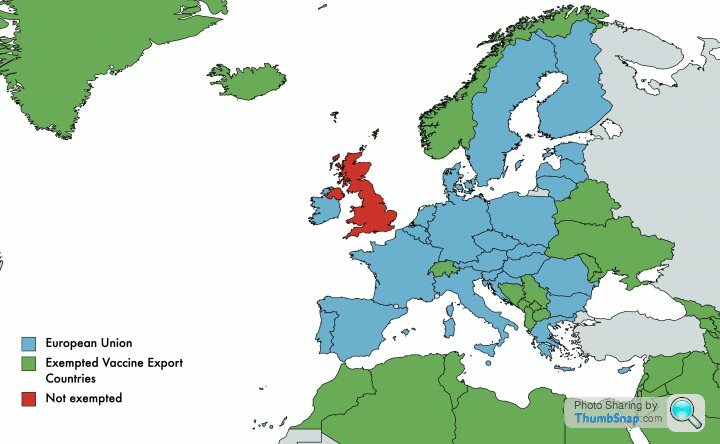
The doses that exist in the UK only exist because of a manufacturing ramp up done under their own contract during the period of time that the EU was still negotiating a lower price. How does it make sense that a separate contract with AstraZeneca allows them to then get the doses produced for the UK re-allocated to another contract?
The Commission is only entitled to those doses that AZ have, after best reasonable efforts, produced for them under their contract. This attempt to grab doses only in existence because of another prior contract is a disgrace.
[0] https://committees.parliament.uk/oralevidence/1505/html/