> ‘"One elephant per year of glycine into an ocean 12 times the volume of Earth's oceans is not sufficient to sustain life," said Neish. "In the past, people often assumed that water equals life, but they neglected the fact that life needs other elements, in particular carbon."’
Titan’s underground ocean is 12x larger than the Earth’s oceans? I had no idea. Wow.
If this result holds, it’s a shame because the gas giant moons always seemed like the only chance of discovering some interesting extraterrestrial life within my lifetime (or the next few dozen generations — the stars are incomprehensibly distant and nearly impossible to visit).
Same here. I just looked up Titan's size [1] and it's in between the Moon and the Earth in size. I know water is just a thin layer on the crust of our planet, but 12x?
If you look up "all of Earth's water in a ball," [2] it's about a quarter the size of the moon. Titan isn't that much larger. It must just be a floating blob of water or someone's estimations/illustrations are way off.
The important concept here is the frost line. That is, in the accretion disk consisting mostly of dust that the planets formed out of, the distance from the newborn sun where water ice could exist in direct sunlight without sublimating and being blown away. This line is somewhere between the asteroid belt and the current orbit of Jupiter. Water inside this line has only arrived here by stray comets, nearly all of the water of the solar system is outside it.
> I know water is just a thin layer on the crust of our planet, but 12x?
Titan has a lot of ice, or maybe water, we don’t really know. Depending how much heat is produced in its core it could have a liquid water/ammonia layer 200 kilometers deep. On the other hand it might be mostly ice.
By contrast the Mariana Trench is only 10 kilometers deep.
If the ocean was 200 km deep, and given Titan’s acceleration due to gravity of 1.35 m/s2, the pressure at the bottom would be 2700 bars. Assuming an average temp of -180C, at that pressure, water would form a type of ice that is denser than liquid water.
If is saltwater the pressure should be even higher, plus the weight of 40km of ice.
200Km is uncharted territory for earth, with a maximum depth of almost 11 Km. But life is able to stand until 800 bars at least. More than this is metabolically defiant in organisms made of cells. Vertebrates can survive 760 bars at least.
The majority of the volume on is oceans could be empty and barred to life, but there is still a lot of space for conventional life (and Titanlings could be very different and defy our standards)
Ice only melts under pressure right around the freezing point - it's that weird overhang on the phase
diagram, maybe to around minus fifty C. But by -180C it's always solid.
> If you look up "all of Earth's water in a ball," [2] it's about a quarter the size of the moon.
Are you sure about that math? According to your [2] the diameter of the water ball is 1384 km while the diameter of the moon is about 3,475 km. The volume of the water is less than a tenth of the volume of the moon: ((1384/2) ^ 3) / ((3475/2) ^ 3) => ~6.3%
Is it all the water on Earth or all the water on Earth's oceans? I'm pretty sure those aren't the same... I seem to remember reading that there's a very large amount of water chemically locked up in the Earth's crust.
Not really. Earth has hardly any atmosphere. The part with any density to speak of is just a thin film. To see for yourself, look closely at any picture of Earth and around around its circumference you will notice how little atmosphere there actually is[1]. It's something many people don't realize because from down here it looks like it goes up far. Just 16,000 meters up the atmosphere is unbreathably thin and most of Earth's oxygen lies below you. We have mountains that are higher than the main mass of Earth's atmosphere (50% is below 5.6km)[2].
The mass of Earth's hydrosphere is about 1.4 × 10^21 kg, while the mass of water in Earth's atmosphere is merely about 0.00002 × 10^21 kg[3].
Venus has a much thicker atmosphere than Earth, about 92 times the pressure of Earth's at the surface.
As for what's common, we don't have many examples of rocky planets (or moons) with atmospheres in our system to use as examples, and we can't see rocky exoplanets very well at this time, so who knows.
> As far as I can tell, Earth's atmosphere seems to extend further into space than Venus'.
Depends on where you want to draw the line for "atmosphere".
About 100km out is where the word "pressure" starts becoming near-meaningless on Earth, while on Venus you'd still have about three times as much to work with.
>As far as I can tell, Earth's atmosphere seems to extend further into space than Venus'.
Technically, Earth's atmosphere extends infinitely far into space. It's not like there's some force-field holding it in; it just gets less and less dense with altitude. So the line depends on your definition, which must be some threshold.
Anyway, Venus has about 90% of the gravity of Earth, so with 92x as much pressure at the surface (of a slightly smaller solid body), I think it stands to reason that at any given altitude, Venus's atmosphere has much higher density than Earth's. If Venus had far higher gravity, then this might not be the case at some altitude, but since its gravity is lower, then Earth's meager atmosphere should show slightly greater stratification I would think.
That doesn't follow. Planets are dynamical systems, not globs of material in situ. For example, Earth has a more substantial magnetosphere, which protects the atmosphere being blown completely away by the Sun.
Saturn's primordial disc had a lot more water (attracted by Saturn's mass, and less volatile in the colder outer solar system) available to coalesce onto Titan, than in the much hotter and smaller neighborhood of primordial Earth. It's very plausible that Titan has quite a lot more water than Earth. Saturn's other moons are known (by density and gravitational analysis) to also be composed of much water ice, up to 70% or more per moon.
Your link says the earth water ball has a diameter of 860 miles. Titan has a diameter of 3200 miles. (https://en.wikipedia.org/wiki/Titan_(moon)) So Titan is 51x the size of the earth water ball by volume. If the oceans are much deeper, then it could genuinely have 12x as much water.
Titan is 71.6 × 10^9 km^3 by volume.
Earths oceans are 1.335 × 10^9 km^3 by volume.
I've also soon a diagram comparing earths oceans to titan, and the water looks to have a diameter around the same radius as titan, which would mean a volume of 1/8th.
That would require earths oceans to have a volume of about 8.95 × 10^9 km^3, so I guess the illustrations are wrong (or from the perspective of the ocean ball being closer..).
Edit: correction, the diagram was a comparison of water per plant - the ocean ball was titans ocean, not earths..
So 12x earths ocean is 16.02 × 10^9 km^3
that's 1/4.46th the volume of Titan. I guess Titans Ocean ball is bigger than the radius..
Elephants can swim really well, but the G-forces at liftoff would be tough on them. Plus you've gotta supply them; 70,000 Calories per day (ideally in the form of oranges), and something like 25 kg of oxygen.
No need to worry about the supply nor the acceleration at liftoff (nor even at lithobraking): none of these factors influence the carbon content of your elephants.
How many elephants per olympic-sized swimming pool? Per (american) football field?
I have never seen any of those things in real life, yet journalists making stupid comparisons. I guess the field must be full of people that were deathly afraid of maths and numbers.
In regular football the spherical ball spends more time in the air than rolling, too. And in popular variants like Australian rules football or Rugby the ball is egg shaped, and that doesn't seem to cause any problems with enjoyment of these sports.
This doesn’t seem to be a very meaningful theory to draw conclusions about life. We have no idea how much carbon is already present in Titan’s ocean and if there’s need for a water cycle that connects to the surface. Also this study only considers impact craters, not surface tectonics. And there could be plenty of carbon sources from ocean floor interactions.
The journal authors agree with you. The "most likely uninhabitable" conclusion is an invention of the popsci article's author.
The actual article's conclusion is basically "for there to be life on Titan, there needs to be more carbon in the ocean than would be transferred solely by surface impactors". It absolutely does not rule out the existence of those carbon source.
To quote the two concluding sentences of the journal article:
> It is unlikely that the calculated fluxes are sufficient to maintain a detectable biosphere, unless the thickness of organics on Titan’s surface is greater than currently estimated, abundant biomolecules are available from Titan’s rocky core, or surface biomolecules can be delivered to the ocean by a process other than impact. Our calculations suggest that despite Titan being the most organic-rich ocean world in the Solar System, this does not automatically imply an organic-rich and habitable ocean.
I feel like science reporting would actually be greatly improved if they simply had ChatGPT write the articles. The human "reporters" they have now are terrible.
Unless the GPT would be responsible for setting up the incentive structures, you’d end up with the same monotonous clickbait. The problem are people who give bad (science) reporting their attention and therefore money. PopSci journals are just answering the demand.
Non-scientists aren't going to be very good at telling bad science reporting from good. There's no way to fix that: you can't expect non-experts to be good judges of the experts.
With GPT, at least the writing quality would be better.
Perhaps, but recognizing clickbait should be within the grasp of everybody, even if they aren’t experts on the subject matter. Maybe that’s where an LLM would fit - evaluating the likelihood of an article offering something of substance.
The whole point of clickbait is to get non-discerning, ignorant laypeople to click on stuff and watch it. If it didn't work, it wouldn't be the problem it is now. You can complain that people aren't intelligent or educated enough on things far outside their domain of expertise (which may be something as mundane as flipping burgers, though to be fair making a great burger isn't that easy), but obviously your expectations do not line up with reality. The entire field of marketing, after all, is based completely on weaponizing and using human psychology against people in order to extract money from them. People have fundamental weaknesses based on their biology, so just complaining that people aren't overcoming their built-in limitations is futile, IMO.
At one point Earth was largely molten, it's a safe bet that Titan was substantially warmer for awhile after it accreted in the first place. Then there's major impacts, which really stir things up.
There were plenty of opportunities for compounds in the rocky center of the moon to get mixed into its ocean.
We don't even know why Titan, alone among the solar system's moons, has a thick atmosphere. The idea that we could know how much carbon has been transferred to a subsurface ocean over the course of the moon's lifetime is pretty fanciful.
> One elephant per year of glycine into an ocean 12 times the volume of Earth's oceans is not sufficient to sustain life".
This reasoning is too limited IMAO. Titan oceans may not have whales, but for sure could still afford a lot of animals.
1) It seems that Titan has been there since the early phases of solar system creation, so I'll assume that is older than 3 billions of years (to pick a conservative value). One elephant a year for 3 billions of years is still a lot.
2) Titan could have been bombed with much more matter on the early phases of solar system history.
3) Live on earth is perfectly able to cope with a poor nutrient aquatic environment. Most of the earth falls exactly on this category after all.
4) Some life forms need just a little bit of carbon to be functional. Earth has very big animals that are 99% water.
5) Cold water promotes slow metabolism. Life just adapts growing really slow, being carried by currents, and adopting a poiquiloterm life style.
Though it's not clear from the article, I think they aren't concerned about the physical material. This organic matter could be an energy source for life and they're saying that it's not enough energy. Even if a lot of stored energy had accumulated, it's not sustainable, and life exhibits exponential growth when food is plentiful.
If the water on Titan is liquid [1], by definition some source of energy is warming it over zero Celsius degrees. And if there are huge oceans of liquid water, the source of energy somewhere must be huge also. This is all that life needs to thrive.
Entire ecosystems on Earth developed at high pressures, close to catastrophic scorching temperatures, without the need of any sunlight or photosynthesis, just using chemical energy from hydrothermal vents.
This does not prove that Titan has life, but life has proven several times that can flourish in such circumstances. I'm not an astrobiologist and can miss essential details about the moon, but in my opinion being isolated under a several km layer of ice, with cold and absolute obscurity, does not prevent life on Titan at all, because it didn't prevented it on Earth. Bioluminiscence still ranks among the more common methods of communication on Earth.
[1] (Having salt on the water could help a lot with that liquid state. I assume that we could find easily several layers of saltwater and also methane)
But after some good replies above, it seems that the real question here is not "if the water is liquid" as much as "if the liquid is water". That changes the game totally.
> by definition some source of energy is warming it over zero Celsius degrees. And if there are huge oceans of liquid water, the source of energy somewhere must be huge also. This is all that life needs to thrive.
Unless you're counting the warmth itself as the energy source warming it, I don't think this has to be true. Earth's core is hot mostly from residual heat from the Earths formation. It's cooling. It just takes a long time.
Thermodynamics won't let you extract useable energy from the ambient temperature. Lifeforms could extract energy from a strong temperature gradient, but not from something like 1°C per kilometer.
The energy source for deep ocean life on Earth is life from near the ocean's surface that dies and falls down. The study in the article was investigating if something similar could happen on Titan due to surface impacts.
> Unless biologically available compounds can be sourced from Titan's interior, or be delivered from the surface by other mechanisms, our calculations suggest that even the most organic-rich ocean world in the Solar System may not be able to support a large biosphere.
Which is much less sensationalist, to put it politely.
The Sahara is kind of a funny example because it actually holds enormous quantities of water over on the eastern side, left over from the last time that whole area was a jungle.
It is not "just a different way". There's no reason to assume impact melting from the surface is the only source of carbon in Titan's ocean. The authors of the study seem clear on this. I don't know why you feel the need to stand up for phys.org on this, or why you think the Sahara is relevant.
Except, if I understand them correctly: they don't know what the Sahara's core is made of and might supply for life, to keep the analogy
Not that that makes it likely to be hospitable. I'm only surprised by the headline because I wouldn't have thought anyone had expected anything different, so a headline like "as uninhabitable as you might figure" would have made more sense, but nevertheless this doesn't rule it out to about the same extent as it wasn't deemed unlikely already in my perception (as a follower of space news)
- "These fluxes suggest an upper limit for biomass productivity of ∼10³ kgC/year from a glycine fermentation metabolism."
This is really an upper bound on accessible energy (the "carbon" explanation in the press office release is hand-wavey). The idea is that solar photochemistry in Titan's atmosphere creates chemical energy gradients, in the form of energetic compounds like that glycine; and these energy gradients could migrate through the ice and support a biosphere in the subsurface ocean. The abstract* says that, actually, very little of that energy gradient can get through the ice shell.
This situation is different from that of some of the other icy moons: they potentially have much larger geochemical energy sources, from chemical reactions between the water ocean and primordial rock. The problem with Titan is it (probably) has a weird ice shelf on the bottom of its underground ocean, which isolates it from rock. So rock-ocean weathering probably doesn't happen there.
* (The paper's not on arXiv or SciHub if you were wondering)
Of course one could say the same about oil, coal, and gas on the earth. We're burning a 100 million years of bio productivity. Any such bio productivity could have been occurring and being stored on Titan for 10^8 years as well.
Reading closer, they point out, "It is nearly impossible to determine the composition of Titan's organic-rich surface by viewing it with a telescope through its organic-rich atmosphere," said Neish. "We need to land there and sample the surface to determine its composition."
The article seems to treat speculation with more confidence than it deserves, and also to report estimates with unjustified level of precision. For example, it claims the annual amount of glycine transferred to Titan is equal to the mass of "a male African elephant" rather than simply an elephant.
I always find the metaphorical estimates in science reporting absurd. I don’t know why the mass of a male African elephant is in any way more visceral than 6000 kg (btw a quick google search gives a band of 1800 to 6300kg, which isn’t particularly precise). Given Titan is about 4.5 billion years old this could be an enormous amount of complex carbon transferred from the surface assuming it’s more or less a one way process.
No matter the estimation, no matter the probability, the history of scientific inquiry has shown that reality is weirder than the wildest of human imaginings. Let’s just go and find out for sure, and maybe write less clickbait, yeah?
I see. The reason for this is that insufficient surface organic materials make it into the liquid water and the only kind of life we know requires those two to combine. Unlucky, I suppose. Would have been pretty cool!
1) Why are organic materials (probably any carbohydrates) only supposed to come from the surface? Would it not be plausible to assume that Titan's ocean ground contains significant amounts of carbon?
2) Why do they assume that there are only dilution processes in an ocean (surface or subsurface). There could be currents and suboceanic terrain features concentrating carbon-rich water (at least I do not know any reason against this).
The actual study this article is about is addressing a very specific question. The article posted takes that specific conclusion and applies it more generally, especially when writing the headline.
Titan has a methane atmosphere, due to prior outgassing from its surface. Methane is destroyed by sunlight; i.e. over time, the atmosphere is reacting with itself and sunlight to form more complex carbon molecules, which fall out of the atmosphere onto the surface. The study does not look at the carbon content of the ocean itself, it simply evaluates whether these complex carbon molecules, that we know are forming in Titan's atmosphere through well-understood processes, can also mix with the liquid ocean.
As the ice sheet covering the ocean is at minimum 40km thick, and over 100km thick in places, it is difficult for surface molecules to penetrate.
Whether or not other carbon sources, such as from within the planet, contribute carbon to Titan's oceans are beyond the scope of this study, and will remain beyond the scope of our knowledge until we manage to place equipment on Titan capable of drilling through tens of kilometers of ice.
The actual paper concludes that carbon transfer from the surface to the ocean is not sufficient to support a biosphere if that is the sole source of carbon. It specifically calls out "unless biologically available compounds can be sourced from Titan’s interior" as something that would allow a biosphere.
Ah, I see. My bad for not drilling deeper and reading the underlying study. In my eyes neglecting the inner planet as source of carbon (only referring to the article here) is a rather large gap.
I am all for shooting some equipment up to Titan. Although I am not sure we have the technology and the will to commit resources to analyze Titan's oceans in detail, yet.
No worries. I think it's reasonable to expect that people who write articles about journal articles would do a good job describing their conclusions. The whole point is that reading the underlying study shouldn't be necessary.
I think this was an important study to be done, because if the conclusion came out the other way, that would have been very exciting. We would then be able to say "using only the aspects of Titan we know for certain to be true, we can model a plausible sustainable biosphere".
A positive result would have been very promising, but this negative result should not be seen as discouraging.
Anyone know the pressure at the top of Titan's ocean? (That is, just under the ice) At first blush I was thinking it might be pretty substantial for a submersible with that much ice, but then the gravity is significantly less than earth (0.138*g). Using:
Pressure = density * g * h
...with density of water as 997 kg/m^3, g = 0.138 * 9.8 m/s^2, and h = 40000 m, you get a pressure of ~540 atmospheres. But I don't know if the ice sheet would have a structural component that doesn't add as much as a naive calculation would suggest.
These are great points. It would be like if a race of flying / buoyant aliens studied Earth's upper atmosphere, and decided that it wasn't sufficient for life, while ignoring that life isn't really found until you get to the surface, and most of that life is found under the surface.
There could be a habitable zone deep in Titan's oceans. I don't even know if "habitable" is the right word, because the concern seems greater to do with the genesis of life, not the sustainability of existing life that might have existed on Titan for millions of years already, from a time where perhaps conditions were very different from what they are today.
To be fair, the scientists that wrote the scientific article came to no such conclusion. The "most likely uninhabitable" thing is an invention of the popsci journalist whose article was linked, not something supported by the underlying journal article.
The journal article asked the question "is the carbon transferred from Titan's surface to its ocean sufficient, on its own, to sustain a biosphere?" to which their answer is "probably not". It explicitly does not claim there are no other sources of carbon in the ocean, nor that Titan is "probably uninhabitable".
This is talking about estimated average comet/asteroid impacts, right? If we're going by the average asteroid impacts on even million-year timescales causing radical changes to a heavenly body, we'd end up with no moon.
I definitely get this is a limited research here, and I'm not faulting it for that. Its good to know it seems like this kind of cycle wouldn't be consistent in adding organic molecules to the subsurface oceans. But let's not necessarily see this as "there's no way organic molecules could have been pushed down in relevant amounts."
There are so many variables that I am not sure that they can conclude anything substantial like they are trying based on this calculation alone.
Titan is old 4 billion years. That alone is enough to not be able to conclude that its oceans are poor in organics.
So many things could have happened during the evolution of Titan during those 4 billion years that we just don't know about.
Plus what about mixing from under the oceans.
I vote for sending meaningful probes as soon as we have tech for it. I dream of an era where humanity will spend 1 trillion per year on exploratory space tech and not on war machinery.
>I vote for sending meaningful probes as soon as we have tech for it. I dream of an era where humanity will spend 1 trillion per year on exploratory space tech and not on war machinery.
What if your peaceful probe starts an interplanetary war with the inhabitants of those oceans?
While we have no idea what kinds of landscapes and terribly esoteric environments life in some form could endure (since our only basis for comparison is the flora and fauna of our own evolutionary tree), I always though it was absurd to assume life on Titan just because it has water. The conditions out by the orbit of Saturn are hellish, even for a body of water protected by a vast surface shield of hard material.
But more seriously, an interesting project would be to simulate the conditions of our solar system's "candidate" for life ecosystems in laboratory conditions as precisely as we can based on known information, and then subject some of the toughest microorganisms we have living on earth to them, to see if at least they could survive or even thrive.
For example: recreate conditions of pressure, cold, radiation and chemical composition like those we think are the case in Titan's subterranean ocean, and then see how well a colony of water bears (tardigrades) endures.
Seems a lot more practical then speculating. I'm curious if this has been done in a systematic way by any organization on Earth.
I found the language in this article to be very strong and it seems to me this discovery only rules out a specific glycine exchange mechanism to power life reactions.
The paper contrastingly is rather descriptive and much less assertive, and doesn’t jump to the same conclusions the article is pushing. You would expect this from a tabloid headline rather than Phys.org.
I don't disagree with the assumptions made here, but the conclusion is bad. Titan is likely unihabitable for life as we know it. There are plenty of extremophiles here on Earth that live in places we wouldn't expect life to exist, but we know that they can because we found them.
If we make conclusions that we cannot find life on Titan, then we never will because we won't be looking. Life could be thriving on Titan, but we won't know unless we look for ourselves.
Also, for all we know, Titan's oceans are loaded with organic compounds that are don't originate from the surface. We don't know what the actual internal structure of Titan looks like because we lack the data.
I heard eons ago that Spock's green blood was inspired by the blue-green blood of horseshoe crabs which has a copper-based system instead of iron, among other oddities:
A horseshoe crab's blood has a blue to blue-green color when exposed to the air. The blood is blue because it contains a copper-based respiratory pigment called hemocyanin.
I'm failing to come up with the right search terms to find what I recall about zooplankton and the oceanic food web. It differs from other food webs and this shows up starkly in certain kinds of charts/models.
Zooplankton are tiny creatures found in relatively small amounts on the surface but breed like crazy and feed huge animals, including some types of whales. So where other food webs are kind of pyramidal and you have a huge amount of plants at the base of the web and a smaller amount of animals that eat those plants and a smaller mass of animals that eat those animals, the ocean's food web doesn't follow a similar pattern. It's not pyramidal. There is much more mass found in other layers of the food web than of zooplankton at any given time.
(Included because of the claim that "One elephant per year of this substance can't sustain life..." How do we know that?)
Furthermore, on Earth we have life sustained by undersea volcanoes which defies our usual patterns of life. I'm out of my depth on exactly how these lifeforms differ from the norm on Earth, so I won't try to give a nutshell version of how they differ, but here are some links:
That's what I know as a former homeschooling mom and Earthbound human who reads. Surely we can do a little better than "It doesn't readily match the patterns of the dominant lifeforms of this planet, so we cannot imagine that some other planet with dramatically different chemical makeup and other details has lifeforms that are fundamentally different from that, and never mind that Earth has some oddities living on it."
Cue the plot from the Star Trek episode where humans were being attacked by the guardian of the eggs that they were destroying willy-nilly without realizing they were eggs:
It's only Titan's surface that is at -292F, anyway, The theory is that life, if it exists, would be present in the subsurface ocean, which would be significantly warmer.
Sure, there is "speculation" about pretty much anything and everything. There's speculation that quantum flux based life could exist on the surface of the sun.
The speculation that is based on things we already know to be possible, speculates that life could be possible in the subsurface ocean.
Saw this lack week and frankly I don't know why it's getting attention.
Alright, I suppose I do actually. Its right up there with Fermi paradox papers wrt the number of wide and wild assumptions required to justify a dramatic headline and clickbait-ha-ha measurement like "one elephant."
It's a reasonable hypothesis, but despite the drama, this sort of thing has no predictive power in our actual universe. Only one where those assumptions all hold.


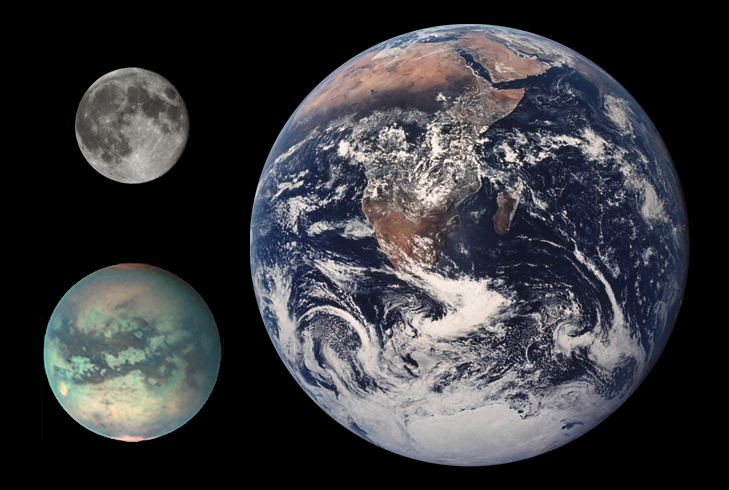

#/media/File:Titan_poster.svg)
Titan’s underground ocean is 12x larger than the Earth’s oceans? I had no idea. Wow.
If this result holds, it’s a shame because the gas giant moons always seemed like the only chance of discovering some interesting extraterrestrial life within my lifetime (or the next few dozen generations — the stars are incomprehensibly distant and nearly impossible to visit).