> ‘"One elephant per year of glycine into an ocean 12 times the volume of Earth's oceans is not sufficient to sustain life," said Neish. "In the past, people often assumed that water equals life, but they neglected the fact that life needs other elements, in particular carbon."’
Titan’s underground ocean is 12x larger than the Earth’s oceans? I had no idea. Wow.
If this result holds, it’s a shame because the gas giant moons always seemed like the only chance of discovering some interesting extraterrestrial life within my lifetime (or the next few dozen generations — the stars are incomprehensibly distant and nearly impossible to visit).
Same here. I just looked up Titan's size [1] and it's in between the Moon and the Earth in size. I know water is just a thin layer on the crust of our planet, but 12x?
If you look up "all of Earth's water in a ball," [2] it's about a quarter the size of the moon. Titan isn't that much larger. It must just be a floating blob of water or someone's estimations/illustrations are way off.
The important concept here is the frost line. That is, in the accretion disk consisting mostly of dust that the planets formed out of, the distance from the newborn sun where water ice could exist in direct sunlight without sublimating and being blown away. This line is somewhere between the asteroid belt and the current orbit of Jupiter. Water inside this line has only arrived here by stray comets, nearly all of the water of the solar system is outside it.
> I know water is just a thin layer on the crust of our planet, but 12x?
Titan has a lot of ice, or maybe water, we don’t really know. Depending how much heat is produced in its core it could have a liquid water/ammonia layer 200 kilometers deep. On the other hand it might be mostly ice.
By contrast the Mariana Trench is only 10 kilometers deep.
If the ocean was 200 km deep, and given Titan’s acceleration due to gravity of 1.35 m/s2, the pressure at the bottom would be 2700 bars. Assuming an average temp of -180C, at that pressure, water would form a type of ice that is denser than liquid water.
If is saltwater the pressure should be even higher, plus the weight of 40km of ice.
200Km is uncharted territory for earth, with a maximum depth of almost 11 Km. But life is able to stand until 800 bars at least. More than this is metabolically defiant in organisms made of cells. Vertebrates can survive 760 bars at least.
The majority of the volume on is oceans could be empty and barred to life, but there is still a lot of space for conventional life (and Titanlings could be very different and defy our standards)
Ice only melts under pressure right around the freezing point - it's that weird overhang on the phase
diagram, maybe to around minus fifty C. But by -180C it's always solid.
> If you look up "all of Earth's water in a ball," [2] it's about a quarter the size of the moon.
Are you sure about that math? According to your [2] the diameter of the water ball is 1384 km while the diameter of the moon is about 3,475 km. The volume of the water is less than a tenth of the volume of the moon: ((1384/2) ^ 3) / ((3475/2) ^ 3) => ~6.3%
Is it all the water on Earth or all the water on Earth's oceans? I'm pretty sure those aren't the same... I seem to remember reading that there's a very large amount of water chemically locked up in the Earth's crust.
Not really. Earth has hardly any atmosphere. The part with any density to speak of is just a thin film. To see for yourself, look closely at any picture of Earth and around around its circumference you will notice how little atmosphere there actually is[1]. It's something many people don't realize because from down here it looks like it goes up far. Just 16,000 meters up the atmosphere is unbreathably thin and most of Earth's oxygen lies below you. We have mountains that are higher than the main mass of Earth's atmosphere (50% is below 5.6km)[2].
The mass of Earth's hydrosphere is about 1.4 × 10^21 kg, while the mass of water in Earth's atmosphere is merely about 0.00002 × 10^21 kg[3].
Venus has a much thicker atmosphere than Earth, about 92 times the pressure of Earth's at the surface.
As for what's common, we don't have many examples of rocky planets (or moons) with atmospheres in our system to use as examples, and we can't see rocky exoplanets very well at this time, so who knows.
> As far as I can tell, Earth's atmosphere seems to extend further into space than Venus'.
Depends on where you want to draw the line for "atmosphere".
About 100km out is where the word "pressure" starts becoming near-meaningless on Earth, while on Venus you'd still have about three times as much to work with.
>As far as I can tell, Earth's atmosphere seems to extend further into space than Venus'.
Technically, Earth's atmosphere extends infinitely far into space. It's not like there's some force-field holding it in; it just gets less and less dense with altitude. So the line depends on your definition, which must be some threshold.
Anyway, Venus has about 90% of the gravity of Earth, so with 92x as much pressure at the surface (of a slightly smaller solid body), I think it stands to reason that at any given altitude, Venus's atmosphere has much higher density than Earth's. If Venus had far higher gravity, then this might not be the case at some altitude, but since its gravity is lower, then Earth's meager atmosphere should show slightly greater stratification I would think.
That doesn't follow. Planets are dynamical systems, not globs of material in situ. For example, Earth has a more substantial magnetosphere, which protects the atmosphere being blown completely away by the Sun.
Saturn's primordial disc had a lot more water (attracted by Saturn's mass, and less volatile in the colder outer solar system) available to coalesce onto Titan, than in the much hotter and smaller neighborhood of primordial Earth. It's very plausible that Titan has quite a lot more water than Earth. Saturn's other moons are known (by density and gravitational analysis) to also be composed of much water ice, up to 70% or more per moon.
Your link says the earth water ball has a diameter of 860 miles. Titan has a diameter of 3200 miles. (https://en.wikipedia.org/wiki/Titan_(moon)) So Titan is 51x the size of the earth water ball by volume. If the oceans are much deeper, then it could genuinely have 12x as much water.
Titan is 71.6 × 10^9 km^3 by volume.
Earths oceans are 1.335 × 10^9 km^3 by volume.
I've also soon a diagram comparing earths oceans to titan, and the water looks to have a diameter around the same radius as titan, which would mean a volume of 1/8th.
That would require earths oceans to have a volume of about 8.95 × 10^9 km^3, so I guess the illustrations are wrong (or from the perspective of the ocean ball being closer..).
Edit: correction, the diagram was a comparison of water per plant - the ocean ball was titans ocean, not earths..
So 12x earths ocean is 16.02 × 10^9 km^3
that's 1/4.46th the volume of Titan. I guess Titans Ocean ball is bigger than the radius..
Elephants can swim really well, but the G-forces at liftoff would be tough on them. Plus you've gotta supply them; 70,000 Calories per day (ideally in the form of oranges), and something like 25 kg of oxygen.
No need to worry about the supply nor the acceleration at liftoff (nor even at lithobraking): none of these factors influence the carbon content of your elephants.
How many elephants per olympic-sized swimming pool? Per (american) football field?
I have never seen any of those things in real life, yet journalists making stupid comparisons. I guess the field must be full of people that were deathly afraid of maths and numbers.
In regular football the spherical ball spends more time in the air than rolling, too. And in popular variants like Australian rules football or Rugby the ball is egg shaped, and that doesn't seem to cause any problems with enjoyment of these sports.


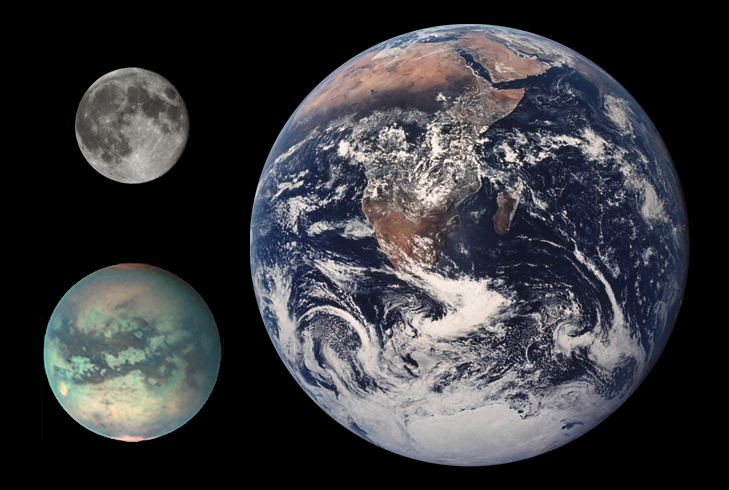

Titan’s underground ocean is 12x larger than the Earth’s oceans? I had no idea. Wow.
If this result holds, it’s a shame because the gas giant moons always seemed like the only chance of discovering some interesting extraterrestrial life within my lifetime (or the next few dozen generations — the stars are incomprehensibly distant and nearly impossible to visit).