There seems to be a fairly huge non-sequitur in the middle of the article: Homicides have fallen, but people say they believe crime has risen in their area, therefore perception is wrong.
It's entirely possible that homicide has fallen back to the pre-Covid level, but pettier crimes are on the increase, and not being recorded due to lighter-touch policing as cited earlier in the article.
People have been railing against the news for years (decades?) about overreporting negative news and making things seem worse than they actually are. Then an article comes out saying things are actually OK and we get comments like these. I suspect there's really no winning here.
The thing that bothers me for instance, living in SF, is that SF has always been kinda nuts. However. In the last 8 years SF traffic tickets issued have fallen by 97%. [1] Now I know that in the last 8 years people didn't suddenly become 97% better at driving. That kind of thing really skews my perception of the statistics.
When I hear mass shootings happen in Bernal and near 24th, and my street gets looted several times -- but crime is actually down and I'm safer than ever according to the stats -- something just doesn't add up to me.
I don't think there were more murders in SF, that kind of thing gets picked up and reported - but I don't think that the number of traffic incidents per murder has dropped 97%. Therefore, I also don't think the number of property crimes per murder has dropped, or car jackings, etc. I have no basis to work from, nothing to anchor my personal perceptions of safety.
I mean ffs SF boarded up downtown for the elections in 2020. That's some failed state shit. I've got my plywood all set for 2024.
The number of killings has never been high in my recollection. Dropping by some percent, large or small, doesn't impact my personal perception of safety. But all sorts of other things do.
Ehh, for an anecdotal counterpoint, I've lived in SF for 10 years. When I first moved here, I'd hear gunshots - actual gunshots - outside of my apartment in the Mission every couple of months, and people were getting shot regularly. Nowadays, alright, the Mission isn't amazing, but it certainly isn't that bad.
I do agree that traffic citations going down is an indicator of less citations rather than better traffic... but while you can avoid reporting on minor crime like speeding to some degree, it's quite a bit more difficult to stop tracking murder, which is what the original article is about.
> The centrepiece of this article is basically "people's feelings are wrong, the government's numbers are right".
True, but such patronizing statements are pretty much what mainstream media has consisted of since at least 2016. There is a vast movement across most media outlets to push the narrative that 'the people' cannot be trusted and need oversight and control. It's probably the most significant anti-democratic wave in several generations, and ironically the perpetrators are mostly those who constantly accuse others of anti-democratic tendencies.
The crap north americans put up with is amazing. In all of Central / South America the only country comes close to the level of day to day restrictions is Nicaragua.
Not even El Salvador which is apparently a right-wing dictatorship where no one has rights has anything close to resembling North American rules.
I'll say it again: "Dropping at a historic rate" is such a weird thing to brag when it's just falling back to the pre-Covid level.
I didn't mix up anything. Covid is a very abnormal event, and seeing the numbers go back to pre-Covid quickly after Covid is more or less expected. It's a good thing (if it's true), but not that newsworthy.
It may be expected, but I disagree that it's not newsworthy. If a sharp-rise is newsworthy, then it's also important to inform people of the sharp-drop. Even if it makes sense to expect a sharp-drop after an anomalous sharp-rise, if you only report the sharp-rise then you leave people misinformed about the current situation.
I think it's fine to complain about the framing of the article, but I think the fact itself is newsworthy.
Technically right, but using "historic" instead of "pre-COVID" is a form of propaganda targeted to people who don't pay attention, and is rightly flagged.
I mentally roll my eyes every time the press love to use the word "historic" to describe an event. I suppose it makes the narrative more dramatic, but it's such an empty buzzword and a cliche. Technically, everything is historic, because anything and everything that happens is future history.
> The decline goes beyond homicides: Violent crime overall ticked down in 2022 across the country, the FBI numbers showed, returning the U.S. pretty much to the level of 2019, before the COVID-19-era increase.
It looks like the original survey was asking about whether there is anywhere near the respondent's home where they'd be afraid walk at night. That sounds to me like it's very much a question about perception rather than statistics. Of course, people rarely base that kind of belief on hard evidence: a single incident that happened to a friend of a friend might be enough to make you say "I'm never walking in that neighborhood at night".
> That sounds to me like it's very much a question about perception rather than statistics. Of course, people rarely base that kind of belief on hard evidence: a single incident that happened to a friend of a friend might be enough to make you say "I'm never walking in that neighborhood at night".
Wouldn't the perception track the statistics in the scenario you've lined out? More people being stabbed, for example, results in more friends and friends of friends being unwilling to take a walk in that area.
I mean, you can have an outlier, a very popular person who triggers more friends/friends of friends, but on average, it seems like perception wouldn't be the worst way to measure this under the scenario you've laid out.
No. Perception tracks publicity of incidents - I know some people still warning others off a neighborhood they were mugged in 20 years ago, but they don’t mention how long ago it was when they say it’s dangerous. So for instance when a group of well off people move into a depressed neighborhood, there might be the same number of muggings, but 10 times as much talk about it because these people go to the police and write to the paper about it.
> I know some people still warning others off a neighborhood they were mugged in 20 years ago, but they don’t mention how long ago it was when they say it’s dangerous.
But, like, wouldn't a neighborhood with a lot of muggings be more likely to have more people doing that?
> So for instance when a group of well off people move into a depressed neighborhood, there might be the same number of muggings, but 10 times as much talk about it because these people go to the police and write to the paper about it.
That seems like a valid explanation for a single neighborhood that just started gentrifying, but seems unlikely to be common enough to disrupt the correlation that I'm talking about globally.
This doesn't address the parent comment's entire point. It's possible that the trend of 'lighter policing' leads to less reported crimes but not actually fewer crimes has been going on since the 2000s.
There’s many ways to validate crime statistics. For example insurance claims are linked to the number of property crimes independent of what police report.
More broadly violent crime has been falling for literally thousands of years. There’s various short term bumps in the rate, but the general trend is down across all societies. The past was simply vastly more dangerous than we are used to.
> "More broadly violent crime has been falling for literally thousands of years."
El Salvador is such an extremely interesting study in violent crime. Until recently El Salvador had one of the highest homicide rates in the world. In recent times it has plummeted precipitously (>90% over the past decade) and in 2023, they may very well end up with a lower overall homicide rate than even the US.
What happened was a complete crackdown on gangs. [1] After declaring an emergency scenario, their government 'temporarily' suspended certain rights, and greatly empowered law enforcement. Anybody who even looked like a gang member was rounded up and thrown into prison. And instead of placing gang members together where they often manage to conspire even within prison, they eliminated all mobile service in the prisons and locked down the cells with members of different gangs placed in cells together. Happy times ensued, undoubtedly.
In short it's been the effective end of civil and human rights, yet it's been extremely effective at lowering crime. This system is far from ideal, because there's zero doubt that some, more or less, innocent individuals have suffered severe consequences at the hands of the government. Yet the overwhelming majority of criminals are also being eliminated, saving their innocent would-have-been victims. And, in the past, this sort of treatment of antisocial elements would have been perfectly normal.
When you look at studies of violent crime in the past, the evidence is hazy at best. You can find studies to say whatever you want, and then other studies to point out the flaws in those studies. Ultimately I think the vivid imagery we have, of the past as being especially violent, is because it's a set piece of practically all 'historic' media we consume. But the factual and logical support for it seems far less clear.
How happy should we be if people in-mass give up on the police and light property crime increases by 1000%, reports of such are eliminated, but car theft stays constant and the overall numbers decrease? That is the direction we are headed.
Car theft, arson, etc are down dramatically not just flat. https://www.statista.com/statistics/191216/reported-motor-ve... Motor vehicle theft per 100k people 1990: 657 vs 2021: 268. That’s a 60% drop, even with the recent spike. Which is why you always hear crime rates compared across short periods, they wouldn’t seem bad by historic standards.
Your proposal around light property crime is simply wrong. You don’t need to trust police statistics for validation pickpockets used to be endemic in NYC to the point where people chained their wallets to their pants. Things have fallen so far we see cultural norms changing.
That isn’t to say every city or every year sees an improvement but the long term trends are really clear. Granted the existence of cellphones means they get stolen, but that’s more than offset by car radio theft practically disappearing.
Beware of cherry picked data. It's not statista doing it, but whoever they sourced their data from choosing to start at 1990. Here [1] are the same data (from the FBI) from 1960, instead of 1990. 1990 was not a historical rate, but the result of an exceptionally sharp spike in crime that began in 1960. In 1960 motor vehicle theft rates were 183. The statista table (which goes until 2021 instead of 2019 from my source) shows today they're at 268 and trending upwards.
I really wish I could find data prior to 1960, but I guess you probably end up with a poor signal:noise ratio at some point. Those data are all from the same source, so have meaningful comparability. In any case, the long term trends are anything but clear. Crime rates currently look something like an eccentric sine wave.
People in 200 years sure will have it easier, data wise.
Obviously the rate was 0 in 1850 because cars didn’t exist. You need a steady state of car ownership for theft comparisons by population to make sense. More recently the number of cellphone thefts spiked as more people owned cellphones, its true but not an accurate reflection of overall crime.
Historically you can do numbers of thefts vs numbers of cars but that’s not a great. There was 61.7m passenger cars + 12.7m commercials vehicles in the 1960’s vs 140.7m passenger cars + 42.8m commercials vehicles by 1988. An increase dramatically faster than population.
328,200 / (61.7m + 12.7m) = 0.44% of vehicles stolen in 1960.
1,635,900 / 193.1m = 0.85% in 1990 is a big jump. But that then falls all the way to 2019’s 721,885 / 276.5m = 0.26% in 2019 sitting just over half of 1960’s rates.
PS: It’s perfectly reasonably to argue that what matters is rate over the population, but including non owners in the population is IMO misleading.
By 1960 the overwhelming majority of households in America already had cars. Increasing number of cars beyond that (to modern times where many households have 2 or even more cars) is unlikely to have played a significant role. This is indirectly corroborated by the fact that near to every other form of crime was much lower in 1960 than modern times, as well. The two exceptions being burglary, whose levels we fell below and have stayed below since 2014 (well at least as of 2019 data), and murder which was just statistical noise.
Historically what happened is that crime started rising in the mid 60s and then reached catastrophic levels in 80s-90s to the point that many were predicting the complete collapse of society. This is what drove all of the 'tough on crime' rhetoric and legislation of that era, or a certain politician's choice of referring to a certain demographic group as 'super-predators.' Crime rates then began plummeting over the next 30 years into modern times. And now we're back to seeing a rise in many forms of crime. What remains to be seen is whether it's noise, or whether we're headed 'into the 80s' again.
Or maybe 30 years from now we'll learn that we've all poisoned ourselves inadvertently, again.. The lead-crime hypothesis [1] is one explanation for the absurdly high rates of crime in the 80s-90s, and then it's subsequent collapse.
22% of households still didn’t have cars in 1960. We can get into why households is a poor metric but 1960 was simply a low point not a long term average.
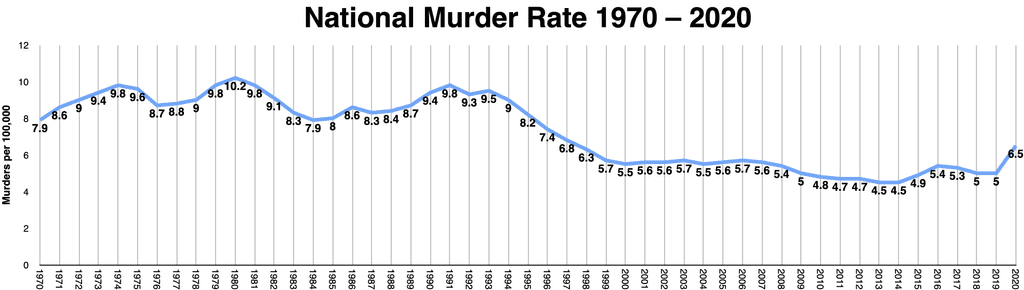
Murder per 100k. 1960 5.1, 2014: 4.5, 2019 5.0. Go back to 1950: 5.3, 1940: 6.3 and it hit 9.5 in 1934.
PS: Lead is one factor post 1960’s, but changing demographics is another. The post war baby boom adds a lot of kids who aren’t killing anyone as preteens/young teens but average into population statistics. The low point of births during WWII is especially important when those years line up with older teens more likely to commit crimes. Add in a good economy and it’s a perfect storm for low crime.
I would not be entirely surprised if the homicide rate was higher during the Great Depression and WW2, but I'm not really sure what that means, if anything. Please cite the data you're referencing, and stop cherry picking. I don't expect you to get decadal averages or whatever, but at least get something pretty averagish looking for the 'group' of time we're talking about. Comparing local mins to local maxes is something we ought leave to lying politicians.
Yeah the vehicular ownership rate only increased from 80% or whatever in the 60s to about 90% now a days. But I'm not saying that's why the increase in vehicles probably isn't a big factor. What I'm saying is that vehicular theft is a very intentional crime. Crimes like phone theft are highly opportunistic - somebody sees a fancy phone somebody forgot, and just decides to pocket it. So more people have more phones means more crime due to more random opportunity. But car theft is overwhelmingly a targeted crime, so changes in the number of cars is going to have a pretty negligible effect above some baseline point. It's like bank robbery - you're not going to just inherently have more bank robberies per capita because there are more banks.
The US only has national death registry starting partway though 1933. Thus 1934 isn’t arbitrary it’s the cutoff before you need to extrapolate statistics from incomplete information.
Households generally hold multiple people, a spouse, teen, or grandparent without a car can’t have their car stolen.
As to car theft being targeted, chop shops can only sell parts to people repairing actual cars which promotes theft based on the number of cars. Similarly local communities don’t represent the demographics of the entire country. Poor communities in 1960 had vastly fewer cars than they do today.
Bah, come on with this nonsense. You obviously know the problem there. Not only is that data noisy as, that paper you're linked isn't even reporting said data but trying to challenge it. As the paper leads with, "Did the United States experience a surge of homicide early in the century? Various scholars answer "yes", but..." Well, then what are we going to do? Have me cite the various scholars while you cite the ones challenging them, and we see who has the most twinkies at the end?
Similarly on the car stuff, I do agree with you. You can't strip cars for profit unless there's a minimally large number of people using cars, but we were obviously well beyond that point by 1960! 80% of households had cars! It's not like there was a shortage of people needing/wanting parts. That's far more than enough to create all the sort of venues necessary to be able to comfortably resell parts (or even entire cars, as occasionally happens).
Oh I agree the data is nosy, that’s why I didn’t quote anything before 1934. We don’t have anything approaching good data going back 3,000 years, but you don’t need precise numbers to notice say piracy is down dramatically from the age of sail. Even fragmentary evidence works when the differences are that large. Compare the global average rate of executions to fragmentary historic numbers and you don’t need to extrapolate.
> It’s not like there was a shortage of people needing/wanting parts
The problem here is you get a lot of different parts from a single stolen car. Steal 10 Honda Civics and you might be able to use almost every part from the first car, but by the 10th only those parts you have 10 buyers for are valuable.
The equilibrium is a function of the number of cars people own and the percentage of mechanics willing to use stolen parts. So even if a handful of people can steal an arbitrarily larger number of cars the limiting factor is mechanics willing to use stolen parts. Total number of mechanics scale with number of cars, but the percentage of those that are criminals can vary through time.
I'd sum up here using your example of executions, because I think it segues nicely. I'm sure you realize a big factor in the reduction of executions is because we greatly limited the use of execution. In 16th century England things as absurd as vagrancy were punishable by death! [1] Idle hands are the Devil's workshop, taken to extremes. That's part of the reason I feel so strongly on this (historic crime/violence, not cars) topic. When you're that liberal with your use of excessive punishment, there's not much room left for casual criminality. And modern examples like El Salvador show that this recipe still works.
On the car thing, I think you made some good points. I regret dragging us down this line of argumentation which has been pretty strained, though informative! You were talking about light crime in general, and I voluntarily picked cars. That was pretty stupid. Anyhow, it's been fun meeting another impassive argumentative data whore. May our kind spread! And may we disagree again, soon!
If you asked me if I would prefer a decrease in violent crime and major property theft if it came with an increase in non-violent light property crime, then I'd say "yes, sounds great".
I think that depends. If someone breaks a car window or spray paints a fence it's likely cheaper to repair it yourself if your deductible is 500-1000. People are also cognizant that if you ever report anything to insurance that your insurance sky rockets so they're less likely to report.
Paying $500-$1000 would not be "minor" to me, but is minor in a crime sense.
How many people actually have theft on their insurance? My car was stolen so of course I called insurance right after the police (who didn’t show up for six hours). But the insurance company just said, “You don’t have theft on your policy, but okay we noted it’s no longer in your possession.” Maybe that would show up in stats? Not sure.
Sure, but what matters is if they track the actual crime rate right? If you’ve never made any claims then you’ve never been a significant data point to begin with.
I fear you’re Goodharting this into oblivion. The only endgame of “people who don’t make claims aren’t significant” is police becoming so inept as to never secure property or arrest thrives (already there), and insurance companies having such massive premium hikes on-incident as to make filing claims net-negative in all but the most egregious cases (approaching there).
The most egregious cases are where you get the best data from insurance. But different metrics work for less violent crimes. You can validate the decline of pickpockets in the rates people replace their driver’s licenses etc.
I actually don't understand the logic of lighter policing resulting in fewer reported crimes. I can see it possibly resulting in police discovering or interrupting fewer crimes, and I can see it resulting in fewer arrests, but the idea that you're not going to report a burglary because your local politician is seen as soft on crime doesn't make sense to me - for starters, you'll need that police report to make an insurance claim.
What I can see causing a drop in reported crime is a lack of trust between police and a community - people may choose not to get the police involved out of fear they will make the situation worse, overreact, or may deem the punishment too harsh.
If you don’t expect the police to do anything about it, why file a formal report?
It’s possible to even go to the station, speak with the on duty officer, find out that they’ll basically do nothing and decide to not waste any more time on that. Such a conversation will not show up in any statistics, ditto an equivalent phone call.
For substantial losses, insurance claims make more sense. If it’s something that’s close in cost to the deductible and you expect your insurance premiums to go up after a claim, most people would not even submit that - there is not much pay off and higher premiums to worry about. So a lot of these costs are basically absorbed by the victims and statistics end up looking better than they should.
In my general area, 20-30 years ago, I’d sometimes forget to close the front door when I left (as in wide open, visible from the street). Nothing ever happened. A year ago, I forgot to lock the car at night - interior got ransacked and turned upside down. There wasn’t anything of value in there, but it sure left me feeling a lot less safe…
> If you don’t expect the police to do anything about it, why file a formal report?
Because your insurance demands a formal report (because if you lie to the police it's a marginally more serious crime than if you lie to your insurance agent).
Only, if the claim is worth it - most people have a deductible and insurance premiums will go up after a claim, so damage has to be substantial. That still leaves a lot of room for crime that didn’t result in enough damage on a given incident to justify a claim, but ensures the community does not feel safe and still goes unreported in these statistics.
I was robbed 3 times in SF. The first time was your run of the mill vehicle break in. Police clearly gave no fucks and weren’t going to do anything. Other two were in person. Stuff wasn’t insured. I didn’t bother with reports.
People are fickle. I know people who won't apply for rebates as "the government would never give money to little people." Hundreds of dollars a form away and they just don't.
Short sentences that put thieves back in a neighborhood can cause the same thing. Anecdotally some Kenyan neighborhoods get tired if this and entrap thieves with goods left out, then the neighbors beat them, and apparently on occasion burn them to death with gasoline.
This is hard to quantify so people will insist it’s not happening. But I have seen it too: there’s a set within America which insist it’s getting more dangerous regardless of which way the trend line points.
I am not surprised people think things are getting worse. negative stuff is always going viral on Twitter, stuff like looting videos, shoplifting videos, fight footage, public freakouts, etc. The ubiquity of smart phones and social media means occurrences of unrest that decades ago would have been ignored, are recorded and uploaded to go viral. It's like the 24-7 news cycle but on steroids and magnified. Everyone is now a reporter, and footage is promoted by algos.
In addition to politicians and media who always tend to benefit from a perception of increased crime, social media feeds perceptions of increasing crime rates.
crime was increasing in some places like Chicago[1][2]. Homicides and car jackings started trending upward roughly about a decade ago. note that a trend doesn't need for there to be an annual increase.
So I think you have to be specific about where but people in Chicago had a valid claim about the perception of crime increasing. These are major crimes so it's also possible reported major crimes have decreased across the country but are increasing in some areas.
No, but homicides are an important benchmark because there is consistency in what constitutes a homicide and murder is hard to brush under the rug or categorize as a lesser crime. If homicides decrease it is a good indicator of overall safety of a city.
With that said, theft seems to be getting worse in many places and that is probably a direct result of lighter sentencing for petty theft.
The vast majority of homicides happen between people who already know each other, so actually homicide rates say nothing about crime within geographic boundaries so much as crime within existing social groups.
Then it stands to reason that reporting on crimes in this or that city is mostly nonsense reporting, it doesn't convey any information that's useful to anyone.
I got shutdown on twitter on this subject once - but I maintain can crime stats go down while crime goes up? As crime rates go up (and police get flooded) do people stop reporting all but the most serious of crimes?
I live on a street that sees almost daily crime (smash and grabs from car windows, bike theft, delivery theft). The police usually don't even bother coming to check things out because they're so routine and the police are so busy. So it does feel a bit useless reporting them to the police, and eventually you become a bit numb to it all as crime becomes normalized.
Can that then explain why crime perception can be high while crime reports come down?
_perception_ is exactly the problem, because news love reporting about crimes and if there is any crime which feels (emotionally) bad they love to go one and one about it for weeks, similar any short term crime increase trends, but if there is a short term huge decrease or a long term decrease it's at most a footnote in the 3rd page
e.g. in Germany you are saver now, then 30 years ago
but perception, especially in certain groups, is that crime got way worse
(I'm intentionally using a 30 year comparison to avoid any short term up-down's around covid.)
In my experience, one's opinion of this centers on one's politics. Usually these things are discussed in the context of large cities in the western US controlled by democrats. This leads to many who are farther on the left claiming rising crime is an illusion and if it exists at all it is caused by police not doing their jobs as payback for calls for reform. This also leads many on the right to clutch pearls and declare that liberal enclaves are dying and failed social experiments in liberalism and weak criminal justice.
I'll say that, in the case of Seattle, I don't believe overall stats show the region is less safe than, say, the 90s. The 90s were sort of peak crack cocaine and street gangs. Having lived through that time and remembering the crimewave, I think the issue now is that crime back then was mostly in bad areas and didn't affect most middle or upper class folks. Now, especially after the gentrification and return to downtowns, middle and upper class folks are more exposed to crime. The meth and fentanyl epidemics are also helping to push crime into more suburban areas.
With all that said, and hopefully not to ruin my other points, I'll say I am leaning more conservative these days after seeing what has become of western cities(from San Diego to Seattle, I've visited them all fairly regularly over the past few decades). I don't think every problem is fixable via public policy, but damn, we're doing something wrong here.
Exactly, you see this to a more extreme degree in South America.
Particularly Rio, Buenos Aires, and Asuncion.
Rio is don’t take your phone out if you don’t want it to get stolen.
BA is you might get mugged at night.
Asuncion is you can forget your phone at a cafe and someone will run after you to give it to you but don’t go to the bad areas or you’ll get killed.
Oddly Asuncion is the poorest city of them all, but also by far the most conservative. In Rio the women will rob you, in Asuncion not even the Venezuelans who live on the street will rob you.
Pretty much everywhere in Seattle is middle and upper class today, so yea - crime is a lot more real to many people when it’s near them.
Along the same vein, “What has become of western cities” is “rich and expensive”. And if by conservative you mean “want less government regulation against building homes” then I think you’re right.
I have lived in the Seattle core since 2010, not out in the suburbs. Over that time, the crime visibly improved over many years. Then it became visibly much worse, starting around COVID, than at any prior time since I have lived there.
The lived reality is that the city stopped making even the pretense of enforcing the law. Theft and assaults regularly happen in broad daylight and law enforcement mostly doesn’t bother. The prosecutors won’t prosecute much short of attempted murder these days; no point in arresting people if they are going to be immediately released. People stop reporting crime because at best their insurance premiums will increase and at worst they will be loudly accused of oppressing the downtrodden or some such twaddle. There is no ROI. Many women who have lived in these communities a long time no longer feel safe.
Anecdotally, this is driving a lot of people to move into the high rises with real security from high-density neighborhoods like Capitol Hill where having your building invaded by miscreants happens surprisingly often. People put a lot of value on being able to live in a place where they feel secure, and so anyone that can afford it is retreating behind secured walls.
It's an interesting picture... rising cost of living and affluence at the same time as law and order broke down. It's getting better from what I hear, but my relatives still avoid downtown. Definitely not the city I strolled around solo as a kid.
I have a relative in public safety(fire) who deals enough with cops to know that the problems are not coming from cops feeling spurned. A combination of lax laws and an almost pro-crime judiciary sent things into a spiral. Things finally got bad enough that PNW liberals are becoming more pragmatic and it looks to be improving. Time will tell.
“Crime” is too broad a word. Violent crime? Sure. Porch pirates, car break ins, public intoxication/defecation, graffiti, public disturbances that people notice more, and may not be reported? Feels higher.
The data shows something that is powerful but hard to internalize: a large portion of crime rates does not strongly correlate with policing but rather external environmental factors.
We often compare the difference in crime between US and Europe, or US and Canada as a direct result of the gun policy (even this article mentions this). But there are many differences between these regions. Canada and European countries all have much stronger social safety nets and typically a more close society in general (not trying to make a race homogeneity argument but one of walkability). I wish more conversation would revolve around this, but I'm afraid of the complexity in this (because you have to solve a lot of problems) makes this unattractive. But if the problems were simple to solve they probably would have been solved. Everything is highly multifactored these days.
There has actually been a large trend of decreasing crime since the 90's, when politicians talked about "super predators." A lot of research has been done on this and there's been been discussions if it is things like the decrease of lead in the air, abortions, or other things, but generally it doesn't seem that "tough on crime" was the dominating factor.
Another interesting statistic is that most Americans believe crime is increasing year over year despite the reverse happening. It's a good example of perception bias and probably is one of those factors mentioned above.
> A lot of research has been done on this and there's been been discussions if it is things like the decrease of lead in the air, abortions, or other things, but generally it doesn't seem that "tough on crime" was the dominating factor.
On the contrary, COVID-19 didn’t suddenly reintroduce lead, ban abortion (that came a few years later, in only a few places, setting up a natural experiment we haven’t yet seen the results of), or do anything more than shut down schools and shatter the police-public relationship.
Post-Ferguson we knew what happens after anti-police protests (more murders).
(To be precise, -300 police killings +1000 to +6000 community-based killings)
The current trend looks like Ferguson effect followed by cities suddenly deciding to take murder seriously again. Portland is having success with focused deterrence and cure violence/credible messengers. Hard to say if that’s diverging from nationwide trends because loads of other cities are taking the same approach.
None of that challenges the idea that post-90s crime declines were fueled by more intensive policing.
but policing is returning to precovid levels compared to 2020-2021, and it appears murder is falling at a similar rate.. where do you get your information from?
So it's returned to a fairly stable pre-COVID level? To some degree, that's a somewhat noteworthy things only got somewhat worse in a very abnormal situation. On the other hand, it mostly means that things are just back to the status quo and aren't really getting better either.
It’s still worth pointing out to counter a narrative. Since the onset of COVID we’ve had a new President from a different party and there’s been a lot of talk attributing bad crime figures to Democratic control.
If it’s reverting to pre-COVID levels that seems like a much stronger suggestion that it has very little to do with who is in charge.
The president has virtually no impact on crime (not directly anyways - some research shows a hope factor can reduce violence in areas with a president that matches the area's party or demographic). The state and local leaders have a much higher impact since most crime is prosecuted at those levels.
Very few Americans blame crime on the president. More likely their mayor or police chief. Sometimes the sheriff, DA or governor. Occasionally they blame the criminal or victims too.
My statement was mostly informed by my weekday mornings at the neighborhood rec center. Half of the geezers I talk to voted for Trump. The other half are so old they probably last voted for Bush — and I don’t mean W. They all talk shit about Biden; primarily about immigration. But when they go on about crime, it’s always local politicians they blame.
I believe you're discounting the power of Fox News[0].
Those comments could be troll farms, or real people, no idea. But, a non-trivial portion of America thinks like this. Ignore/discounting this group is actually how Trump won the presidency. Progressives got ahead of themselves (ourselves?) and got blind-sided.
Loosely related - I hate that people get the narrative in their heads (in itself isn't bad) but when presented with new info, won't let go of the flawed concept.
Yeah, it’s like if you had a commercial plane crash in 2024, and then none in 2025, writing an article about the precipitous decline in plane crashes. It’s like no, it was just that in 2024 there was a huge increase and we reverted to the norm.
The fact that you reverted to the norm *is* important and newsworthy. It's how you know that, in fact, 2024 was an *anomalous* increase, and not an important change in the base rate.
Personally I would like to see us go below countries like Afghanistan (4.0), Argentina (4.6), Kenya (5.3), Iran (2.4), Israel (1.9), Palestine (0.9), or India (2.9). And preferably as low as, for instance, Spain (0.6), or even Japan (0.2).
Excuse me what? You’re claiming there are only 0.9 homicides per 100k people in Palestine? That’s so far from the truth I can’t begin to take you seriously.
That's the number Wikipedia gives for 2021. It's sourced from the United Nations Office on Drugs and Crime. Maybe the data is self-reported and Palestine fudged the numbers? Maybe it's accurate for the time period and just surprising?
There was no war declared then. The actions were identical to Mexican immigrants coming over and going on murdering spees here. Would you not consider that an example of crime that should be accounted for?
And the falseness of that distinction is exactly my point. Nobody watches their baby get murdered and says "Well at least it was at the hands of a government agent! My country is still a very safe place to live!". Yet if you were to believe those stats that's exactly what they're claiming: deaths at the hands of government agents "don't count" when considering the safety of an area.
We've banned this account for egregiously violating HN's rules. No matter how right you are or feel you are, you can't post like this. It's abusive and destructive of the type of forum we're trying to preserve here. Moreover we warned you many times before (https://news.ycombinator.com/item?id=35619490)
Of course I understand that this topic (though it was entirely off topic for this thread) is among the most sensitive and divisive of all, for deep reasons, and I'm sure that you have good reasons to feel the way you feel. But the site rules could not be clearer about such situations, you broke them extremely badly (and repeatedly) in this thread, and we obviously can't allow that if we want HN to survive for thoughtful, curious conversation.
We've banned this account for egregiously violating HN's rules. No matter how right you are or feel you are, you can't post like this. It's abusive and destructive of the type of forum we're trying to preserve here. Moreover we warned you before.
Of course I understand that this topic (though it was entirely off topic for this thread) is among the most sensitive and divisive of all, for deep reasons, and I'm sure that you have good reasons to feel the way you feel. But the site rules could not be clearer about such situations, you broke them extremely badly (and repeatedly) in this thread, and we obviously can't allow that if we want HN to survive for thoughtful, curious conversation.
More lies, I didn't say any of that... why are you fake quoting?
Here's Golda's famous quote again, study it, maybe you'll change:
“When peace comes we will perhaps in time be able to forgive the Arabs for killing our sons, but it will be harder for us to forgive them for having forced us to kill their sons. Peace will come when the Arabs will love their children more than they hate us.”
― Golda Meir,
The purpose of the argument was to present areas we innately consider “dangerous” and try to pretend like they are in fact safer than America by secretly disregarding all the deaths that happen at the hands of government agents. But it is those very deaths that make us consider those areas dangerous. This isn’t exclusive to Palestine, but it is the most egregious example.
This argument is disingenuous and should be called out at such.
Murders committed by people wearing cute badges in their arm are still murders.
I regret including Palestine and Afghanistan in my original comment. I didn't mean to be disingenuous. I should have included more countries like Argentina, Kenya, and India that aren't politically charged. My main point is that 5.5 should be seen as absurdly high for a first world country, and not just a little worse than usual.
I wonder how the long tail of murders per “neighborhood” looks in those other countries. It’s well-known that in America the vast majority of murders happen in tiny areas. And if one were to look at only the predominant race in America, the murder rate would match the best of the examples you just listed (3.0, the same as racially-homogeneous India).
That’s not to say that minority murder means less in any way, but on the contrary to question whether America records it to an extent other countries might not. I do not know if this is the case or not, and I don’t know how one might be able to tell. But I’ve personally been in slums of third world countries that the police would flat out refuse to answer calls to, and I can’t imagine anyone there was taking the time to report each death to the United Nations when even their own local police couldn’t give enough of a shit (/were too scared) to show up.
it seemed obvious from his comment? He wants a drop to BELOW precovid levels because covid was the correlated with a sharp increase and covids effects on society at large have now (mostly) subsided
Our drug economy alone is larger than a lot of “more civilized” countries. But we can’t talk about that. Only look at murder as some naturally occurring phenomenon.
Yes, we should aspire to a murder rate seen only in the asteroid belt and other places uninhabited by humans. Recreating those circumstances would temporarily raise the homicide rate in a given year but it would drop to 0 in the next.
A lot of US cities still had pretty bad violent (and property) crime rates going into the 1990s--and were still losing population. It's great that things are better than 1991 but the general consensus is that things were often pretty bad then.
Maybe my statement was a bit too broad. What I was trying to communicate was that statistically, the chance you get murdered in Seattle is still extremely low despite the headline that seems to be spreading fear.
Isn't this Steven Pinker's core thesis? He got howled down for the soft-pop-sci take on the stats, but although I find him a reprehensible egotist, I had some sympathy for the underlying factoids: It felt like although NEWS of crimes of violence continues to be high, actual RATES of crimes of violence set against population overall, aren't rising.
The basic thesis of the book seems pretty convincing, criticism seemed to be as you mention "howled down for the soft-pop-sci" and "reprehensible egotist" rather than the thesis being actually like wrong.
Pinker was pals with Jeffrey Epstein, which is getting into legit villain territory
"Pinker was included in the flight log for Epstein’s plane, which was dubbed the “Lolita Express,” for example, in 2002. He was photographed with him at a gathering in 2014. And he shared an affidavit from the case via Twitter in 2015."
Perhaps homicides are rapidly decreasing overall. Meanwhile in Seattle surpassed 2022’s record setting homicide count with 3 months to spare.
Seattle has roughly 2x the pre-pandemic homicide count. And roughly triple the count from 10 years ago.
Is the rate declining nationally? Maybe! Is that going to impact news coverages in areas where it is not decreasing? Absolutely not. Should it? Obviously no.
Is there a strong association between local crime rates (and/or direction of change) and local perceptions though? As far as I can tell, it’s quite common among New Yorkers to think crime is rising too, even though it really is falling in NYC, unlike Seattle and DC. But I have not seen a quantitative study correlating these. Are people who live in areas where crime actually is rising more likely to think it is?
Honestly? It’s impossible to say due to lack of data.
Homicides are well tracked. They’re either up or down. It varies by locale.
Petty theft and similar isn’t tracked. Everyone in a city knows the police can not and will not do anything about it. Small crimes simply are not reported. It’s a waste of time. The only data we have is anecdata.
If someone uses stats to claim non-violent crime is down they’re full of shit. They don’t know. If someone says it’s up they’re relying on anecdotes. So maybe true, maybe false.
In addition to what others have mentioned, advances in trauma care could be responsible for the longer term decline that's been going on before the pandemic.
"Crime did rise nationwide in 2020 and 2021. The disruption caused by a deadly pandemic, a record increase in the availability of guns, a pullback of policing in some cities and perhaps other factors combined to create a surge in homicides and other crimes."
Why not look at those one by one?
Guns last basically forever, so I don't see how a spike in purchases followed by a drop in purchases would explain a spike and then a drop in crime. The guns are presumably still around.
Next, a pull-back in policing in 2020 may have reversed somewhat by now. A bad DA in SF was recalled. It's plausible that this explains at least a part of the spike followed by the drop.
I'd be interested in hearing other explanations. Maybe the criminals are busy with other things (jobs, etc.)? Maybe the free flowing pandemic cash drying up means less money to fight over? Maybe criminal-enablers (drug users, etc.) are busy with other stuff?
It's all about perspective. There was a decrease after an increase. I'd venture a guess that most people never experienced the initial increase and so they won't notice any decrease. Either rate is rather low and there are a variety of factors that are more influential in making your likelihood higher or lower.
I heard a podcast episode recently (the name escapes me) which suggested that US emergency trauma centres are getting so good at preventing people from dying of gunshot wounds that they are skewing the stats relating to homicide. The thesis being that, although the incidence of gun violence was increasing, the absolute number of people dying of gunshot wounds was decreasing.
Reported crimes are falling while actual crimes are rising. Nobody wants to do the work of measuring ACTUAL crime rates. Only rates of filed crime reports.


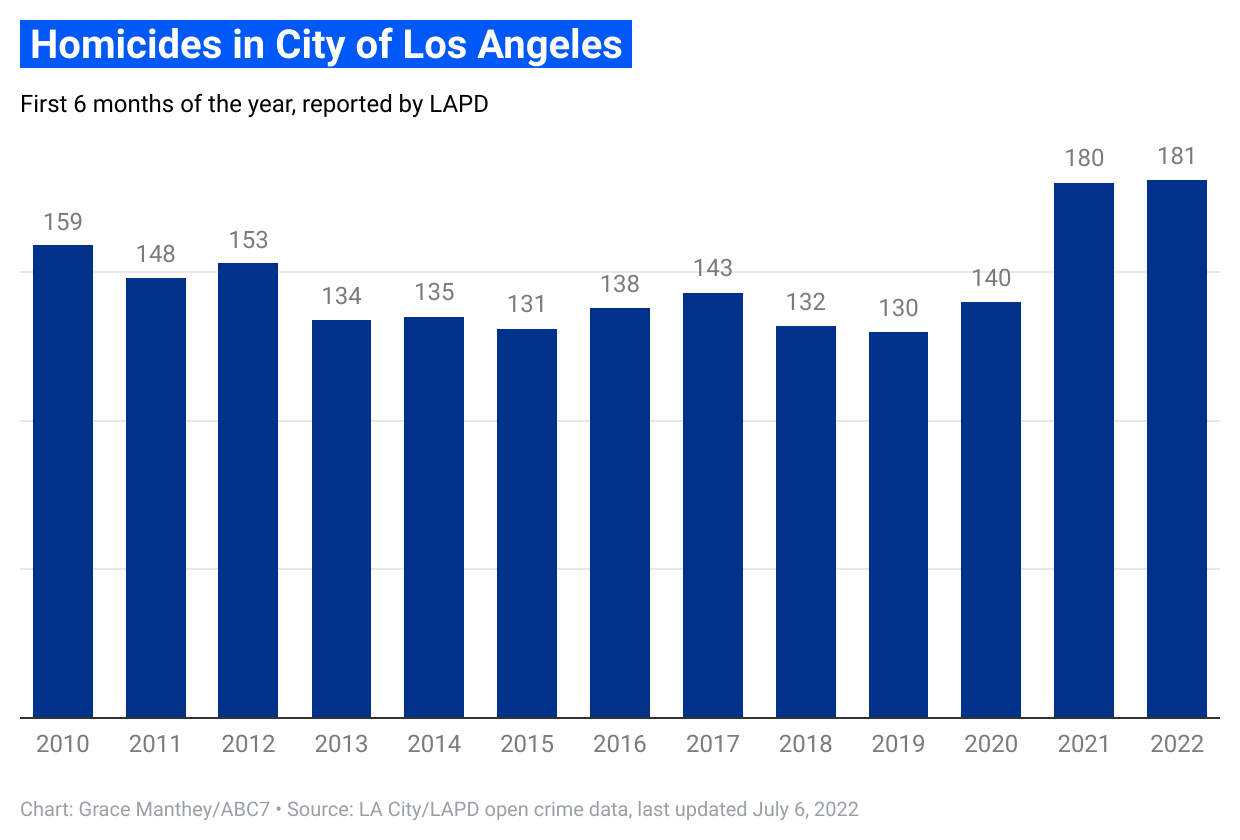
It's entirely possible that homicide has fallen back to the pre-Covid level, but pettier crimes are on the increase, and not being recorded due to lighter-touch policing as cited earlier in the article.